
Trump to Israeli parliament after hostage release: ‘It’s the historic dawn of a new Middle East’
Hamas completed the handover of the last 20 living captives on Monday, and world leaders signed the ceasefire deal at a summit in Egypt
Israel began closing one of the most painful chapters of its short history on Monday, as Hamas completed the handover of the last 20 Israeli hostages still alive in the Gaza Strip. The release was broadcast on a giant screen to several thousand people in what has now been renamed Hostages Square in central Tel Aviv.
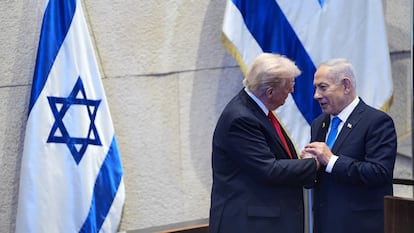
On Monday, U.S. President Donald Trump presented his plan for Gaza to the Israeli Parliament—which gave him a bigger ovation than to Prime Minister Benjamin Netanyahu—not as a fledgling initiative, but as an accomplished success that heralds “the historic dawn of a new Middle East.” In a hyperbolic and much-applauded speech, Trump spoke of his plan—which made possible the release of the last 20 living hostages—as “the start of a grand concord and lasting harmony for Israel and all the nations of what will soon be a truly magnificent region.”
The U.S. president suggested that two years of bloody invasion, with more than 67,000 dead, Gaza in ruins, and children dying of hunger, had so tarnished the Israeli leader’s reputation that the only option was to end it.
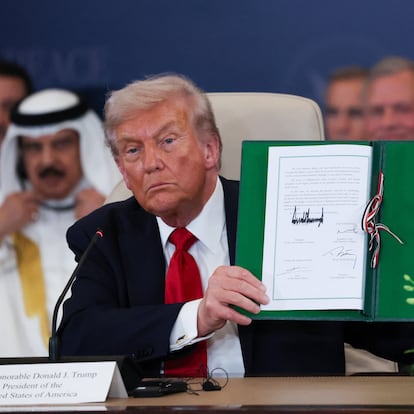
Later in the day, representatives from the countries that mediated the peace agreement in Gaza—the U.S., Qatar, Egypt, and Turkey—signed the pact at a summit held in the Egyptian city of Sharm el-Sheikh, attended by some 20 world leaders and featuring Trump, who addressed attendees with words of praise: “We have achieved together in recent days a change that really is historic.”
A historic day for the Middle East ended up becoming a day dedicated to the glory of Donald Trump. The peace conference in Sharm el-Sheikh quickly turned into a ceremony celebrating Trump’s personal power. He was the omnipresent protagonist throughout the day, which was meticulously designed so that all the spotlight would be on him. One after another, all the leaders greeted an elated Trump, while another of the day’s key figures, Egyptian President Abdel Fattah el-Sisi, told him: “Only you could have achieved this peace.”
Hostage release
Amid tears of joy and shouts of excitement, the released Israelis watched the exchange unfold in two stages. In the first, shortly after 7:00 a.m. (GMT), the militia handed over the first seven hostages to the International Committee of the Red Cross in northern Gaza; they are already in Israeli territory. The remaining 13 captives were released about three hours later in the south of the enclave and have been handed over to the Israeli Army by the Red Cross. In exchange, Israel will release around 2,000 Palestinian prisoners throughout the day.
The bodies of the 28 Israeli hostages who died in Gaza are also expected to be returned, though it is unclear whether this will happen simultaneously or immediately after the living hostages return to Israel. It is also unknown if all of the deceased have been located. The mourning for these dead captives is the only thing overshadowing the celebration of the return of the last hostages still alive.
The Hostages and Missing Families Forum stated in a release that its struggle will not end until the bodies of the 28 hostages still in Gaza are located and returned for a proper burial: “Only then will the people of Israel be complete,” the organization said.
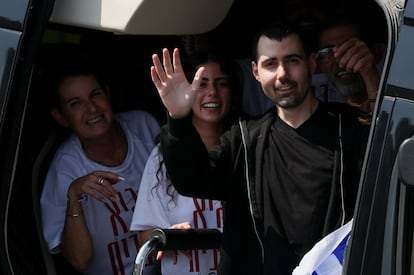
As the crowd erupted in cheers at the sight of the convoy carrying the first seven hostages traveling on an Israeli road, U.S. President Donald Trump arrived in Israel. The giant screen in Hostages Square split in two: one half showed the cars transporting the released captives, while the other displayed Air Force One preparing to land in Tel Aviv. “Thank you, Trump! Thank you, Mr. President!” blared from the speakers, as many Israelis present — some waving U.S. flags — applauded and praised the American president.
Many in the square described Trump as a “savior” or even “the king of Israel,” according to Guy, an Israeli who preferred to give only his first name, crediting him with a deal they said would not have been possible without his involvement.
Trump was in Jerusalem, where he delivered a speech before the Knesset, Israel’s Parliament. The city had also been decorated in his honor, with large posters on buildings displaying his image alongside Israeli and U.S. flags. One even compared him to King Cyrus the Great, founder of the Achaemenid dynasty in ancient Persia, who freed the Jews from captivity by conquering Babylon and allowing their return to Jerusalem — a symbolic reference to Trump’s role in the hostages’ release.
The president was greeted on the tarmac with a red carpet by Israeli President Isaac Herzog and Prime Minister Benjamin Netanyahu. Trump reiterated that Hamas would be disarmed in accordance with the peace plan and that the war was over. In the afternoon, he will travel to Sharm el-Sheikh in Egypt, where the peace agreement signing ceremony for Gaza will take place, attended by leaders from around 20 countries, including Spanish Prime Minister Pedro Sánchez.
Netanyahu will not attend the Egyptian resort city ceremony, his office announced Monday, due to the ongoing celebrations for the release of the hostages.
Meanwhile, in Hostages Square — which filled to capacity — Ohad, a 27-year-old who preferred not to give his real name, said he believed Israel “can now begin to heal” from the wound left by the events of October 7. He personally knew none of the hostages, but he did know two of the 1,200 people killed in those attacks — the deadliest in Israel’s history — which triggered the subsequent offensive in Gaza. That campaign, until the ceasefire took effect last Friday, has killed more than 67,000 Palestinians. Monday’s hostage release took place under the first phase of the agreement reached between Hamas and Israel.
The family of Guy Gilboa-Dalal, one of the Israeli hostages freed alive, said they hoped all families would one day be reunited with their loved ones. “We hope that every family will reach this longed-for moment and receive their loved one home, including all the deceased for burial in the land of Israel,” the family said in a statement.
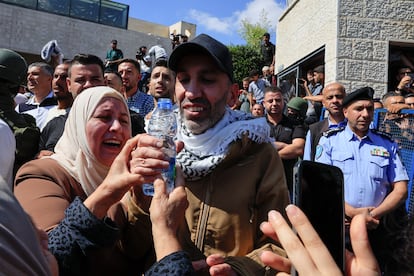
At nearly the same time, buses carrying Palestinian prisoners began leaving Israeli jails late Monday morning. Nearly 2,000 detainees are being released. The majority — 1,718 of them — had been arrested in Gaza by Israeli forces during mass detentions over the two years of invasion, with an eye toward future prisoner exchanges. None, according to the Israeli government, took part in the October 7 attack that led to the war. They are being transported back to Gaza, where a welcoming committee awaits them in the southern city of Khan Yunis.
Another 250 prisoners, whose release required more delicate negotiations, were serving long sentences in Israeli prisons — most of them at least one life term — for participating in or organizing attacks against Israelis. Of those, 154 will be deported, according to Minister of Prisoners’ Affairs Raed Abu al-Humus, who spoke to this newspaper from the Cultural Palace in the West Bank city of Ramallah before departing for Egypt.
Eighty-eight others are being released into Ramallah, where hundreds of relatives and friends have been waiting since early morning — many wearing traditional Palestinian clothing in celebration. The crowd grew so large that Palestinian authorities eventually closed the access gates. Journalists on the ground captured videos and photos showing military vehicles moving from Ofer Prison toward nearby Beitunia, where clashes were taking place.
Sign up for our weekly newsletter to get more English-language news coverage from EL PAÍS USA Edition









































