
Winners and losers of Trump’s Gaza plan
A geopolitical balance of the diplomatic initiative with which the US president has scored another success after the bombing of Iran and the imposition of military and trade demands on Europe
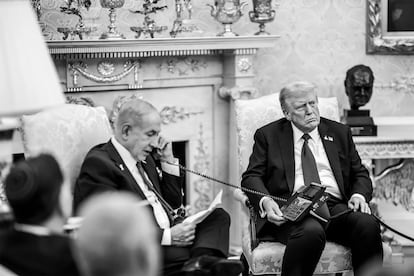

Trump’s plan for Gaza faces an uncertain future, but its very inception is a significant event. Its importance lies, first and foremost, in the obvious relief it could provide to Gazan civilians subjected to a medieval siege that a United Nations commission of experts has deemed genocide on the part of Israel. But, on a second level, the plan has significant geopolitical consequences. Although its outcome is unclear, some of the dynamics crystallized by this initiative appear likely to reverberate over time. Below is a compilation of factors that should be taken into account when assessing what has happened.
Donald Trump
The plan contains multiple positive elements for the U.S. president. Despite deep perplexities surrounding the initiative’s wording, it has garnered widespread international support — not only in the region but also beyond, from Europe to Russia and India — thus emerging as a diplomatic success.
The process allows Trump to deflate the growing and enormous pressure that was building on the United States as a necessary accomplice to Israeli actions, which provoked enormous outrage.
Furthermore, it guarantees a consolidation of relations with the Sunni authoritarian regimes in the region, furious with Israel’s actions, especially the bombing of Qatar. These countries are interesting allies in many ways. Economically, they possess extremely deep portfolios that can guarantee, for example, arms purchases that would have been severely affected had they not perceived Washington as putting a stop to Israel. The crisis will undoubtedly spur an instinct for diversification in these countries, but the plan contains underlying anxieties.
The initiative must also be framed within the context of the U.S. attack on Iran — the material outcome of which is difficult to clarify, but which in geopolitical terms has been a success, given the fluidity of the strike and the negligible Iranian reaction. Those outraged by Washington’s support for Israel will not forget it, but in geopolitical terms, the entire move reaffirms the centrality of the U.S. in the region — and in the world. If we add to these achievements the agreement by NATO members to raise military spending to 5% of GDP, and the trade agreement imposed on the Europeans, Trump has notched considerable success in his first nine months as president.
Benjamin Netanyahu
For the Israeli prime minister, the plan has been a bitter pill to swallow, symbolized by the humiliating apology to Qatar from the White House for the attack on Hamas targets on its territory — complete with a photograph of the forced contrition. The plan, on the other hand, contains some uncomfortable elements, such as the reference to two states and the rejection of ideas of annexation, colonization, or ethnic cleansing.
But these annoyances are insubstantial or marginal. The substance is a plan that closely resembles what Netanyahu wanted: the return of the hostages, the capitulation of Hamas, no real obligation to withdraw completely from Gaza, and no commitment of any kind to Palestinian rights.
Considering that the end of Israel’s legislative term is drawing near, 12 months away, it’s reasonable to assume that Netanyahu would have preferred to avoid starting the campaign with the hostages still in Gaza and amid an ongoing full-throttle military operation, which, in addition to consolidating his hold on power, is also causing fatigue in Israeli society.
Netanyahu knows that the only thing standing between Israel and complete pariah status is U.S. support. He couldn’t afford to take the excessive risk of angering Trump, and he’s come up with a plan that commits him to little and offers him many possibilities. His record of broken commitments — for example, the withdrawal from Lebanon, where Israeli forces remain ensconced in half a dozen locations — leaves no doubt that he will maneuver to do only what is in his own best interest.
Hamas
The plan is essentially a diktat of capitulation. It demands the release of the hostages — Hamas’ only asset — the surrender of weapons, the renunciation of participation in political management, the acceptance of an international stabilization force, and international supervision of the day-to-day management of Gaza with colonial overtones. All this in exchange only for a promise that Israeli fire will cease.
Hamas has emerged deeply wounded from this entire conflict. The human suffering has been immense. The so-called Axis of Resistance is on its knees. The collapse of the normalization process between the Sunni regimes and Israel has been far from definitive. Its leadership is headless and fragmented, internationally isolated.
The plan is nothing more than a confirmation of Hamas’ absolute weakness. This does not preclude the possibility that, in the future, the hatred fueled by Israel’s abuses will breathe new life into the idea that Hamas represents, and that, in the immediate future, like Netanyahu, the party-militia will avoid unfavorable compromises. But there is no doubt that the plan is an affirmation of defeat.
Palestinian Authority
The Palestinian Authority is severely affected by the plan, as it is expressly excluded from the transitional governing body in Gaza. The agreement also contains no explicit reference to safeguards regarding the West Bank.
That said, at the very least, the initiative represents an improvement over the past for all Palestinians, not only because it promotes a ceasefire, but because it crystallizes a shift away from the undisguised ethnic cleansing that was embedded in Trump’s vision for the “Riviera of the Middle East.”
Sunni Arabs
For them, the plan contains some assets, and their support is based on these. First, because it puts a stop to a massacre that put them in a very uncomfortable position with their own citizens, who watched indignantly as their leaders did little or nothing.
Second, although partial, Trump’s pressure on Netanyahu after the Qatar attack represents a valuable reaffirmation of the U.S. commitment to regional alliances.
The stabilization of the region is also a fundamental prerequisite for the development of the economic transformation plans upon which everyone — and especially Saudi Arabia — is relying to safeguard their future in the face of the likely decline in oil revenues. Their role in the crisis is seriously flawed, and exposed limitations and weaknesses. But the plan itself opens the way to a perspective that is probably more interesting for them than the critical phase of the last two years.
The ‘Axis of Resistance’
The plan is yet another humiliation for the Axis of Resistance. After the military defeats of Iran and Hezbollah, and the fall of the Bashar al-Assad regime, this diplomatic initiative, which overwhelms Hamas by failing to guarantee rights for Palestinians and uniting Sunni and European countries around it, is a true calamity for its geopolitical interests.
Europe
For the European Union, the plan is proof of its complete irrelevance in the region, after its inaction exposed it to criticism over its moral double standards. Some governments, especially those of Germany and Italy, may benefit from a pause in violence to gain respite from public opinion, which has been strongly mobilized against their passivity. But for Europe as a whole, the conflict represents an extremely unfortunate geopolitical period of impotence and paralysis.
China
For Beijing, the plan is not a favorable development either. Immersed in a zero-sum game with Washington, it reaped a certain geopolitical advantage from having the U.S. isolated in its staunch support for Israel and worn down by widespread international disdain for that stance. Trump’s move alters that path and reaffirms its centrality in the region, which China has tried to challenge in recent years. For example, by mediating the thaw between Saudi Arabia and Iran. But the crisis — and the plan — have exposed the still significant limitations of its capacity and will to exert influence in the region. And if the region stabilizes, the U.S. will have greater room to pivot its attention toward the Asia-Pacific.
UN
The United Nations was unable to provide the place where the solution was developed. Previously, its agency for Palestinian refugees (UNRWA) was the victim of a boycott fueled by unfounded accusations from Israel. The entire crisis, and now Trump’s initiative, do not reflect well on the organization. At least — despite the U.S. president’s usual diatribes — the plan recognizes its role in the distribution of aid in Gaza and, although only occasionally, the General Assembly has been a space for facilitating diplomacy.
Sign up for our weekly newsletter to get more English-language news coverage from EL PAÍS USA Edition









































