
Trump presents Gaza plan that calls for Hamas disarmament and a ‘board of peace’ supervised by US president
Israeli Prime Minister Benjamin Netanyahu has accepted the plan after meeting with his US counterpart at the White House
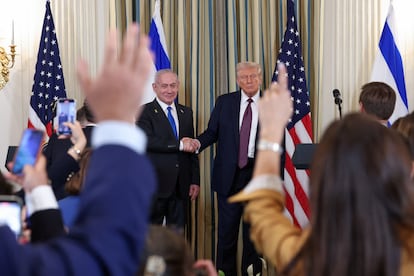

Will a U.S. peace plan for Gaza become a reality? It is still unclear, pending a response from Hamas, which would have to surrender its weapons and, just hours earlier, claimed it had not even received a copy of the document in question. But one of the unknowns surrounding the project has been cleared up: following Monday’s meeting between Benjamin Netanyahu and Donald Trump, Israel says it accepts the 20-point proposal. And the Republican has given his ally permission to continue the offensive if the Palestinian party-militia rejects the offer.
The plan calls for the surrender of Hamas, the return of all Israeli hostages still in the Strip — both living and dead — and the creation of a provisional Palestinian government entity that will be supervised by an international “board of peace” that will include former British prime minister Tony Blair and will be chaired by Trump himself.
“I support your plan to end the war in Gaza, which achieves our war aims,” Netanyahu said at a joint press conference with Trump in the East Room of the White House, where the two leaders elected not to take questions. The proposal “will bring back to Israel all our hostages, dismantle Hamas’ military capabilities, end its political rule, and ensure that Gaza never again poses a threat to Israel,” the prime minister added.
Trump, for his part, claimed that it was “a big, big day, a beautiful day, potentially, one of the great days ever in civilization.” According to the Republican president, the parties are “much closer” to achieving peace and bringing about “an immediate end to the war,” as he detailed the sections of the plan drawn up in recent months in collaboration between the U.S. government and Blair. “It’s a historic day for peace,” Trump insisted.
But the triumphant statements from both leaders clash with reality. So far, it is unclear what Hamas’ response will be. Some of the points included in the document — such as the obligation to disarm — force it to take steps that the Islamist group has repeatedly rejected during two years of war. And if Hamas’ response is “no,” the negotiation document will remain moot.
Trump acknowledged that it is still unclear what the Palestinian party-militia’s position will be. “I’m hearing Hamas wants to get this done, too, and that’s a good thing,” the U.S. president said, before pointing out that if the leaders of the Islamist militia reject the proposal, he will give Israel the green light to continue the offensive that has already killed 66,000 Palestinians and which an independent UN commission has openly described as genocide. “Israel would have my full backing to finish the job of destroying the threat of Hamas,” the Republican said.
“I also want to thank Prime Minister Netanyahu for agreeing to the plan and for trusting that if we work together, we can bring an end to the death and destruction that we’ve seen for so many years, decades, even centuries, and begin a new chapter of security, peace and prosperity for the entire region,” Trump solemnly declared.
The 20 points in the document stipulate that, if Israel and Hamas accept the agreement, an immediate ceasefire would be implemented. Within 72 hours, Hamas would have to hand over the surviving Israeli hostages and the bodies of those who have died; a total of 48, according to Israeli estimates. In exchange, Israel would return 1,700 Gazans detained since the start of the war and 250 prisoners sentenced to life imprisonment. The agreement also stipulates that once the exchange is complete, Hamas members will disarm; those who wish to do so will be able to leave the Strip, with guarantees of safety on their journey to third countries.
Once the agreement is accepted, the full and unhindered delivery of humanitarian aid to the Strip and the reconstruction of basic infrastructure would begin.
Gaza residents would not have to leave the Strip, and if they did, they would be able to return. Trump said he will chair a transitional body that will oversee the Palestinian governing entity that will temporarily rule Gaza. While these institutions are active, a “Trump economic development plan” for reconstruction will be implemented.
The project was presented after a long meeting between the two allies. No other international leader has been as frequent a visitor to the White House during Trump’s second term as Netanyahu: the Israeli prime minister’s visit to the Oval Office Monday was his fourth in eight months. None of his previous trips yielded any progress toward peace, and those meetings only served to buy the Israeli leader more time in his deadly offensive in Gaza. On this occasion, the U.S. president declared, moments before the start of the meeting between the two leaders, that he believed it could finally yield an agreement in principle that would halt the war in the Strip.
The two began their conversation with a handshake at the entrance to the West Wing of the presidential residence. Netanyahu’s motorcade had entered the White House a few minutes late. Trump came out to greet his Israeli counterpart, as he likes to do personally when a foreign leader arrives. The leaders acknowledged the press with a nod before entering and beginning the meeting; Trump said, in response to a question from reporters, that he felt “very confident” in a peace agreement for Gaza.
On the eve of the crucial meeting, representatives of the U.S. administration made last-minute contacts in an attempt to bridge differences and secure Netanyahu’s agreement over a peace deal. Trump’s personal Middle East envoy, Steve Witkoff, spoke with Israeli representatives; Jared Kushner, the president’s son-in-law and negotiator of the Abraham Accords during the Republican’s first term, spoke with Arab allies.
Sign up for our weekly newsletter to get more English-language news coverage from EL PAÍS USA Edition









































