
At the UNRWA warehouses where food is being stockpiled for Gaza: ‘The aid entering the Strip is a drop in the ocean’
Barcelona Mayor Jaume Collboni visits the UNRWA in Jordan and announces that he will double the funding provided by the Catalan capital
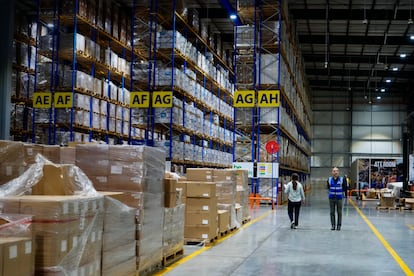

Pallets of boxes filled with rice, sugar, legumes, flour, and cans of coconut oil. Bandages, dressings, serum, antiseptics to treat infections, antibiotics. The blockade of humanitarian aid in the Gaza Strip is clearly reflected in the warehouses of UNRWA, the UN agency for Palestinian refugees, where thousands of tons of food, medicine, cleaning supplies, clothing, tents, and educational materials are piling up and cannot be delivered to the civilian population victimized by Israel’s attacks. In the Jordanian capital, Amman, the humanitarian agency watches as the materials stocked in one of its six locations in the city accumulate dust, while it is forced to rent new spaces, some with air conditioning to prevent supplies from spoiling. Aisles and aisles of pallets, as if it were an IKEA warehouse.
“We have more than 3,000 tons of food and a large amount of medical supplies here that are essential for a population in a very serious situation. All of this could be brought in immediately if Israel allowed it. It’s unacceptable and unprecedented; we are the main United Nations agency on the ground,” said UNRWA spokesperson Jonathan Fowler at an industrial estate on the outskirts of the city during a visit this Monday by Barcelona Mayor Jaume Collboni to learn about the projects in which the City Council is participating with funding. Surrounded by row upon row of packed boxes, the UNRWA spokesperson notes that “the costs of renting the warehouse could be used for humanitarian aid.”
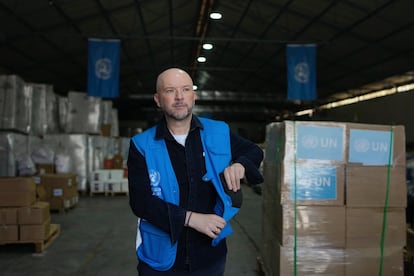
Fowler admits that the agency created by the United Nations in 1949 has never enjoyed a buoyant financial situation. “But what we’re experiencing now is unprecedented.” He warns that UNRWA is suffering from a “triple crisis: financial, following the withdrawal of U.S. funds; humanitarian, because the situation in Gaza, with the officially declared famine, is unprecedented; and political, due to the decision by the Israeli government and parliament to prohibit and restrict humanitarian operations.” The spokesperson describes a “very uncertain” outlook for UNRWA starting in October and November due to the lack of funding and the blockade: “There is a very real risk that operations will collapse by 2026 unless there is a change.” The agency, which has 30,000 employees across the Gaza Strip, the West Bank, Jordan, and other countries in the region, has lost 360 of them since the war in Gaza began almost two years ago. “Some have died while working, but others were at home with their families, just like any other citizen,” Fowler says.
In this context, the spokesperson demands that Israel allow the entry of the 6,000 trucks that UNRWA has waiting at the gates of the Strip, because “the aid coming in is a drop in the ocean.” Fowler also welcomes the increase in private contributions (around $260 million since the start of the war) and aid from public administrations as diverse as those of Germany, Ireland, Belgium, Spain, and the Barcelona City Council.
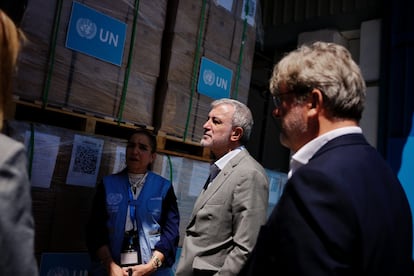
During a visit to two of the six warehouses on the outskirts of Amman, the mayor of the Catalan capital announced that the city’s annual contribution to UNRWA will double next year, increasing from €200,000 to €400,000 ($232,835-$465,550). The funds will be used to purchase medicine and food and “strengthen the health project, with doctors, nurses, and social workers helping families of children with disabilities.”
The mayor recalled Barcelona’s “historical tradition of cooperation with Palestinian cities on issues such as urban development, the environment, education, and health,” but noted the leap forward represented by the current situation of isolation: “The current humanitarian crisis is of unprecedented proportions.” The blockage of aid by Benjamin Netanyahu’s government means that several tons of food boxes — whose expiration date is approaching in the coming weeks or months — are sitting in one of the two warehouses visited Monday.
Collboni also referred to Israel’s veto on his entry into the country, from where last week he wanted to travel to the occupied West Bank, to the cities of Ramallah and Bethlehem, whose mayors had invited a delegation from Barcelona. From the warehouses in Amman, the mayor declared: “The important thing was not that I enter Israel, but that the 6,000 trucks with humanitarian aid can enter Gaza.” “Barcelona’s commitment is above vetoes,” he said, insisting that “the objective of the visit is to learn about the projects in which the City Council is involved firsthand, to help and improve their situation” and that “far from changing its position, the veto [by Israel] reinforces the denunciation of isolation and Barcelona’s commitment.”
During the second part of the mission, in Jordan, Collboni was accompanied by the Deputy Mayor for International Relations and Cooperation, Maria Eugènia Gay, and the Spanish ambassador to the country, Miguel de Lucas.
During the first day of his visit to Jordan, Collboni received thanks from the Mayor of Gaza City, Yahya R. Sarraj, for Barcelona’s “solidarity” with the Gazan population over the decades and for the “shared values of friendship, peace, and humanity.” At noon, Collboni met with his counterpart in Amman, and they signed a first memorandum of understanding for a future collaboration agreement on infrastructure and mobility.
Sign up for our weekly newsletter to get more English-language news coverage from EL PAÍS USA Edition









































