
Daniela in Miami and Daniel in Africa, the deportation of a trans woman: ‘I dressed as a man to survive’
A Cuban immigrant has had to change her appearance after ending up in ICE custody. The Trump Administration has stripped rights from trans people in detention
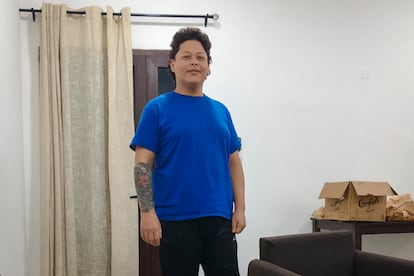

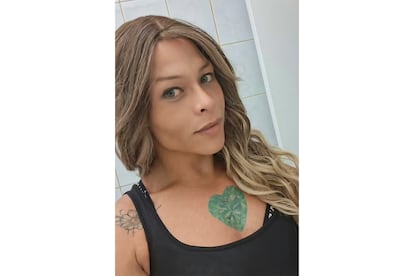
In a single life that seems like many, she was born Daniel in a municipality on the outskirts of Havana; became Daniela at the height of adolescence; reverted to Daniel to cross Central America; and was Daniela again when she finally arrived in Miami.
Until she fell into the hands of the guards and figured that to survive an Immigration and Customs Enforcement (ICE) detention center, she had to, by necessity, pose as a man. The wig taken from her when she was arrested was only returned when she landed as a deportee in the Central African Republic. Sometimes, away from people’s eyes, alone in the bathroom of the Maison Confort in a central neighborhood of Bangui, the country’s capital, she puts the wig on and stands before the mirror that returns the image of Daniela. “That’s when I remember who I am,” she says. She still does not dare to keep the wig on.
The day police arrived at the Stardust motel on Calle 8, the avenue that is almost a monument to Cuban nostalgia in Miami, Daniela Fuentes wore the same ash-blond wig with white streaks. Her hair spilled over a semi-sheer leopard-print bodysuit, where the tips of two unsupported nipples peeked out. Daniela had spent the night there and was waiting outside the motel for an Uber with a few suitcases when the cleaning attendant alerted police to her presence. “She said she thought I was homeless. It was a mistake, but a mistake that cost me dearly.” Authorities arrived, made a call and confirmed that Daniela had missed a court date in Texas after requesting a change of location and never received a response. She ended up with an expedited deportation order.
Despite living as an undocumented migrant, Miami remained a minimally safe place for her: part of her family was there, along with friends, her beauty-salon clients and nights doing drag at Club Azúcar. It was a place that allowed her to be Daniela, with 14-millimeter false lashes, pointy high heels and a face full of glitter. She had fought to be who she was: a woman.
Daniela was five when she understood she didn’t behave like the other children in La Lisa, a neighborhood west of Havana. At 18 she began self-medicating with Cipresta to stop testosterone’s action in her 1.74-meter body. Within months the skin on her face was radiant, smooth, hairless, and her breasts had grown considerably. It was not a snap decision, but she had to accept it: “It’s confronting everyone and living the life you really want to live.”
Her body has since become the map of that decision. She carries, almost like a testament, two wounds: one on her arm that required five stitches, and another 17 stitches on her head. “Just because I’ve always been different,” she says. “Without rhyme or reason someone came and attacked me.” The Cuban police never left her alone either. They would stare at her and summon her to the local station, concerned she worked not for the State but in the house Daniela had turned into a beauty salon offering all kinds of dyes and haircuts. If she stops to think about it, Cuba was not a place for her. She always wanted to leave.
In 2023, when she turned 30, she set aside her skirts and dressed as a man again. Cubans were leaving in droves. The Covid pandemic had struck an already crisis-hit economy; the tourist groups that sustained businesses and Varadero hotels had not returned, and restrictions from the first Donald Trump administration had left the Castro regime with its hands tied, cutting off remittances and cruise traffic full of Americans. There had also been a major mass protest and the government made clear it was willing to imprison anyone attempting to remove it from power. Cuba was inhospitable. Daniela sold her house, bought a ticket to Nicaragua, found a coyote and told him her name was Daniel. She put on wide pants and a coat that covered her body as much as possible.
“It was safer for me,” she confesses. Since setting out on the migrant route, she has changed her appearance as needed. On the darkest days she is Daniel. When the journey seems lighter, Daniela reappears. In truth, she has never stopped being Daniela on any of her trips.
After a week’s journey through Nicaragua, Honduras and Guatemala, she reached Mexico and tattooed a heart on her neck that reads Love. After seven months of waiting, she was admitted to the United States through the CBP One migration appointment app.
She entered through Texas, continued on to Miami and put on the clothes Daniela wears. “In Miami I felt at home. I was always very pretty, well dressed—and Miami is spectacular for that.” While free, she thinks she was happy, but there was one day she understood her life had irrevocably changed: when at the Turner Guilford Knight (TGK) Correctional Center in Florida they made her remove the leopard bodysuit and put on a male inmate’s uniform. That’s when, she says, she began “de-transitioning.”
“I felt like everything I had achieved was gone. That was lethal. It’s very hard to be treated like a man,” she says. “When I felt they were putting me in a men’s prison, I screamed in terror. I told them no, please, no. They took off my wig and I felt horrible. From that moment all treatment was as if I were a man.”
When a barber at the Lake County Detention Center, the second facility she was held at, gave the first snip to hair that had grown to mid-back length, she was almost resigned. “I felt pain, but I was in survival mode.” She began to walk less gracefully, adapted to greeting with a hand instead of cheek kisses, moderated her voice’s pitch.
“At the center there were many people looking out for me, the guards asked me a lot about my safety, they had to accompany me to the bathroom; it seemed more comfortable to cut my hair. It was the best thing I did, the best way to reach Africa. I never felt obliged to dress as a man to survive.”
‘Worrying’ deportations of trans people
Daniela went into a supermarket in the bustling Lakouanga neighborhood intending to buy some limes. She wore bermuda shorts and the same wide blue pullover she has worn for weeks. “At first they pointed at my breasts,” she recounts. “They told me no, they weren’t going to sell the limes to me.”
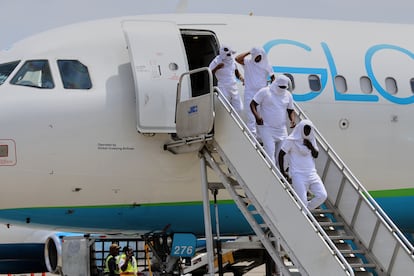
She had arrived in Bangui in the middle of the night on August 31, 2026 alongside a group of men chained at the wrists and ankles on a flight operated by ICE, a 22-hour trip—the longest of her life. “I was desperate to get off that plane, I was cramped, cramped from so many hours of flight,” she says.
No one ever told her where she was going. The day before, before they were expelled from the country, a group of armed officers arrived at the Alvarado detention center. “They came with shields, pistols, masks, vests—it was ugly. I felt fear because I knew they were going to deport me; what I never imagined was that it would be to Africa.” After five hours of flight, and faced with the group’s desperation, officers confirmed they were being taken more than 10,000 kilometers from where they were. “They didn’t give me the option of going to Cuba,” Daniela says. “If they’d let me choose, I would have gone to my country.”
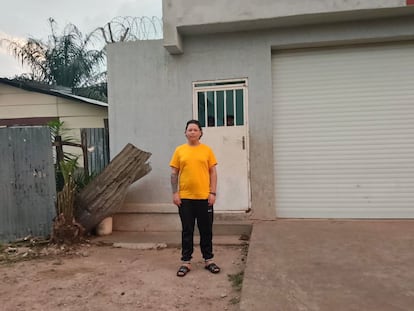
None of the men deported with Daniela can explain why they ended up so far away, and she can explain it even less. “There’s a lot of homophobia here, people make fun of me, they point at me. I feel very unsafe here, that’s why I want to leave quickly.”
The United States Department of State, which signed a deportation agreement with the Central African Republic and allocated $85 million for deportation operations to that country, published a human-rights practices report three years ago noting that in the Central African Republic the law— which did not allow legal gender recognition—criminalized “consensual same-sex sexual relations in public or in the military.” The penalty for this kind of “public demonstration of affection” can range from six months to two years in prison and a substantial fine.
“I don’t feel well here; in a place where you can’t be yourself you cannot be well. It’s illegal and unfair when one has to stop being oneself because of a bad administrative decision,” Daniela says. “If they know I’m trans, how can they send me to Central Africa where this issue is so forbidden?”
Bridget Crawford, director of law and policy at Immigration Equality, the national U.S. advocacy organization for LGBTQ+ and HIV-positive immigrants, says they have identified “what appears to be a disproportionate number of LGBTQ+ people” deported to third countries. “This pattern raises serious questions about whether people are being intentionally selected to be sent to countries where the government knows—or should know—that they could face persecution and torture because of their sexual orientation or gender identity,” she says.
What, according to Crawford, makes these transfers particularly worrying “is that many of the countries receiving LGBTQ+ refugees are themselves countries that people are fleeing from.” The great contradiction is that the U.S. government acknowledges in its courts that an LGBTQ+ person needs protection, while at the same time it sends them back to the country they fled.
From the start, the Trump Administration dismantled specific protections for LGBTQ+ people held by ICE. Among other actions, it revoked the 2015 Transgender Care Memorandum, which set out how transgender people should be treated in immigration detention. ICE then began changing contracts at detention centers to remove protections for transgender people, and the government stopped publishing figures on the number of transgender, intersex and gender-nonconforming people in its custody. According to data processed by the Vera Institute, the last ICE report published in January 2025 recorded 47 transgender people in ICE custody and confirmed that 69 transgender people had been admitted to detention centers in fiscal 2025 up to that point.
Immigration Equality has handled cases of transgender people denied hormonal treatment or housed in spaces that do not match their gender identity. Some have suffered harassment and sexual assault. “We have spoken with transgender people to whom medical staff said hormonal treatment was no longer available due to new policies,” Crawford says. To this day, the figures on how many transgender people have been deported by ICE and where they have been sent remain unknown.
The never-ending journey
At Bangui M’Poko International Airport, Daniela and the rest of deportees were vaccinated, given a hygiene kit and a change of clothes, and taken by van to the Maison Confort. Once there, they were accommodated by staff from the International Organization for Migration (IOM). A spokesman for the organization confirmed to EL PAÍS that they normally provide immediate 24/7 support to deported people.
They ensure they have a place to stay, food and a medical check. They help them contact family and explain each person’s options: to remain in the Central African Republic, to return to their country if they request it, or to go elsewhere. One of these IOM officials approached Daniela and asked what her gender identity was.
“I said I was trans. That’s when they asked whether I wanted to be moved to the women’s building.” Daniela chose to stay with the four other deported Cubans she shares a room with at the Maison Confort, who protect her, tease her all the time and have given her all kinds of nicknames. They call her “the baby,” “the little demon,” “the perverse one”; she laughs, turns her face away, scolds them for how messy they’ve left the Maison Confort apartment—mismatched shoes and clothes strewn everywhere. “They’re ferocious animals,” Daniela says. “Too much testosterone! I’ve been surrounded by nothing but men for eight months. It’s complicated; I want to paint my nails and put on lashes, to do what I like.”
She has told the guys she shares the room with that she is not what they see in front of them. “The boys in the house understand me, they know I’m a jeva, as they say in Cuba, but I’m in disguise.”
She does not want to remain in the Central African Republic, so she has asked consular authorities at the Cuban embassy in Congo to send her to Cuba. Daniela has no passport and no form of identification, but an official said they would process a safe-conduct document for her. “She told me she didn’t know how long it might take.” For now she barely leaves the apartment and spends her time glued to the phone, sometimes feeling very depressed. On Monday, September 14, she turned 32 far from everything she knows and wanted to go out the next day to at least have a beer.
The plan is this: she will leave Africa dressed as Daniel, arrive in Havana and stay at her sister’s house—because she sold her own home—put on earrings, a wig, lashes and acrylic nails. She will go out into the street as Daniela, looking for clients to open another salon. When she raises enough money she will buy a ticket. “I’ll go anywhere,” she says. “Anywhere I can feel safe, because Cuba gets worse every day; everyone’s rights are violated more each day.”
She will probably dress as a man again, she says, because life—she knows well—will never be easy for Daniela.
Sign up for our weekly newsletter to get more English-language news coverage from EL PAÍS USA Edition









































