
Trump’s deportations shake up Eswatini: A journey to the tiny African kingdom
A coalition of NGOs has challenged in court the deal in which the United States paid $5.1 million to the African country to take in migrants who were deported without a trial, some even after serving their sentences
Nearly 100 people packed into the sweltering High Court chamber on an early October morning, in Mbabane, the capital of Eswatini, filling the wooden benches and spilling into the aisles. They had come to hear Judge Titus Mlangeni rule on whether accepting foreign deportees from the United States in exchange for millions of dollars violates the nation’s own constitution — a question that has consumed this landlocked kingdom, formerly known as Swaziland, for months.
The case, he declared, raised constitutional questions serious enough towarrant review by the Chief Justice and a full bench of judges. The full court met on November 3 and postponed its ruling to an indefinite date.
However, the fact that judges are considering the unconstitutionality of receiving deportees has been seen as a significant victory for the activists and lawyers who have spent months challenging a deportation agreement they say was signed in secret, bypassed Parliament, and turned their country into what one critic called “a dumping ground for America’s unwanted.”
Eswatini received $5.1 million from the U.S., as confirmed in mid-November by Neal Rijkenberg, the finance minister of the African nation, an absolute monarchy. The sum is considerable for this small country of 1.2 million inhabitants, where two-thirds of the population live below the national poverty line.
Human Rights Watch cited that figure in September and denounced that, in the agreement signed on May 14, Eswatini committed to accepting up to 160 deportees.
The first five — nationals of Vietnam, Laos, Yemen, Cubaand Jamaica — arrived in July at the maximum-security prison in Matsapha after being labeled violent offenders in the United States. A month later, a coalition of NGOs took the case to court, arguing that the agreement breached both Eswatini’s laws and the men’s due-process protections. They accused the monarchy-appointed government of effectively serving as an extension of U.S. immigration enforcement. In October, despite the pending legal case and growing public opposition, a second group of 10 people arrived. Only one deportee, Jamaican citizen Orville Isaac Etoria, has been able to return to his country.
The agreement has now spiraled into a full-blown constitutional crisis. Yet for the five deportees, who are at the core of the case, the ruling brought little immediate relief. They remain in a notoriously overcrowded facility — the occupancy rate of Eswatini’s penal system exceeds 171%, according to the World Prison Brief — with a record of human rights abuses that has been confirmed by the U.S. State Department. What’s more, they are being held without charge, unable to contest their detention and effectively trapped between two governments.
The first five men deported to the African country had been convicted of serious crimes in the United States, including homicide and child rape, and had served their sentences. But rather than being returned to their countries of origin, they were sent to Eswatini under an agreement that the government had never disclosed to its own citizens or Parliament.
The case has thrust this small African kingdom into the center of a broader controversy over the Trump administration’s third-country deportation program. Since July, the United States has sent more than 40 migrants to at least four African nations — including South Sudan, Rwanda, and Ghana. Rights organizations say the program circumvents due process by exiling migrants to states with poor human rights records.
Eswatini is one such country. The U.S. Department of State report cites cases of arbitrary detention, politically motivated killings, and torture and cruel treatment by law enforcement.
Since 1986, Mswati III, Africa’s last absolute monarch, has reigned in this country. The economy relies on the service sector, and poverty is deeply entrenched, according to the World Bank, due to limited formal job creation, a weak business climate, and scarce economic opportunities. More than half the population lives on less than $4.20 a day in a country highly vulnerable to climate change, which manifests above all in recurring droughts.
A deal shrouded in secrecy
The news of the arrival of the first five deportees in mid-July quickly reached activist circles. “We only found out about this through rumors and then media reports,” says Mzwandile Masuku, executive director of the Eswatini Litigation Centre, one of the organizations that challenged the agreement. “Our own government made a deal affecting our sovereignty and security without telling anyone.”
In late July, the Eswatini Litigation Center joined forces with the Southern African Litigation Center (SALC), a regional advocacy group, to issue an ultimatum to the government to withdraw from the deal or face legal action. The demand was ignored.
On August 14, the groups filed an urgent application in the High Court of Eswatini, arguing that the deportation agreement violated three sections of the country’s constitution. Section 236 requires Eswatini to conduct international relations transparently and in accordance with international law. Section 238 mandates parliamentary ratification of international agreements. And Section 69 holds the Cabinet accountable to Parliament for its decisions.
“This is not just about these five men,” says Melusi Simelane, program manager for civic rights at SALC and a co-applicant in the case. “It reflects a deeper issue regarding Eswatini’s commitment to human rights and the rule of law.”
The government has maintained that the deportees pose no security threat and are being treated humanely. Thabile Mdluli, the acting government spokesperson, says that the arrangement reflects 50 years of “fruitful bilateral relations” between Eswatini and the United States. “Every agreement entered into is done with meticulous care and consideration,” argues Mdluli, adding that the deportees will eventually be repatriated to their home countries with assistance from the International Organization for Migration (IOM).
Constitutional questions
But activists and legal experts have questioned that narrative. Sibusiso Nhlabatsi, a human rights lawyer, filed a separate urgent application in August challenging prison authorities’ denial of access to the detainees. Despite being hired by the men’s U.S.-based lawyers, Nhlabatsi was repeatedly turned away from the prison.
“Regardless of the reason for their detention, their right to access a legal practitioner and communicate with family is inviolable,” says Nhlabatsis. “If they were truly being treated humanely, they would have been brought before a judge.”
The lack of access has fueled speculation about the men’s treatment and legal status. Simelane argues that the deportees are effectively victims of human trafficking, having been sent to a country without their consent and detained without due process. “These people should not be imprisoned,” he says. “They have not been convicted by any court. They were trafficked to Eswatini, as they never consented to being brought here.”
Legal experts have warned that the case carries implications far beyond Eswatini’s borders. Mandla Hlatshwayo, an Eswatini attorney, argues that the government “needs to show us the law under which they are receiving and detaining these foreign nationals.” “All conventions and treaties with other countries are required to be affirmed by Parliament. Otherwise, this looks like human trafficking.”
Sifiso Vuyo Musi, a law professor at the University of Eswatini, agrees that the case raises fundamental questions about national integrity. “What is at stake is our national integrity and the basic rights of individuals,” he says.
Protests
The controversy has also drawn concern from neighboring South Africa, which has expressed security worries about the deportation program.
Hlatshwayo fears that Eswatini’s acceptance of the deal could encourage other cash-strapped African governments to enter similar arrangements, undermining human rights standards across the continent.
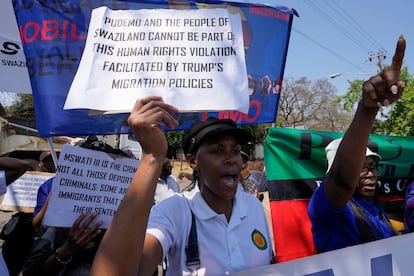
The activists have organized protests outside the U.S. Embassy in Eswatini and attended court proceedings, using the case as a rallying point for broader concerns about democratic governance in a country ruled by an absolute monarchy.
For Simelane and other activists, the case represents a crucial test of Eswatini’s commitment to constitutional governance and the principle of separation of powers. The fact that the Cabinet bypassed Parliament entirely, they argue, signals a dangerous erosion of democratic institutions.
“Over and above this is the principle of open government and accountability, which requires the Eswatini government to account to its electorate for the details of the deal and how it benefits the country,” says Simelane.
Sign up for our weekly newsletter to get more English-language news coverage from EL PAÍS USA Edition









































