
Israel moves closer to Austria’s Freedom Party, founded by former SS members and Nazi Party affiliates
The Netanyahu government had until now boycotted the formation, with which it now seeks to build ‘a political bridge’
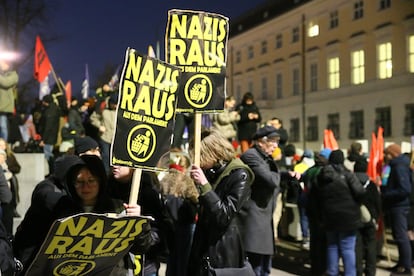

Since the October 7, 2023 attacks and the subsequent Israeli offensive in Gaza, Israel has stepped up contacts with various far-right parties in Europe and Latin America, including Spain’s Vox. However, last Thursday, the Israeli government took that policy a step further when its foreign minister, Gideon Saar, said the country seeks “a substantive, open and sincere dialogue” to establish ties with Austria’s far-right Freedom Party (FPÖ), the Israeli daily Haaretz reported.
The FPÖ, created in 1956, not only counted former SS members among its founders, but — according to leaders of Austria’s Jewish community — still includes numerous supporters of the ideology behind the extermination of six million Jews between 1933 and 1945.
Saar spoke after a meeting at the European Parliament headquarters in the French city of Strasbourg, organized by the Austrian far-right party and hosted by the extremist parliamentary group Patriots for Europe, which brings together parties such as Vox, Matteo Salvini’s Lega, the formation of former Hungarian prime minister Viktor Orbán, and France’s National Rally (RN), led by Marine Le Pen, among other populist far-right parties. In February 2025, Likud, the party of Israeli Prime Minister Benjamin Netanyahu, joined the group as an observer member at Vox’s request.
In his speech, FPÖ leader and former Austrian interior minister Herbert Kickl condemned the Hamas attacks of October 7 as “a crime against humanity.” He also adopted the controversial International Holocaust Remembrance Alliance (IHRA) definition of antisemitism, Saar noted. That definition is disputed because it equates most criticism of the State of Israel with antisemitism.
The FPÖ leader later acknowledged “the historical connection of the Jewish people with Judea and Samaria” — the biblical name for the Palestinian territory of the West Bank, occupied by Israel since 1967 — and expressed “his declared intention to move Austria’s embassy to Jerusalem” if the FPÖ enters government, as well as “his commitment to deepen practical cooperation and build a new partnership with Israel,” a move praised by Saar, as cited by Haaretz. Such a move would amount to recognizing Israel’s occupation of East Jerusalem, which it has also held illegally since 1967. That is why most Western countries, with the exception of the United States, keep their diplomatic missions in Tel Aviv.
Until now, Israel had maintained a formal boycott of the Freedom Party because of its Nazi past and the history of its leaders who have expressed antisemitic views. Those relations have softened in recent years alongside Israel’s rapprochement with other European far-right parties. Saar’s remarks now point to a likely normalization with the FPÖ, despite Austria’s Jewish community’s outright rejection of the party.
“More than a turning point, this [Kickl’s speech] was crossing the Rubicon,” Amichai Chikli, Israel’s minister responsible for Diaspora Affairs and combating antisemitism, later wrote in a tweet. Chikli said the rapprochement follows “a long process of building trust, deepening cooperation, and creating a genuine political bridge between Israel and Austria’s Freedom Party.”
Chikli, who is seen as the main architect of Israel’s tightening ties with the global far right, called the Patriots for Europe meeting in Strasbourg’s Eurochamber “a historic turning point in the relationship between Austria’s Freedom Party, the State of Israel, and the Jewish people.”
Rejection
When the FPÖ failed in its bid to form a governing coalition in Austria in February 2025, after winning the September 29, 2024 election with 28.8% of the vote, Oskar Deutsch, president of Vienna’s Jewish community, said he felt “great relief.” Earlier, while the extremist party negotiated that possible coalition with other right and center-right formations, Deutsch had said he feared his community might “have to start packing their bags.”
Although Deutsch avoided explicitly calling the party “Nazi” at the time, he stressed that there were many supporters of Third Reich ideology among its ranks and even among its leaders. When Harald Vilimsky, the FPÖ leader in the European Parliament, was received at Netanyahu’s office in Jerusalem earlier this year, Deutsch told Haaretz the meeting had been “extremely worrying.”
In 2017, Netanyahu himself had said Israel would avoid contacts with far-right ministers in Austria. Much earlier, in 2000, when the FPÖ first entered the Austrian federal government, Israel withdrew its ambassador.
That policy has changed over time, especially since the Hamas attacks of October 7, 2023, when Israel’s government — the most far-right in the country’s brief history since its creation in 1948 — promoted rapprochement with foreign far-right parties that share its rejection of Islam, migration, and the left. That cooperation offers parties such as the FPÖ the opportunity to whitewash their Nazi past, analysts say.
Sign up for our weekly newsletter to get more English-language news coverage from EL PAÍS USA Edition









































