
From the Shield of the Americas to the Golan Heights, De la Espriella keeps his promise to align with Trump and Netanyahu
The president of Colombia has undertaken a marked shift from the diplomacy of his predecessor, the leftist Gustavo Petro
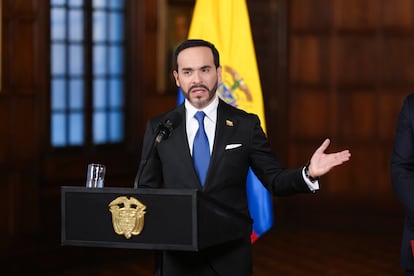

Colombian president Abelardo de la Espriella has repeatedly shown he is more than willing to fulfill his promise to align unreservedly with Donald Trump —who returned the favor with his “full endorsement” during the campaign— and to move closer to Israel without qualms. The criminal lawyer, who marks his first month in office this Monday, has already joined the Shield of the Americas, the Republican-led alliance of like-minded political leaders in the hemisphere that seeks to coordinate the fight against drug trafficking, and on Tuesday he is scheduled to meet with Secretary of State Marco Rubio.
On the diplomatic front, the De la Espriella government has been defined by a series of weighty announcements, in stark contrast with his predecessor, Gustavo Petro, who clashed repeatedly with Trump —to the point of suffering the feared decertification in antinarcotics cooperation— and who repeatedly denounced the “genocide” in Gaza. Perhaps the most striking decision by the new president as part of that shift was to recognize Israel’s sovereignty over the Golan Heights, a territory disputed with Syria, occupied since the 1967 Six-Day War and illegally annexed in the 1980s. He made the decision in the middle of the emergency caused by the August 10 earthquake. Only the United States, under Trump, had taken that step, which was welcomed by Benjamin Netanyahu and rejected by around 20 Arab countries —including Egypt, Saudi Arabia and Qatar.
That gesture “will quite simply mean that Colombia will not find the support of the United Nations when it needs it,” assessed former diplomat Eduardo Pizarro Leongómez, an emeritus professor at the National University and a security analyst, in an interview with this newspaper. “We lost the support of all Arab and Muslim countries, of much of Africa and of the progressive countries of Western Europe, because of this unnecessary recognition, which had also been condemned by the United Nations itself. If Colombia continues its foreign policy as it now appears, it will end up deeply isolated at the United Nations,” he added. “Colombia could perfectly well have moved its embassy to Jerusalem, which is already a gesture that would have generated international tension, but without going so far as to recognize the Golan Heights.”
Military operations
Another of the most notable announcements was the authorization for the United States to conduct military operations on Colombian soil, according to Defense Secretary Pete Hegseth, although no Colombian authority has commented on that permission or its details. Strengthening military cooperation between Bogotá and Washington is moving at full speed, with a joint agenda to combat drug trafficking. During his recent visit to Colombia, General Francis L. Donovan, head of U.S. Southern Command, met with Defense Minister retired General Jorge Mora and set as priorities operations on the border with Ecuador, surveillance of the Pacific —the main drug route to U.S. cities—, and the rehabilitation of the air fleet.
In another diplomatic milestone, also announced by a U.S. official, Trump’s nominee for ambassador to Bogotá said Colombia would withdraw from the Belt and Road Initiative, despite Petro having committed to join that megaproject of Chinese investments and infrastructure. The Foreign Ministry, led by Germán Bula, who has declared himself a defender of Western values, has not issued any official announcement on the matter. The Asian giant is an indispensable trading partner, with stakes in key projects such as Bogotá’s metro.
The new administration aims for close rapport with almost all its nearest neighbors, including those who had irreconcilable differences with Petro. A clear affinity has been evident with Panama’s José Raúl Mulino, Ecuador’s Daniel Noboa and Peru’s Keiko Fujimori, in marked contrast to the distance with Brazil’s Luiz Inácio Lula da Silva. Relations with Venezuela, with which Colombia shares a porous border of more than 2,200 kilometers, also pass through Washington. Both De la Espriella and his vice president, José Manuel Restrepo, have repeatedly said those ties will be channeled through the State Department, a stance that prompted a mild protest from the interim government in Caracas, which in any case operates under Trump’s tutelage.
That closeness to Washington is no surprise. De la Espriella holds U.S. nationality —in addition to Italian— and in the final stretch of the campaign, ahead of the runoff against left-wing Senator Iván Cepeda he secured Trump’s endorsement, which he had sought throughout the electoral season. He also pledged to combat criminal groups with the help of the White House and to revive a Plan Colombia 2.0 of military cooperation. He was highly critical of multilateralism, although that attitude will be tested this month at the first U.N. General Assembly session to be attended by a delegation led by the vice president, since De la Espriella has promised he will not leave the country during his four-year term.
International relations specialist Sandra Borda calls De la Espriella’s diplomatic start “overacted,” noting that some decisions were explicitly requested by the United States and others were not, yet the new government has acted instead of exercising caution. “It’s a kind of preventive diplomacy to please,” says the University of the Andes researcher. “Enthusiastic alignments are a terrible idea in an international climate of uncertainty,” she warns.
Analyst Sergio Guzmán, of Colombia Risk Analysis, agrees that the foreign policy is overly “anchored” to the United States. “It is not a very sovereign strategy, because ultimately it is surrendering national interests to Washington,” he says. “De la Espriella makes a strategic error by subordinating Colombia’s interests to foreign interests, those of the United States or Israel.”
Sign up for our weekly newsletter to get more English-language news coverage from EL PAÍS USA Edition









































