Jacqueline Dunkley-Bent, midwife: ‘Two million babies are stillborn every year worldwide, one every 17 seconds’
The head of the International Confederation of Midwives warns about the stigma and inequalities surrounding these losses, which, unlike other major global health crises, attract little attention and few resources
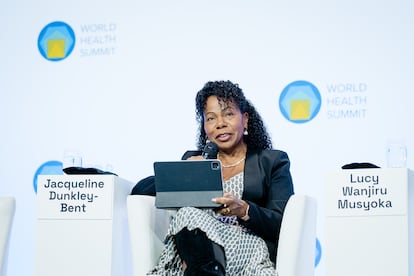

Jacqueline Dunkley-Bent knew the baby had died. As the infant’s head began to emerge, she waited for the slightest movement, a turn to the left or right, any sign of life. None came.
“I knew the facts. But in my heart and in my head I could not accept it,” recalls the chief midwife for the International Confederation of Midwives as she reflects on the first stillbirth she attended.
“Come on, move a little,” she kept thinking silently. “I was very young and naïve. I thought I was entering a profession where everything would be about life and everything would be wonderful. And yes, there was life, but there was also death,” says the British midwife, who had only recently qualified at the time. More than three decades have passed, but the scene has never left her.
Behind every stillbirth, Dunkley-Bent says, there is a story that risks being buried beneath overwhelming statistics: “Two million babies are stillborn every year worldwide, one every 17 seconds.” Yet unlike other major global health crises, stillbirths are not part of the public conversation, nor does the issue attract significant resources.
Behind each of those figures, however, is a family returning home without the child they were expecting, and a grief that is rarely discussed. “The crib is empty. The arms are empty. The breasts are full of milk,” says the midwife, stressing that the pain does not end when parents leave the hospital. She points to another sobering statistic: around 41% of women who experience a stillbirth suffer from depression during the following year.
That lack of attention is one reason why maternal health experts have spent years calling for more investment to prevent deaths that, in many cases, could be avoided. Last week, at the World Health Summit in Berlin — one of the most important events in global health — the Gates Foundation and Wellcome Leap announced the launch of UZIMA, a $100 million initiative aimed at halving the number of stillbirths in several countries through new tools for monitoring pregnancy and childbirth.
The program, whose name comes from a Swahili word meaning “life and wellbeing,” will explore a range of innovations, from tests designed to detect pregnancy complications earlier to artificial intelligence systems to help identify them in low-resource settings.
“We are working toward a future in which no mother, no baby and no child dies from a preventable cause,” Anita Zaidi, president of Gender Equality at the Gates Foundation, which collaborates with this newspaper, said at the launch event in Berlin.
Technology alone is not enough
For Dunkley-Bent, however, no innovation will make a meaningful difference unless it is accompanied by stronger health systems. “An innovation alone is not enough,” she warns.
The midwife notes that the world still faces a shortage of nearly one million midwives, a gap that limits the ability to detect complications and intervene before it is too late. Identifying a high-risk pregnancy is of little use if there are no trained professionals, healthcare facilities or referral systems in place to provide care for the mother.
Dunkley-Bent stresses that many of these deaths could be prevented with adequate prenatal checkups, early detection of complications and timely access to specialized care when warning signs appear.

Often, she explains, the danger signs are there. “We look for changes in fetal movements, problems with the baby’s growth, infections or hypertensive disorders such as preeclampsia,” she says. These are signs that may indicate something is wrong during a pregnancy. The problem is that millions of women do not have access to regular checkups or seek care at health centers too late.
Also, not all women face the same risk. “Four out of five children” who are stillborn are born in sub-Saharan Africa and South Asia, where health systems typically have fewer resources and access to prenatal care is more limited. And sometimes, some deaths could be avoided with knowledge as “basic” as teaching mothers to recognize their babies’ movements, says Dunkley-Bent.
“In countries with more developed health systems, women are informed from the first weeks about the importance of knowing fetal movement patterns and of seeking help if they notice a change, so they know whether their baby usually moves at night, in the afternoon… They know their pattern,” the midwife explains.
And when something changes, they have someone to turn to. But in many other parts of the world, the opposite is true. “There is no one to go to. There is no education about fetal movements. There are people who can’t even afford a consultation or to go to the hospital,” she says. The result is that “some women stay at home unaware that the baby is in danger.”
This lack of information and access to healthcare has another consequence: many mothers end up blaming themselves for a death they may never have been able to prevent. The grief is often accompanied by silence. Dunkley-Bent says stillbirth remains a subject shrouded in stigma and guilt.
Many women spend years wondering whether they did something wrong during pregnancy or whether they could have prevented their child’s death: “Did I eat something I shouldn’t have? Did I work too hard? Did I wait too long to ask for help?” These are questions she says she hears again and again from mothers searching for an explanation for a loss that often has no simple answer.
The reactions of those around them do not always help. Some families offer well-intentioned comments that minimize the magnitude of what has happened. Remarks such as “you can have another baby” or “you’re still young, you can try again” can deepen the feeling of being misunderstood.
“No baby replaces the baby you lost,” says Dunkley-Bent. Each death, she adds, “means the loss of an imagined life, of plans and expectations that vanish in an instant.”
Dunkley-Bent struggles to understand why a tragedy on this scale continues to occupy such a marginal place on the global health agenda. “The knowledge to prevent some of these deaths exists,” she insists. The tools to detect many complications earlier exist as well.
What is often missing, she argues, is ensuring that these resources reach all women, regardless of where they live. “We have the opportunity to prevent these deaths and the responsibility to act,” she says. “And to act now.”
Sign up for our weekly newsletter to get more English-language news coverage from EL PAÍS USA Edition