
The far right in Latin America threatens progress against deforestation, report warns
A 33% drop in forest loss across the region drove a global improvement, but uncertainty surrounding Brazil’s elections and Colombia’s new government could put those gains at risk, according to the Forest Declaration Assessment
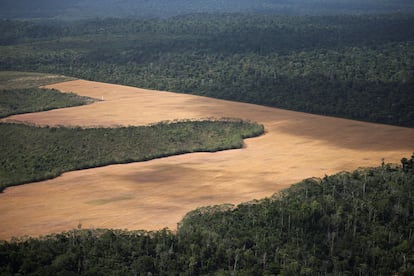

There is both good news and bad news about the state of the world’s forests. The good news is that deforestation fell by 15% in 2025 compared with 2024, the largest decline recorded so far this decade. The bad news is that a shift in political priorities could undo some of those gains. Much of the progress in forest conservation depends on the political will of a handful of key countries, particularly in Latin America, which is now entering a period of electoral uncertainty and possible changes of government.
That is the main conclusion of the Forest Declaration Assessment, a report produced by a coalition of civil society and research organizations that each year tracks changes in forest loss against its 2018-2020 baseline period.
The report was released on Wednesday ahead of the COP17 on biodiversity, which will be held in Armenia later this month, and the COP31 on climate change, scheduled to take place in Turkey in November. Erin Matson, the study’s lead author and a consultant with Climate Focus, says the historic decline was driven largely by a sharp reduction in deforestation in Latin America, where forest loss fell by 33%.
“The drivers of progress are achievable,” said Matson, while immediately warning that they are “fragile and can be reversed.” “We have seen large swings in certain countries when, for example, new governments come to power and discard or reverse policies that had been aligned with forest goals, cut funding for law enforcement initiatives or even openly undermine the law through public messaging,” she argued at a virtual press conference.
The report explicitly mentions Brazil and Colombia. “The decline [in commodity-driven deforestation] was driven in important part by reduced agricultural and pasture expansion in the Brazilian Amazon, where federal authorities strengthened enforcement using satellite monitoring,” the document states, citing the relaunch of President Luiz Inácio Lula da Silva’s anti-deforestation action plan.
But in a press release, the coalition warns that the outcome of the October 25 presidential runoff between Lula and far-right candidate Flávio Bolsonaro could have serious implications for the future of the Amazon, particularly in the context of looming climate threats.
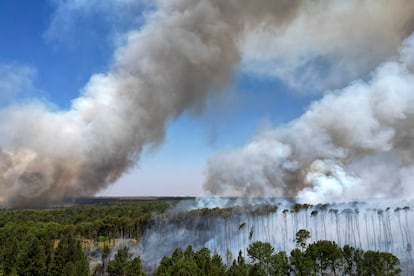
Brazil is home to 60% of the Amazon, the world’s largest tropical rainforest, and recent governments have shown just how profoundly political decisions can shape the future of the ecosystem.
Ana Flávia Corleto, a legal analyst at the Climate Policy Initiative, notes that when the administration of Jair Bolsonaro took office in 2019, “budget cuts, staffing shortages at environmental agencies, and changes to and dismantling of the governance structures responsible for implementing public policies culminated in the suspension of the Action Plan for the Prevention and Control of Deforestation in the Legal Amazon.” As a result, she says, forest loss increased between 2019 and 2021.
National and international organizations are now watching the campaign of Bolsonaro’s son with concern. The Observatório do Clima, for example, analyzed the candidates’ policy platforms and found that Lula’s included 16 of the 28 environmental commitments the group considers necessary. Bolsonaro’s included just one.
Colombia, meanwhile, recorded historic lows in deforestation in 2023, although forest loss rebounded in 2024. Even so, the Forest Declaration Assessment highlights policies aimed at curbing the expansion of cattle ranching as an important factor in protecting the Amazon and other forested areas.
In its press release, however, the coalition warns that Colombian President Abelardo de la Espriella “has pledged to support expanded oil and gas exploration,” measures that “pose potential threats to forests.” During the campaign, the far-right politician proposed expanding the agricultural frontier by 1.5 million hectares.
At the same time, De la Espriella’s platform also contains environmental commitments. Under the ABC strategy (Water, Biodiversity and Communities), presented as part of his proposed “environmental miracle,” he has pledged to combat forest degradation through the “criminal prosecution of those financing deforestation.” It remains to be seen how these environmental commitments will coexist in practice with the new government’s proposals for agricultural and energy expansion.
Degradation in Africa
Samuel Nguiffo, a Cameroonian lawyer and founder of the Center for Environment and Development, warned during the report’s launch press conference that governments will play a decisive role not only in Latin America but also in Africa. This year, for the first time on record, deforestation in the Congo Basin, the world’s second-largest tropical rainforest, reached 2.4 million hectares, a figure very close to that recorded in the Amazon (2.5 million).
The report also points to a deterioration in other indicators across tropical Africa, including forest degradation: the gradual decline of forests caused by activities such as selective logging, resource extraction and fires, without the complete loss of forest cover. In the region, forest degradation rose by 25%, compared with a 34% decline worldwide.
“There is both a deficit in government capacity and a lack of political will to drive a change in how forests are managed,” Nguiffo said, adding that logging laws on the continent are very weak. He laments that “what continues to dominate forest management in Central Africa is the economic dimension: logging for timber and the conversion of forests for other economic activities, such as agroindustry or mining.”
Beyond the federal executive
Despite the risks posed by changes of government in countries that are key to the fight against deforestation, some experts believe certain policies and gains can endure. “No institutional safeguard can completely insulate environmental policy from political change, but institutional design can make rollbacks harder and make policy implementation less dependent on a single electoral cycle,” Corleto said.
The legal adviser at the Climate Policy Initiative cites Brazil as an example. There, responsibility for implementing environmental policies does not rest solely with the federal executive but is shared across different levels of government. “Of course, a shift in federal political priorities can have significant consequences, especially for federal institutions and federal budgets, but environmental action will continue to be sustained and implemented by subnational governments,” she explained.
Matson stresses that the key is to ensure that environmental strategies that work become structural policies. “The real challenge is making those changes so robust and far-reaching that they cannot be fully reversed,” she concluded.
Corleto says that ensuring robust long-term policies requires incorporating key environmental protections into legal frameworks that are more difficult to change, establishing institutions with sufficient staff and operational capacity, distributing implementation responsibilities across different levels of government, and ensuring effective accountability mechanisms.
Achieving this is imperative. Despite the progress made in 2025, the world remains 70% short of what would be needed to halt deforestation by 2030, according to the report.
“If we had been on track [to achieve the zero-deforestation target by 2030], 10.7 million hectares of forest would still be standing today — the equivalent of Iceland or Cuba — that have been deforested since the start of the decade,” Matson said.
Sign up for our weekly newsletter to get more English-language news coverage from EL PAÍS USA Edition









































