
The midterms in maps: A guide to the key Senate, House and governor races
Republicans and Democrats will battle for control of the US Congress on November 3. In midterm elections, the party that controls the White House typically loses ground
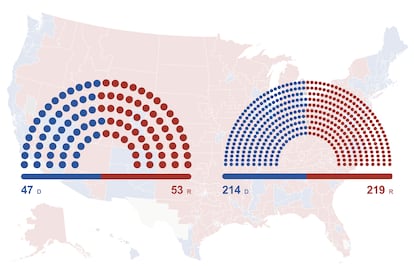

On November 3, voters will head to the polls for the midterm elections, which will determine whether Donald Trump’s Republicans retain a friendly Congress or whether Democrats take control of one or both chambers, enabling them to mount a more aggressive opposition by blocking legislation, budgets and appointments during the final two years of his term.
The Republican Party is entering the election with narrow majorities. In the House of Representatives, a swing of just four seats would cost them control. In the Senate, Democrats need a net gain of four seats to reclaim the chamber, with several of the key races taking place in states won by Trump in 2024. Meanwhile, voters in 36 states will also elect their governors.
These maps show the current makeup of the House, Senate and governorships, and the key races that could reshape them.
The House: Democrats hopeful of winning control
The House of Representatives is seen as the nation’s political barometer: all 435 seats are up for election every two years, and 218 are needed for a majority. Republicans are entering the race with only a slim advantage, and a swing of just four seats would be enough for Democrats to regain control of the chamber.
History is on their side. Since World War II, the party that holds the White House has lost House seats in 17 of 19 midterm elections, by an average of about 27 seats, although Joe Biden’s Democrats suffered an unusually small setback in 2022. Meanwhile, two seats are currently vacant: Florida’s 20th District and Texas’s 23rd, both opened by resignations in 2026 and awaiting special elections.
This map shows a snapshot of the House as it stands today, before November’s midterms: all 435 congressional districts shown within their current boundaries. Colors indicate the party holding each seat, while vacant districts are shown in gray.
The Senate: A tighter race still up for grabs
The Senate sets the pace in Washington: it confirms judges and senior officials and can either advance or block a president’s agenda. Republicans currently hold the majority, and Democrats need a net gain of four seats to take back control. Only 35 of the chamber’s 100 seats are on the ballot this year, comprising one-third of the Senate plus special elections in Florida and Ohio, and several key races are taking place in states that voted for Trump.
Unlike the House, the Senate does not always move with the midterm tide. In 2018, Trump’s Republicans gained Senate seats even as they lost the House. On November 3, Democrats will defend seats in Georgia and Michigan, two states that Trump carried in the 2024 presidential election.
This map shows the Senate as it stands today. Each state is represented by its two senators, and the map is colored according to which party currently holds those seats: blue for Democrats and red for Republicans.
Click on the tab to see which states will hold Senate elections in November.
Governorships: Republicans defend ground in key states
Voters in 36 states will elect their governors this year. There is no national majority threshold, but gubernatorial races shape policies on issues such as abortion, voting rights, immigration and education that have a more direct impact on daily life than many federal laws. In many states, voters will also choose state legislators and local officials, including city councils, school boards and prosecutors, who help determine taxes, schools, policing and civil rights as much as governors do.
Among the governorships up for election, the partisan balance is even: 18 are currently held by Democrats and 18 by Republicans. As in Congress, midterms have historically tended to punish the president’s party at the state level. In 2010 and 2014, Republicans expanded their hold on statehouses; in 2018, Democrats recaptured key governorships in states including Michigan, Kansas and Maine.
Nationwide, Democrats currently hold 23 governorships to Republicans’ 27. With 36 races on the ballot in November, the midterms could once again reshape the political map of the states.
Governors do not serve in a federal chamber, but the map of who holds power in each state capital offers a snapshot of political control across the country.
This map shows the party of the current governor in all 50 states. Use the toggle to highlight the 36 governorships that are up for election in 2026.
Sign up for our weekly newsletter to get more English-language news coverage from EL PAÍS USA Edition









































