
The researchers who achieved Chile’s first cloned horse: ‘It would not be complicated to clone humans; the only limitation is ethical’
Two Cuban scientists, who began their careers a few years after the Dolly the sheep milestone, have created the country’s first identical copy of an equine
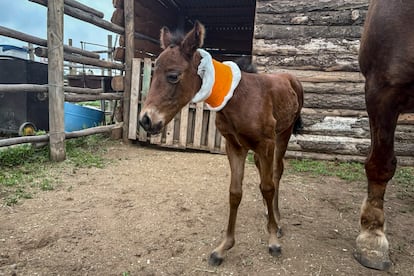

Chile has achieved its first successful equine cloning. The foal, an identical copy of the polo pony Capacidad, was born on September 26 in the O’Higgins region after a pregnancy of nearly a year. Fidel Ovidio Castro, 65, and Lleretny Rodríguez, 50, two Cuban-born academics working at the School of Veterinary Sciences of the University of Concepción in Chile and founders of the company Vi-Embryos, led a research team that accomplished this reproductive biotechnology milestone, together with the Los Abedules Equine Reproduction Center.
The scientists have spent 22 years in Chile and had already managed in 2008 to clone the cow Victoria, the first animal born in that country using this technique. The ruminant, however, died at three months old from pulmonary and digestive complications, but the setback did not stop them. Their aim was to refine a method that could be used to save endangered species, so they continued cloning cattle and goats. They say that moving on to other species was challenging because each has its own physiology. The couple had realized this long before in Cuba, where they began their careers and where they unsuccessfully tried to clone rabbits. That attempt came shortly after the world was awestruck by the birth of Dolly the sheep in 1997, and after the Cuban regime was dazzled by advances in biotechnology.
Castro, who holds a PhD in veterinary sciences, experienced that enthusiasm firsthand. In his youth he worked at Cuba’s Center for Genetic Engineering and Biotechnology, where he says he was once called by the other Fidel Castro — the one who ruled the island for 47 years — who told him, according to a La Tercera article published in 2012: “So you are my namesake; from now on I will be your godfather.” Today the scientist asks to be referred to by his full name, Fidel Ovidio, to avoid confusion.
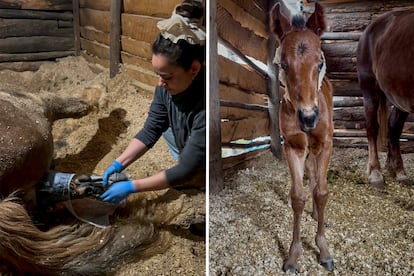
The birth of Capacidad 1 is a milestone in Chile because cloning is not a minor matter. Rodríguez warns that a common mistake is to assume that once a protocol is mastered in one species, it can simply be applied to another: “Reproductive physiology between species is very different.”
Several components are involved in cloning, and all of them vary from one species to another. The first is the egg that will receive the cells and begin embryonic development; some eggs are more resilient to manipulation than others. Then there is the donor cell and the embryo’s own development, which must later be transferred to a surrogate. The synchrony between that embryo and the uterus that will host it requires a meticulous assessment, and it is different in each species, as are gestation, placentation and birth. Each stage must be standardized for the animal being worked with. “Equine oocytes are nothing like ruminant oocytes. We thought it would be easier, but standardization was difficult for us, from oocyte collection and in vitro maturation to the handling itself,” says Rodríguez, who holds a PhD in agricultural sciences from the University of Concepción.
To produce Capacidad 1, five embryos were implanted into one mare, although only one carried to term. The scientists emphasize that cloning a large animal that only produces one offspring is not necessarily harder than cloning a small, highly prolific one. “In the popular imagination, people think that the smaller and more prolific an animal is, the easier it is to clone. And that’s not necessarily so,” Castro explains.
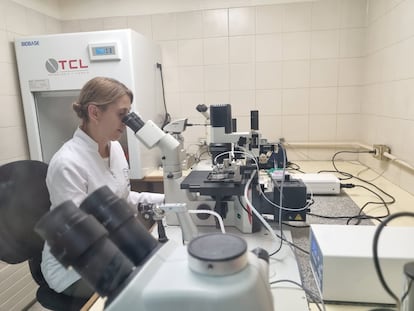
On whether humans could be cloned, Rodríguez warns that the answer may be surprising, because Homo sapiens is probably one of the easiest species to work with in vitro. “Human oocytes are very easy to work with,” she explains. She adds: “It is very easy to culture human embryos. From a biological and technical standpoint, I would say cloning humans would not be complicated. The entire limitation is ethical.”
Castro recalls that the leap to primates has already been made. The first cloned primate was Tetra, a female rhesus macaque born in 1999 at the Oregon National Primate Research Center, so in his view “technically it is very feasible to do this [in humans].”
The scientists, while not endorsing adoption of this innovation in humans, say that cloning remains surrounded by stigma because it is not a conventional form of reproduction. Rodríguez asserts that “it is an extremely complex issue,” although she views it through the lens of biotechnological progress. “It’s like what we once saw with the development of insulin or ICSI [intra-cytoplasmic sperm injection] for human reproduction, which is allowed in Chile. Chile is a very Catholic country. Nevertheless, assisted reproduction is performed in humans,” and the expert adds that perhaps, broadly speaking, there is “that idea sold by the movies [about cloning]: copies of individuals are made to kill or exterminate. Hopefully clones—and those of us who work in biotechnology—are not seen that way. People say cloning creates monsters because at times animals have been born with defects. But, as an embryologist, I must say that in natural reproduction there are also cases of animals born with malformations or problems.”
The milestone of cloning ‘Capacidad’
For the researchers, equine cloning opens an opportunity for an industry that lives from multiplying high-value animals. Capacidad is an example: she is a mare brought from Argentina who competed in that country’s Triple Crown, one of the main polo circuits, and in 2018 she was part of La Dolfina Polo Ranch. “Cloning is the only technology that allows us to reproduce 100% of the genome of an animal identified as having high value,” Rodríguez said.
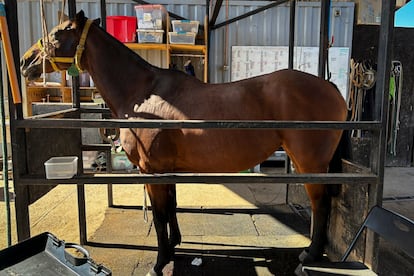
In Argentina, this is an industry that has already matured. Polo player Adolfo Cambiaso, who has competed with dozens of replicas of his mare La Cuartetera, is evidence of that. That country has some of the lowest horse cloning costs (between $35,000 and $40,000), depending on the sporting value of the specimen. In Europe or the United States, the price can be higher, around $85,000. Hence Castro sees commercial opportunity for Chile in the successful birth of Capacidad 1. “The Chilean Fina Sangre [or thoroughbred] horse is a native species; it is a breed of our own. This is an opportunity to multiply that breed, add more value and export stallions, semen, cell lines or cloned horses from genetics that are Chilean,” he explained.
However, Castro notes that clones are like identical twins, but sharing a genome does not guarantee the same fate: “Twins can be completely different because of their upbringing and environment. Therefore, saying the clone will be identical competitively would be risky. It is most likely to be so, provided it is trained the same way as the mother.”
Sign up for our weekly newsletter to get more English-language news coverage from EL PAÍS USA Edition









































