
I want my dog back: The rise of pet cloning
From Tom Brady to Javier Milei, more and more people are paying tens of thousands of dollars to clone their animals, a business that exploits the notion of ‘eternal love.’ But what do they actually buy? Twenty years after the cloning of Snuppy, companies, scientists and bioethicists are divided


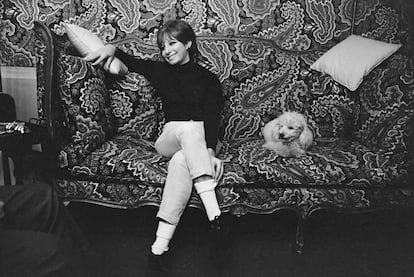
Actress and singer Barbra Streisand felt literally “devastated.” After 14 years of companionship and unconditional affection, her dog Samantha passed away and she wanted to keep “her with me in some way.” As she explained in The New York Times in 2018, she sent Samantha’s DNA to the ViaGen Pets laboratories, a Texan company and market leader in the business of pet cloning. Streisand got two puppies, Miss Violet and Miss Scarlett.
Similarly, Argentinian President Javier Milei chose ViaGen to clone his dog Conan. Five puppies were born, although it is not known how many of those dogs survived. The latest celebrity to sign up to this trend is former NFL player Tom Brady, who has just cloned his dog Lua. “The science of keeping them alive,” ViaGen proclaims on its website to convince humans who adore their pets to pay the nearly $59,000 it costs to clone them. But the reality is that the cloning process cannot duplicate personalities. This is the paradox of an industry with an annual growth of 15% by virtue of claiming something it is unable to achieve, namely the keeping of a dead animal alive.
The global market for cloning pets, especially cats and dogs, reached $300 million in 2024, according to analytics company Wise Guy, and is projected to reach $1.5 billion by 2035. In Spain, the Marbella company Ovoclone offers the cloning of pets “to customers from all over the world,” explains CEO Enrique Criado. But the world’s leading company is ViaGen, which has just been acquired by Colossal, the controversial company behind the “de-extinction” of the dire wolf and which is also trying to resurrect the mammoth.
None of the three companies offers business figures; nor do they say how many animals they have cloned or give customer numbers. EL PAÍS spoke by videoconference with Blake Russell, president of ViaGen, and Matt James, director of the Colossal Foundation. Both try to clear up what they see as misconceptions. The first is that this is not something new or surprising: “We’ve been in this business for almost two decades,” says Russell, and his company has cloned “thousands” of animals. “And yet, most people don’t know that this service is available and it’s amazing,” he adds.
The technology used by ViaGen is, broadly speaking, the one used to clone Dolly the sheep. In fact, the company holds licenses for the patents of the Roslin Institute, the Scottish outfit that created Dolly. Almost 30 years later, technology has advanced considerably. The technique is relatively simple: cloning laboratories extract DNA from a skin biopsy obtained from the either living or recently deceased animal, and the cells are cultured and frozen. When the client decides to activate cloning, the nucleus of one of these cells is transferred to an egg from a donor dog from which the donor’s own genetic material has been extracted. The embryo is implanted in a surrogate mother. And a few months later, if all goes well, a puppy is born with a 99.9% match to the DNA of the original. The remaining 0.1% is mitochondrial DNA from the donor.
Despite what his website claims, Blake Russell insists when talking to EL PAÍS that his customers know that the cloned animal is not their actual animal. “Our customers visit our customer service team, and we make sure they understand that, in the first place, they’re going to have a puppy — they’re not going to get a cloned adult like the one they’ve lost,” he says. “And then it is explained to them how each puppy is its own individual, even though it is an identical twin [of the original]. Our customers understand very clearly what we are doing.” ViaGen offers a genetic preservation service, for about $3,000, which is the first step in the cloning process, “and that gives the customer all the time in the world to sit down, think, digest and ask more questions. No one rushes into making a decision about cloning. It is very important to us that we are producing animals that have a fantastic home,” he explains.
Criado, from Ovoclone, agrees, insisting that the customer profile varies. “We have three types of customers, including the rich and famous one everyone supposes,” he says. “But you’d be surprised at how many customers aren’t wealthy. There are those who do not have the money to clone their pet but keep the genetic line of the animal for €1,500 ($1,760) or €2,000 ($2,350), and have it preserved. And there are those who take out a loan.” According to Criado, 15% to 20% of pets in Europe “are humanized and are part of the family. Many of the owners whose pets die sink into depression and take medication. When we give them the clone, they stop medicating or seeing the psychiatrist or psychologist. They know it’s another animal, but its behavior is very similar.”
But Fabiola Leyton, a specialist in bioethics and animal ethics, takes a dim view of the trend. “Any type of business that is based on the exploitation of sentient beings is morally unacceptable,” she says. As she sees it, these animals are “instruments… What happens to surrogate mothers, to embryos that do not thrive? No laboratory protocol can guarantee their well-being 100%, because what matters is that the animal serves as a means to an end,” says Leyton, who is a lecturer in ethics at the Department of Fundamental and Clinical Nursing at Barcelona University where she is also a member of the Observatory of Bioethics and Law.
The expression “sentient beings” is not accidental. Animal welfare laws were first based largely on the Cambridge Declaration (2012) and, later, on the New York Declaration on Animal Consciousness, approved last year. They consist of scientists and philosophers acknowledging the growing scientific evidence that many animals, both vertebrates and many invertebrates, are conscious and capable of subjectively experiencing the world. Although pet cloning is not expressly prohibited by legislation in countries such as the United States and Spain, many experts believe that this acknowledgement should be enough to stop it.
“The first thing we do is take good care of our animals,” says Russell. “I invite people to my ranch all the time to see how we take care of them, and they lead a pretty good life. And as you can imagine, [ViaGen’s] workers are animal lovers, and that’s an important part of what we do.” Russell insists that they are trying to create “a process” that is “as efficient as possible,” so that the number of surrogate mothers “does not exceed what is absolutely necessary. Each surrogate mother is treated with respect and honor and looked after with care. And then, of course, all of our puppies, foals and kittens go to forever homes. Our employees go to sleep at night feeling great about the work we are doing,” he explains.
Criado has just returned from Argentina, where he attended a polo match in which four of the eight horses “were cloned, and there was no difference; they were even better.” His company, Ovoclone, is expanding its business into Dubai and Doha where it will offer to clone camels and falcons. Regarding surrogate mothers, he agrees with Russell that they are “animals that are very well cared for, with specialized vets.” But he also proposes a technological route for the future: “In the next five years, cloning companies may have artificial wombs; that way you could avoid having pregnant mothers.”
Scientific evidence on pet cloning is scarce, but compelling. According to a 2022 study on 1,000 puppies successfully cloned over a decade, published in the journal Scientific Reports, cloning in dogs that results in a live puppy is around just 2%. However, once the clone is born, the rates of premature deaths, disease and longevity is similar to that of any dog. One of the authors of the study is the Korean scientist Hwang Woo-suk, who cloned the first dog, Snuppy, 20 years ago and then fell from grace, accused of massive scientific fraud. He now clones camels in Abu Dhabi.
Another study, published in 2018, reported that 4% of transferred eggs develop into viable puppies and that 50% of clones that survive gestation die at birth or in the first few months. Those which live, however, lead lives similar to the average pet. The study questions the ethics of cloning pets, arguing that if we understand the human-dog relationship as a friendship, cloning a dog lacks ethical sense.
“Shelters are full of animals [about 300,000 dogs and cats are counted each year in Spain] that need attention, affection, and a home,” says Leyton. “Why are we seeing such narcissistic pigheadedness?” Leyton believes that this business raises ethical questions that not only have to do with animals, but also with human nature: “It is very difficult to overcome the death of an animal. But normalizing the idea that everything — even a life — has a price begs the question of what kind of relationships we are establishing with animals, and also with natural processes, such as life and death.”
In response to this criticism, Criado says: “This is a free world. There are people who take a dog from a shelter, others who buy a purebred dog, and there are those who clone their dog. They are completely different things. Ethics in animal cloning are actually related to price. If I told her that she could have a copy of her dog for free, would she do it or would she go to a shelter? We have gone out on the street to ask and 90% of people say that they would clone their dog.”
Russell agrees. “Most clients are people who have just had a very dear relationship with that particular animal. The feedback we receive from customers about the similarities between their cloned puppy and their original dog is amazing.” Russell explains that much of ViaGen’s business revolves around what he calls “performance dog production.” For example, dogs that have demonstrated unique odor detection skills for military and police work. The same happens with polo or rodeo horses, “which have had a high performance as athletes, but also others that were excellent producers of high-performance offspring… Our customers span the entire demographic, from wealthy to ordinary people who have a deep devotion and affection for their pet,” he explains.
Sixty percent of Americans consider animal cloning to be morally wrong, according to a 2018 Gallup poll. Russell is confident that the perception will change: “Those figures come from people who have read an article and have no idea how we work,” he says. “A very high percentage of our business comes from people who have done this before and had a great experience, or from customers who told their friends, neighbors, and family. The best ambassadors for our business are the cloned animals themselves.”
Matt James, director of Colossal, imagines a future in which cloning is understood as just another tool: “I think in 10 years we will remember the wins, not only with helping families recover from the loss of a pet, but also with the species that will continue to exist thanks to these technologies,” and those undergoing de-extinction, such as the dodo, the thylacine, and the mammoth. “It is a question of freedom,” Criado says. “You might think it’s indecent to buy a Mercedes, but I do so because I can.”
In response to this argument, Leyton says, “We have to assume that death is part of life, including the death of other living beings that live with us. And if you miss the animal that has died, go to a shelter and adopt. We have to respect the dignity of individuals, not just humans.” Leyton criticizes companies that play God, and she includes trying to reverse the process of extinction in this.
In any case, bioethicists and cloning companies agree that biology has a knack of introducing small inevitable variations that make an exact reproduction of a life impossible. Science can copy a genome, but it cannot copy a story. As a somewhat disappointed Barbra Streisand said about Miss Violet and Miss Scarlett: “You can clone the look of a dog, but you can’t clone the soul.”
Sign up for our weekly newsletter to get more English-language news coverage from EL PAÍS USA Edition









































