
The fall of a prolific science journal exposes the billion-dollar profits of scientific publishing
One of the 15 publications that put out the most studies globally has been expelled from the indexing system for irregularities. Its publisher, Elsevier, has a 38% profit margin that reached $1.5 billion in 2024
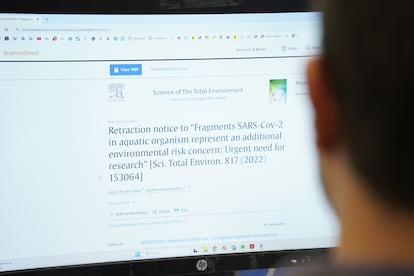

With humanity terrified by the deadly second wave of the coronavirus, in the fall of 2020, a scientific journal published a study with a solution: jade amulets from traditional Chinese medicine could prevent COVID-19. The proposal was outlandish, but the editor-in-chief of the weekly, Spanish chemist Damià Barceló, defended its quality controls. That journal, Science of the Total Environment — one of the 15 that publishes the most studies worldwide — has just been expelled from the group of reputable publications by one of the leading evaluation companies, after dozens of irregular articles were discovered. The scandal exposes the windfall profits of scientific publishers, who in recent years have amassed billions of dollars in earnings from public funds earmarked for science.
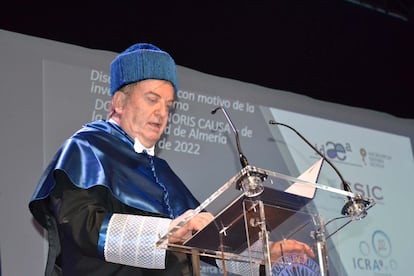
Damià Barceló, 71, took over as editor of the journal in 2012. In just two years, he doubled the number of studies published. In a decade, he increased the number tenfold, with the journal reaching nearly 10,000 articles annually. As the number of articles increased, the quality declined, because there was a perverse incentive to accept mediocre work: to publish research open access in the journal, a scientist has to pay $4,150 plus taxes.
Emilio Delgado, professor of documentation at the University of Granada in Spain, explains it this way: “It’s clearly an open-door journal that takes almost anything. It’s what I call a mega-journal, that is, a mega-business.” The publication belongs to the Dutch publishing giant Elsevier, which dominates the world of science publishing, with a 17% share of the global market. Its 3,000 journals published 720,000 studies last year. Swedish businessman Erik Engstrom, CEO of RELX (the multinational that owns Elsevier), earned more than €15 million ($17.4 million) in 2024 between his salary and other compensation.
Delgado and his colleague Alberto Martín analyzed the unusual behavior of the mega-journal at the request of EL PAÍS. Of all the studies published in Science of the Total Environment, 40% are by Chinese authors and 8% are by Spanish authors — percentages that are double the usual ratio in the subject area. The third institution that publishes the most articles in this journal, after two Chinese organizations, is the Spanish National Research Council (CSIC), Spain’s largest scientific organization, where Barceló himself worked until his retirement last year. “With these patterns, one might consider the possibility of publication fraud, but this is speculation,” says Delgado.
The scientific system operates in a controversial way. Researchers’ funding and promotions depend largely on the number of studies they publish in journals, which are validated by a handful of private companies. One of these companies, the London-based multinational Clarivate, removed Science of the Total Environment from its database on November 18. “The journal was removed because it no longer meets our publicly available quality criteria,” explained a spokesperson, who declined to offer further details.
In theory, the quality of scientific journals is safeguarded by anonymous experts who voluntarily review manuscripts to determine whether they should be published. In Science of the Total Environment, this system was allegedly compromised. The publisher Elsevier itself has retracted some 50 studies published by the Brazilian biologist Guilherme Malafaia, after discovering that his work had been “reviewed” through fake peer reviews signed with the names of real scientists without their consent — as was the case with an article on coronavirus in fish and another on the toxicity of a herbicide in turtles. Malafaia and Barceló are co-authors on several studies on microplastic pollution, but these shared investigations have not yet been retracted.
The four major scientific publishers — Elsevier, Springer Nature, Wiley, and Taylor & Francis — earned more than $7 billion in 2024, with profit margins unimaginable in almost any other industry, exceeding 30%, according to a new analysis led by British anthropologist Dan Brockington of the Autonomous University of Barcelona. This collective windfall is explained by the “publish or perish” system — which rewards improbably prolific scientists who produce a study every two days — as well as a shift in the industry’s business model. Previously, readers paid subscription fees to access quality journals. Now, amid the push for open access to science, it is the authors themselves who must pay to have their research published so that others can read it for free. This perverse incentive — whereby both scientists and journals earn more the more they publish, regardless of quality — has fueled a flood of millions of low-quality studies.
Elsevier is the publisher that publishes the most studies and earns the most, with a 38% profit margin ($1.5 billion in 2024), according to the analysis by Brockington and his colleagues. The researchers call for efforts to “dismantle the system” that sees billions of dollars of public money being spent on publishing empty studies for the exclusive benefit of private companies. According to their calculations, Elsevier, Springer Nature, Wiley, and Taylor & Francis have received more than $14 billion in profits over the last six years. Among the co-authors of the analysis is the Spanish engineer Pablo Gómez Barreiro, from the Royal Botanic Gardens, Kew, in southern England.
An Elsevier spokesperson defended the company’s actions. “We uphold the highest standards of rigor and ethics in our publishing to protect the quality and integrity of research,” they stated. The publisher conducted an initial investigation that resulted in dozens of retractions in Science of the Total Environment, officially due to the fraudulent peer review of articles. “We are now undertaking a broader investigation focused on conflicts of interest, as well as reviewing papers flagged for other potential indicators of misconduct,” the spokesperson added. The publisher intends to “fully rehabilitate” the journal.
Damià Barceló is a hyper-prolific scientist, one of those who publishes a new study every five days or even less. He has authored some 1,800 papers in his lifetime, more than 200 of them in Science of the Total Environment, his own journal. His name appears numerous times as editor of his own studies, such as one on drugs in wastewater in Mexico and another on chemical pollution in the Ebro and Guadalquivir rivers in Spain.
The Elsevier spokesperson explained that Barceló “stepped down” as editor-in-chief in March 2025. “This change was part of a broader effort to strengthen the journal’s governance and address concerns raised,” the spokesperson stated. Elsevier maintains that the “systemic problems” that led to the expulsion of Science of the Total Environment “cannot be attributed to any single individual.” EL PAÍS requested a comment from Barceló, both via his personal WhatsApp and the email address associated with his current position as honorary professor at the University of Almería, but did not receive a response.
Barceló’s prolific output helped him enter the Highly Cited Researchers list, a ranking compiled by the multinational Clarivate that includes some 7,000 researchers worldwide. The more highly-cited researchers a university has, the higher it ranks in the influential Shanghai Ranking, which designates the supposedly best academic institutions in the world. An investigation by EL PAÍS revealed in 2023 that Saudi Arabia offered bribes of up to €70,000 ($81,000) a year to highly-cited scientists to falsify their affiliations in Clarivate’s database, claiming they worked at an Arab university in order to boost those institutions in the ranking.
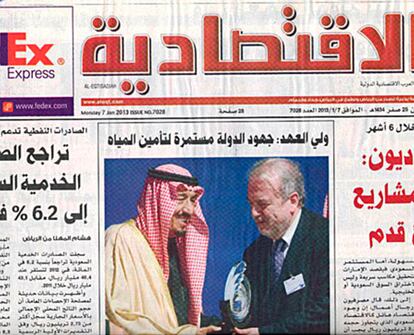
Damià Barceló had been listed as a professor at Saudi Arabia’s King Saud University since 2016, despite his primary role being director of the Catalan Institute for Water Research in Girona, Spain. Barceló told this newspaper at the time that he had not been receiving the €70,000 annual salary. In 2013, the Spanish chemist received a $133,000 award from Saudi King Salman bin Abdulaziz for his research on water contaminants.
Spanish universities, like those in other countries, have become places where producing research papers is prioritized above all else, almost like a large-scale factory farm that churns out studies, according to Emilio Delgado and Alberto Martín, bibliometrics experts at the University of Granada. Professors with completely inflated CVs have risen to full professorships or even rectors. Spurred by various international manifestos, the National Agency for Quality Assessment and Accreditation (ANECA) —the Spanish agency that decides whether a university professor can be promoted or deserves salary increases — has changed its criteria to stop evaluating scientists based on sheer volume.
The president of the Spanish Research Ethics Committee, Dr. Jordi Camí, has called for further action. “We must clean up this mess,” he proclaimed at a conference in Barcelona on November 6. In his opinion, “we must continue to introduce measures to discourage, almost penalize, publishing for the sake of publishing.”
Sign up for our weekly newsletter to get more English-language news coverage from EL PAÍS USA Edition









































