
Colombia’s left flexes its muscles in first street protests against De la Espriella
Tens of thousands marched without any major incidents in the country’s main cities despite adverse weather and the president’s threat of a harsh response
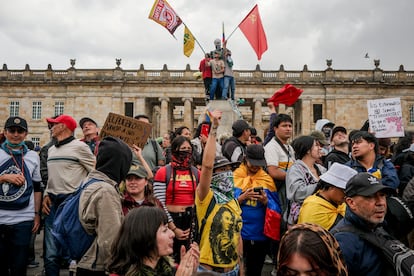

Colombia’s left took to the streets on Wednesday against President Abelardo de la Espriella and fared better than expected. Despite doubts about its ability to mobilize people, fears of police repression stoked by the president himself, the threat of rain and the fact that the protest fell on a weekday, thousands of Colombians demonstrated peacefully for hours. The marches, seen in the country’s main cities, were the first test of the ability of a battered left to mobilize the grassroots after losing power to a right-wing outsider allied openly with the United States and who embodies everything that progressives abhor.
Only hours before the rally, De la Espriella had challenged the demonstrators by approving a tougher new protocol by decree for how authorities should act during protests. With the memory of police brutality during the 2021 marches still fresh in their minds, many Colombians feared the day would end in pitched street battles that would scare others away or that the president’s warning alone would deter people from leaving their homes. That did not happen. It rained, there was a hailstorm, and the sun came back out, while Bogotá’s demonstrators numbered in the thousands and everyone, including some wearing hoodies to conceal their identities, marched through the city for more than five hours without any notable incidents or clashes. The presence of uniformed officers along the route was minimal.
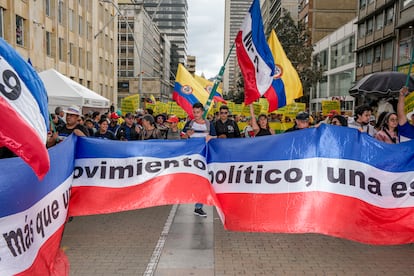
The opposition seems still shaken after losing the election by only 250,000 votes. During the campaign, former president Gustavo Petro himself warned of a social explosion if De la Espriella reached the Casa de Nariño, but until now the streets had remained calm. They did not even erupt on June 21, election day, when Petro refused to recognize the results and the most radical elements of the left announced they would mobilize forcefully. “We endured more than 50 years under a fascist, genocidal right. People will not put up with that,” Sergio Pastor, 19, one of the youngsters jailed in 2021 for clashing with police during mass protests against Iván Duque’s government, told EL PAÍS from prison. “Everything will start the day that man is gone,” he declared. It took a little longer.
Now, with their power tested, several social leaders are talking about calling a major national strike on November 14. It is not certain it will happen, but from the stage, speakers insisted that Wednesday’s events are only “the prelude” to many more protests.
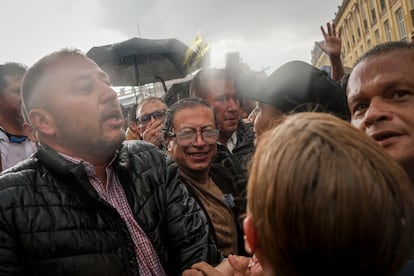
There was something unusual about the marches: they had no single leader or a single slogan. Iván Cepeda, the leftist senator who had been expected to succeed Petro, led the Bogotá march for a while amid chants of “president!” from followers who treated him like a pop star. He stepped aside shortly after and the marchers continued without him. Petro showed up toward the end of the route, in Bolívar square, but left during a heavy hailstorm without taking the microphone. Senators, trade unionists and social leaders spoke instead.
The march brought together teachers, public university students, retirees, civil servants, indigenous people and feminists. Many wore Palestine shirts in rejection of De la Espriella’s rapid and radical rapprochement with Israel. And while a batucada beat on, the government celebrated the opening of its embassy in Jerusalem, making Colombia the most populous country in Latin America (and the tenth in the world) to take that step. There were also chants against Donald Trump, calls to defend national sovereignty and rejection of any foreign interference in a country whose president does not conceal his alignment with Washington. “Colombia is nobody’s backyard,” read several placards.
Cepeda summed it up: “The single slogan is everyone against De la Espriella” and at the same time attributed the many different slogans to the government “trying to attack all sectors simultaneously.”
The challenge for the opposition now is to turn this first show of force into a genuine counterweight to a government that, so far, has managed to alienate or silence much of the economic elite, political parties and the media. Petro, who continues to set the pace for the left even though he no longer occupies the Casa de Nariño, made only a brief appearance and remains beset by scandals. Cepeda, who claims the backing of “an organized opposition that obtained almost 13 million votes,” left the march halfway through. Asked whether the former president would attend the demonstration independently, the senator denied it: “We are an articulated, unified movement; we are not a loose wheel. We will come together at some point.” It did not happen. When that moment will arrive, beyond the streets, is now the big question.
Sign up for our weekly newsletter to get more English-language news coverage from EL PAÍS USA Edition









































