
Mediums, horoscopes, tarot... how much does modern mysticism have to do with neoliberal individualism?
In her book ‘Liquid Spirituality,’ author Marta Sader addresses the rise of pseudo therapies as a symptom of a disconnected and selfish society
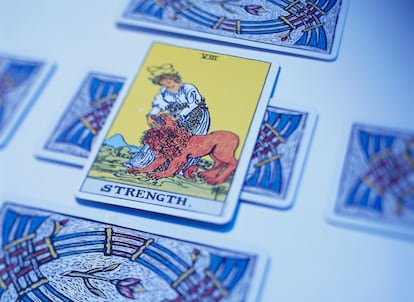
Anyone on social media will find infinite references to horoscopes, mediums, tarot and other practices. This seems to contrast with the era in which we live which is hyperconnected and technologically advanced.
However, as journalist Marta Sader, author of the book Espiritualidad líquida (or Liquid Spirituality) explains to EL PAÍS, it is not as contradictory as it seems. In this precarious moment in which the promises of a stable life — home, work, family and so on — seem increasingly empty, this type of belief system comes into its own. “It is safe because the beliefs are anchored to a kind of mandate. They offer peace of mind in a world in which nothing is clear and evident,” she explains.
This combines perfectly with the fact that everything these days changes very quickly, including science. “This leads many people to think that they cannot trust it,” says Sader. “People are oversaturated and overloaded with information, and all they want are a few basic explanations.”
A spirituality based on individuality
The curious thing about this type of spirituality is that it is not linked to classical religion. According to Sader, classical religion requires a certain commitment, whether it is praying or going to mass. However, liquid spirituality does not require any such commitment and has more to do with marketing than with spirituality itself. “It can be anything from a bio-emotion course, a two-day meditation retreat... the list is endless because new things are coming out almost every day,” says Sader.
Another characteristic is that liquid spirituality is nourished by individuality and by putting ourselves at the center. The responsibility of healing falls on the individual while other uncontrollable conditioning factors take a back seat. “If we are poor or unhealthy, it is because we have not given the matter enough attention.”
It is a reality that fits perfectly with the current system in which we live: neoliberalism. As we witness everything crumbling around us, we feel that our individuality is the only thing we can control. But, as Sader points out, this only flags up the world’s flaws. “No matter how often you get up at five in the morning to do yoga and prepare a healthy breakfast, you are not going to change things. The only thing you are doing is putting a patch on a problem that is systemic,” she explains.
From horoscopes to the far right
The horoscope exemplifies the rise of this liquid spirituality. In recent years, it has become fashionable and permeates everything, from the media to dating apps, songs and culture while it demands almost nothing. “Many times, it tells you about yourself and, therefore, tells you how to position yourself with respect to it: it makes you feel part of a group,” says Sader. “It also has a powerful symbolic function: that of the oracle. It should be noted that it does not give you a closed answer, but one that is open to interpretation so you can integrate it into your life. Thanks to the confirmation bias, it seems to be talking directly to you. That is where its appeal lies.”
This can make us believe in things that have no scientific basis. But, above all, the horoscope acts as a launch pad to a more dangerous place where the hoax is cultivated. “I read an investigation that a journalist did within a yoga group. In it, he explained that during the pandemic, super powerful health hoaxes began to spread. Even fascist hoaxes. It went from the sun salute to the Hitler salute,” Sader explains.
This cause-effect relationship does not necessarily have to occur, but occasionally does. Contrary to what we might think, people who begin to believe in pseudoscience tend to be extremely individualistic and, in many cases, occupy a privileged economic position, Sader says. “If you see how much a yoga or meditation retreat costs, not only is it quite expensive, it will often be hosted in five-star hotels. Many of those attracted to this type of spirituality consider the conventional political circuit boring. In this world, it is easy for an alternative discourse linked to conspiracy theories and far-right gurus to sneak in,” she says.
Medicine is no joke
Another transition is the transition from liquid spirituality to pseudoscience. The horoscope or the tarot may not have the capacity to decisively transform people’s lives, but pseudoscience does. Sader uses the example of bio-neuroemotion, a pseudo therapeutic approach that has changed its name over time and is driven by a massive marketing machine. “What they say is that the symptoms you may be experiencing are not linked to disease, but instead have an emotional root. So, for example, if you have a breast problem it is because you have had [problems] with your mother, or, if you locate it [a cancer] in a testicle, it has to do with your children. This link is very random, very Judeo-Christian. Besides, everyone has had a problem with their mother or their children,” she says.
According to Sader, this is just one more expression of individualism taken to the extreme: a framework in which healing is the individual’s responsibility. “This is unfair because people who cling to these beliefs do so because they trust them or because nothing else has worked for them before. At this point we enter the blame realm,” she says.
Sign up for our weekly newsletter to get more English-language news coverage from EL PAÍS USA Edition









































