
The WHO searches for a new leader as US funding dries up and trust in science wanes
Spanish candidate María Neira is vying to lead an organization seen as essential to tackling pandemics and the health impacts of the climate crisis
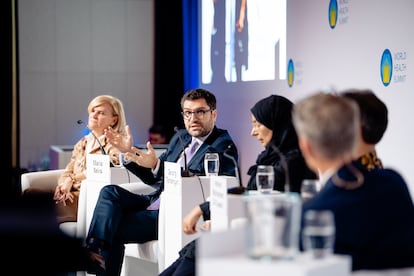

A woman in her 70s holds a sign against the World Health Organization (WHO) in the rain outside the World Health Summit in Berlin, one of the main international forums on global health. The image catches the eye of Gevorg Tamamyan, an Armenian physician and candidate to lead the agency. “When I was a child, the WHO meant trust. Why has that trust become so fragile?” he asks hours later during the first debate among several of the seven contenders to succeed Tedros Adhanom Ghebreyesus.
The anecdote could serve as a metaphor for the moment facing the United Nations health agency. As it searches for a successor to Dr. Tedros, the organization is confronting questions about its authority, its ability to influence policy, and the level of trust it commands among parts of the public and even among its own member states. In a context marked by a political climate increasingly hostile toward multilateralism, the WHO continues to carry the baggage of the controversies that surrounded its handling of the Covid-19 pandemic, from criticism of its initial response to the outbreak in China to doubts over some of its public-health recommendations.
This distrust extends beyond the WHO itself. A report by the Wellcome Trust, presented at the World Health Summit and based on more than 140,000 interviews in 140 countries, concludes that trust in science has fallen below pre-pandemic levels, from 77% in 2018 to 72% in 2025.
These questions about legitimacy are compounded by financial difficulties. The United States’ withdrawal from the WHO, after decades as one of its leading contributors, has deepened the funding problems that the director-general has been warning about for months. The organization has already had to scale back its budget ambitions: its 2026-27 program budget was reduced from $5.3 billion to $4.2 billion.
At the same time, only 41% of the organization’s expected funding comes from flexible resources that can be allocated to priorities set by the WHO itself. Most of its budget still depends on voluntary contributions earmarked for specific projects, a system that limits the agency’s autonomy and complicates long-term planning.
Whoever is elected next May at the World Health Assembly will therefore inherit an organization weakened both financially and in terms of public trust. But the question is not simply who will take over the job. It is also what kind of WHO member states want for the next decade. Should it focus on its traditional roles of coordination and standard-setting, or continue to pursue a broad agenda that ranges from pandemics to climate change? And at a time of constrained financial resources, which activities should it keep and which should be handed over to other organizations?
A more uncertain world
Seven candidates are competing for the job: María Neira (Spain), Gevorg Tamamyan (Armenian but nominated by Botswana), Hanan Mohamed al Kuwari (Qatar), Budi Gunadi Sadikin (Indonesia), Hans Kluge (Belgium), Hanan Balkhy (Saudi Arabia) and Song Li (China).
The answers of some of the candidates reflect different visions for an institution trying to redefine itself at a time when international cooperation on health is more necessary than ever. Pandemics remain a threat, antimicrobial resistance continues to grow, and climate change is multiplying health risks.
The succession could also shape the agency’s political direction. Some observers are closely watching the candidacies from Qatar and Saudi Arabia because of what they could mean for issues such as sexual and reproductive rights and health policies related to climate change.
As Axel R. Pries, president of the World Health Summit, tells this newspaper: “Health cannot be separated from geopolitics, the economy, security or climate.” Yet the organization created to coordinate the response to these challenges enters this succession process poorer, more heavily scrutinized and once again forced to justify its relevance.
For María Neira, redesigning the WHO of the future begins by leaving behind a word that has dominated the global health debate for years: coordination. “We need to go further,” the Spanish candidate argues. In her view, the question is no longer how to get different organizations to collaborate more effectively, but rather who should lead specific areas and how resources and responsibilities are distributed. “What do we want to achieve?” she asks, calling for more ambitious decisions.
Neira’s reflection points to the complex global health architecture that has taken shape over the past few decades. Alongside the World Health Organization, actors such as the Global Fund, Gavi (the Vaccine Alliance), development banks, philanthropic foundations and regional organizations have gained influence. The result, several candidates agree, is a richer ecosystem, but also one that is more fragmented and marked by “overlapping mandates.”
Qatari candidate Hanan Mohamed al Kuwari points to the achievements of that system, noting that “mortality among children under five has fallen by more than half since 2005 and deaths from AIDS have declined by three-quarters.” But she also argues that the architecture was designed for a different era.
“Many plans, many governing bodies, many partners, all competing for the same donors,” she laments. Her proposal is a clearer division of labor, coordinated financing and a WHO focused on its role as global coordinator. Above all, she says, the key is “doing fewer things, but doing them better.”
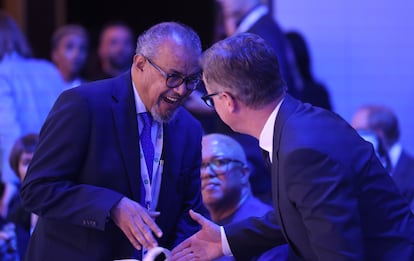
“The WHO has a lot of science. It simply does too many things,” says Indonesian candidate Budi Gunadi Sadikin. After speaking, he says, with nearly a hundred health ministers, he has reached one conclusion: countries are demanding greater “health sovereignty.” For that reason, he argues that one of the WHO’s essential functions should be to work with each country to develop “its own plan and its own budget,” and then mobilize development banks, international organizations and foundations to help finance them. Still, he believes that “the great challenge of global health” is turning recommendations into action.
Accountability
According to Gevorg Tamamyan, the gap between objectives and their implementation is one of the WHO’s greatest challenges. “We have excellent documents. We have big goals. The ideas are good. But we must achieve results on the ground,” he says.
To illustrate the problem, he reads aloud what he calls “a beautiful image” from the WHO’s General Programme of Work 2025-2028: “The WHO Academy will expand the availability of cutting-edge, high-impact training for millions of health workers and policymakers around the world.”
But reality, he says, is very different. “I visited the Academy in April or May and saw a beautiful building and wonderful people working there, but it felt like nothing important was happening,” he recounts. In the emergency simulation center — “the best,” he says he has ever seen in his life — he expected to find “many people receiving training, like in a university, and yet nothing was happening there,” he continues. “Three years had passed since its creation and, if I remember correctly, they told me they had run six trainings,” he adds, citing the example to explain why discussions have emerged about cutting the WHO’s budget.
The criticism is not limited to the Academy. For the Armenian candidate, the organization needs to do a better job of measuring its performance and being accountable for its results. He proposes that the director-general and senior officials publicly report each year on the goals they set and the ones they actually achieved.
He links that transparency to a broader effort to rebuild lost trust. As a physician, he argues that the first step is to go where the problem lies. That is why he says that, if he becomes head of the WHO, one of his first decisions will be to travel to the United States and Argentina to listen to their criticisms and try to persuade them to rejoin the organization. “Citizens and states should not feel they are funding something they question,” he concludes.
Despite their differences, however, the candidates share one conviction: the WHO is still necessary. None question its role as the global health referee or its ability to bring together governments, scientists, international organizations and donors. But they all agree that the agency must reassess its priorities.
Al Kuwari puts it this way: “The WHO the world needs must be a reliable, independent institution focused on its mission” if it is to regain a level of confidence that can no longer be taken for granted.









































