
Why Democrats think they can finally flip Texas in the Senate
James Talarico is leading his Republican opponent, Ken Paxton, in the polls — something that has never happened before in this race
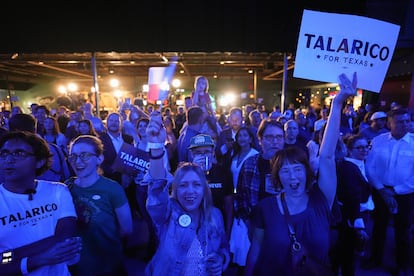

Despite years of political defeats in Texas, Democrats are hoping that the 2026 midterm elections will finally turn a Senate seat in the staunchly red state purple. James Talarico, a rising star within the party, is seen as one of the keys to achieving that new shade. For Republicans, he has become one of the biggest challenges in this closely contested campaign. So much so that a substantial share of the money being spent in the race has gone not toward promoting their controversial Senate candidate, Attorney General Ken Paxton, but toward attacking his opponent.
The polls, however, have not always looked this favorable for Democrats in Texas, even when voters felt the party was on the verge of a breakthrough. The 2018 midterms offer the closest example of a Democratic disappointment. Representative Beto O’Rourke sought to unseat Ted Cruz from his Senate seat. His party believed he could pull it off because polling trends appeared to be moving in his favor. Expectations grew among voters that a blue victory was within reach. In reality, though, the polls never showed O’Rourke ahead of Cruz.
In 2026, the picture looks different. Jerónimo Cortinas, director of the Center for Mexican American and Latino Studies at the University of Houston, believes it will take longer for Texas to turn from red to blue, but he acknowledges that James Talarico’s consistent lead in the polls shows that elections in the state are becoming increasingly competitive.
The polls suggest that if the midterm elections were held today, the Democrat would take the seat from the Republicans. He would win Texas’s Senate seat by a margin of more than three percentage points and give Democrats their first statewide victory in three decades.
But what factors are working in Talarico’s favor now that weren’t present in 2018?
Higher cost of living
In his 2024 presidential campaign, Donald Trump made a promise that helped propel him to victory at a time of widespread frustration over the rising cost of living: that his second administration would improve the U.S. economy and bring inflation under control after annual price growth had approached double digits during part of Joe Biden’s presidency.
But nearly two years into his second term, the cost of living has not eased as he promised, due in large part to U.S. involvement in the war with Iran and a tariff battle with some of the country’s largest trading partners. Trump now serves as the face of the Republican ticket at a time when gasoline prices are nearing or exceeding $4 a gallon, depending on the state, and inflation remains well above the Federal Reserve’s 2% target, standing at 3.4% in August.
Cortinas says Trump told voters they should judge his presidency by whether gas and grocery prices came down, but “none of this has materialized.” According to polls, approval of his administration continues to fall, and these are the issues hurting him the most. As voters effectively judge Trump in the midterm elections, Republican candidates are dragged down with him. Meanwhile, Talarico, a 37-year-old state legislator, is benefiting from that dynamic in Texas.
In 2018, Democrat Beto O’Rourke did not have that economic backdrop working in his favor. Days before the midterm elections, Trump could point to an economy growing at an annual rate of 3.5% in the third quarter and average inflation of 2.4%. At the time, inflation was not a significant liability for Republican campaigns.

A protest vote?
Jerónimo Cortinas argues that by making himself the face of the Republican ticket, Trump “lets voters put a name and a face to the crisis they are experiencing.” The result, he says, is either a protest vote or voters simply choosing to stay home.
For Cortinas, that “protest vote” will be seen especially among independents who voted for Trump or among Republicans who are “more moderate than conservative.” Some of these voters live in the Rio Grande Valley, an area that surprisingly voted for Trump in 2024. It’s an area both Talarico and Paxton have visited repeatedly as part of their campaigns.
But this time, several polls have shown a shift in voting intention — trending toward Democrats — because residents feel Trump’s immigration policies and the detention of migrants who have lived in the United States for years “have gone too far.”
A survey conducted by the American Civil Liberties Union in the region found last week that nearly half of respondents, or someone they knew, had been questioned by federal agents about their immigration status. Most also said that the presence of immigration authorities in their communities had made daily life more difficult rather than making them feel safer.
In interviews with various media outlets, residents of the predominantly Hispanic region said the arrests had hurt local businesses. Many reported losing workers and, as a result, seeing their profits decline.
That is another factor working in Talarico’s favor, says the University of Houston professor.
For example, support among Texas Republicans for Trump’s immigration policies was stronger in 2018. An October 2018 University of Texas/Texas Tribune poll found that 57% of Republican voters in the state believed the president had not gone far enough in enforcing immigration laws.
Questions about Paxton
Talarico, a moderate progressive with strong Christian values, won the Democratic nomination with 53% of the vote. Since then, his campaign has been backed by strong fundraising, bringing in nearly $70 million in individual contributions, according to official records.
Paxton’s campaign, by contrast, has been turbulent. He wrested the nomination from veteran Senator John Cornyn with Trump’s endorsement, but not with the full support of the Republican establishment, which viewed him as a risky choice. His campaign has raised just over $9 million in contributions.
In a desperate attempt to reverse the polling trend, Trump last month turned to his main super PAC, MAGA Inc., directing $10 million toward advertising on behalf of the attorney general. Half of that money was spent on attacks against Talarico, focusing on issues that resonate with Republican voters, particularly religion and gender-related topics.
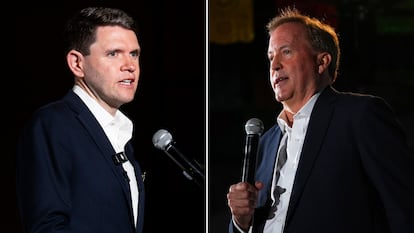
Talarico has been able to present his campaign proposals — creating affordable insurance, lowering the cost of living, adjusting corporate tax payments, among others — and has also used his social media platforms to defend himself against Republican attacks.
Paxton, meanwhile, has had to contend with lingering doubts within his own party stemming from his 2023 impeachment on more than a dozen charges. Although he was ultimately acquitted, the episode continues to weigh on the Republican establishment’s view of his candidacy. And while Trump has publicly defended him and insisted that Paxton must win, polls have shown little evidence that he is gaining support among voters.
“Ken Paxton has a very gray record,” Cortinas says. “He is an extremely polarizing figure inside and outside the Republican Party.”
In 2018, Senator Ted Cruz did not face these problems, Cortinas notes. Although he had disagreements with Trump, the professor says Cruz is seen within the party as a figure with political clout, capable of striking deals even with Democrats.
“To win an election you need the ideal candidate and the ideal electorate. In this case, one could argue that Paxton is not the ideal candidate for this election,” the expert says.
Sign up for our weekly newsletter to get more English-language news coverage from EL PAÍS USA Edition









































