
The great crackdown: The year Trump envisioned a United States without immigrants
The president has closed the border and aims to carry out the largest deportation campaign in history, bringing terror to the streets of the country in the process


In 2026 — the year the United States celebrates the 250th anniversary of its independence — U.S. President Donald Trump is redefining the country, pushing it toward a model very different from the one that has characterized its history. The United States was founded as a country of immigrants, and it has continued to be so, but the Republican president has inaugurated a new era in which immigrants have no place.
In his first year in office, more migrants left the country than arrived. This is the first time this has happened in the past 50 years for which there are records. According to data compiled by Brookings, net migration is between 10,000 and 250,000 people, and this trend is expected to continue through 2026. In addition to mass deportations — official figures indicate 605,000 were deported through December, but these are impossible to verify — Trump has also ordered border closures, the cancellation of refugee and asylum programs, entry bans for citizens of certain countries, and the tightening or suspension of visa requirements.
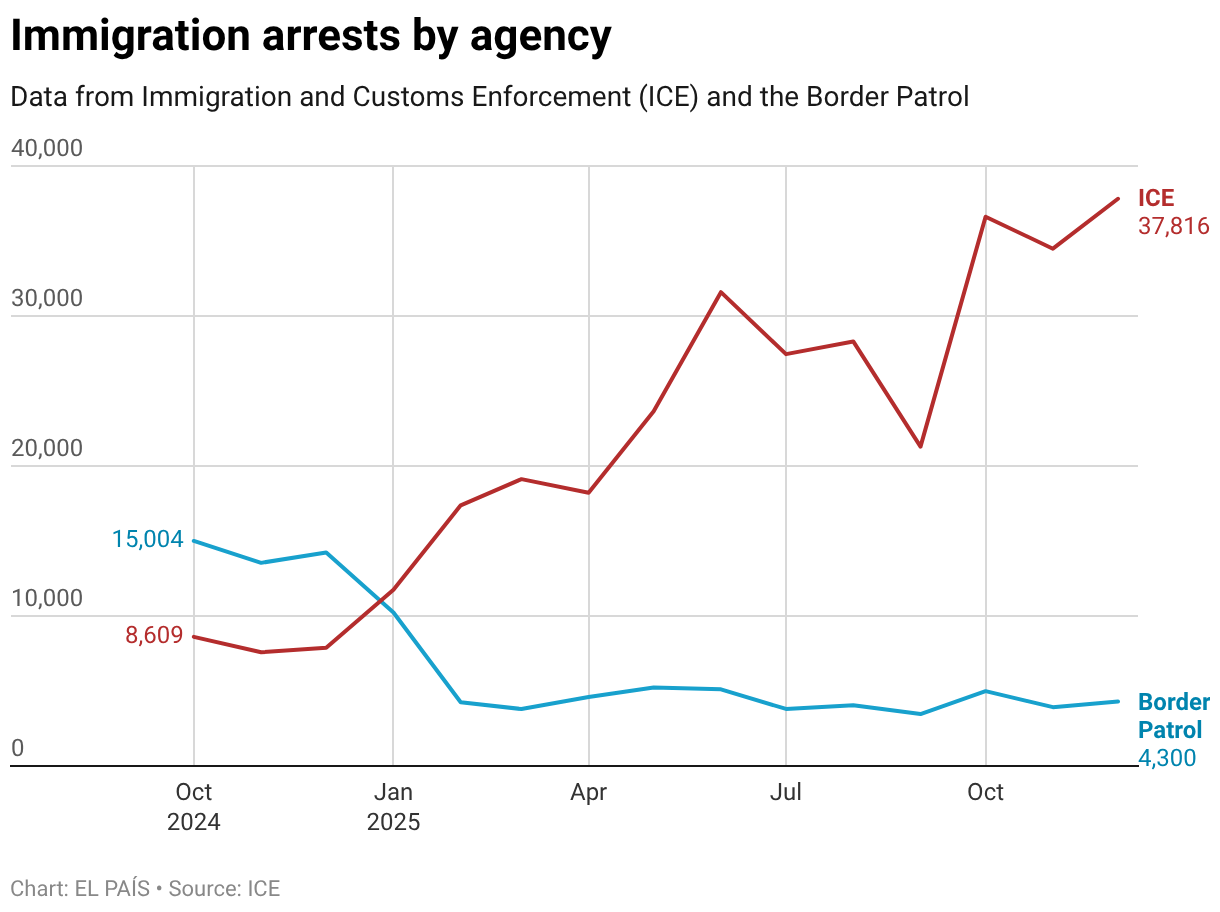
The United States is drifting further from the American Dream. Many immigrants prefer not to come or even to self-deport, despite the fact that doing so means abandoning the lives they had built in a country they believed would welcome them. The anti-immigrant crusade launched from the White House on the first day of Trump’s second term has brought terror to the streets, where agents from Immigration and Customs Enforcement (ICE) and the Border Patrol, hidden behind masks, conduct raids anywhere, leaving behind dramatic images of chases, brutal detentions, home invasions, and family separations.
A high point in the violence used by officials was the killing of 37-year-old U.S. citizen Renée Good on January 7 in Minneapolis, the latest city where Trump has launched his largest anti-immigration operation, deploying 3,000 agents. The death of Good, who was shot by an ICE agent, has sparked widespread protests, which are being harshly suppressed by authorities.
“The Trump administration has redefined immigration, shifting from viewing it as a beneficial phenomenon for the country to seeing it as a threat to our national security and the well-being of American citizens,” Doris Meissner, director of the Migration Policy Institute (MPI), noted last week. “The extent of the use of administrative authority that we are witnessing is unprecedented.”
Immigration was crucial in Trump’s election to a second term. The narrative championed by the Republican Party, which blames immigrants for all of the country’s ills, from crime to unemployment, resonated with voters. A year later, however, many believe his tactics have gone too far. According to an Associated Press poll released last Friday, Trump’s approval rating on immigration has declined among Republicans over the past year, falling from 88% in March to 76%. And among the general population, only 38% of U.S. adults approve of his handling of the issue, while 61% disapprove.
But it wasn’t just a crucial part of the election campaign; it has also remained a central theme of his administration. According to a study by the MPI, Trump has issued approximately 38 executive orders on immigration laws, representing 17% of the 225 total executive orders issued in a year. While it’s difficult to track all executive actions, it’s estimated that he has issued more than 500 in 12 months. By comparison, 472 executive actions related to immigration were issued during the four years of Trump’s first term.
Trump has two objectives. One is to end what he calls an “invasion” at the border, and the other is to carry out the largest deportation in history, with the stated goal of one million expulsions per year. However, even the official figures, which are higher than those reported by several independent experts and observers, fall far short of this target, causing the president’s frustration.
For this reason, in recent months he has replaced the heads of immigration agencies and elevated more aggressive figures, such as Gregory Bovino. Until recently, Bovino was head of the Customs and Border Protection (CBP) office in the El Centro district of California. He has directed immigration operations in Chicago, Los Angeles, Charlotte, New Orleans, and now Minneapolis, encouraging agents to use violent tactics against protesters, including tear gas and pepper bullets.

The largest anti-immigration operations have taken place in cities controlled by Democrats, many of which, under local laws, do not cooperate with immigration authorities. In contrast, the government has promoted cooperation between Republican local and state governments and ICE through agreements known as 287(g), which have multiplied exponentially across the country. Under these agreements, local police and sheriffs have become involved in detaining migrants and share immigration information about those arrested for other reasons with ICE to determine if they are subject to deportation.
No criminal records
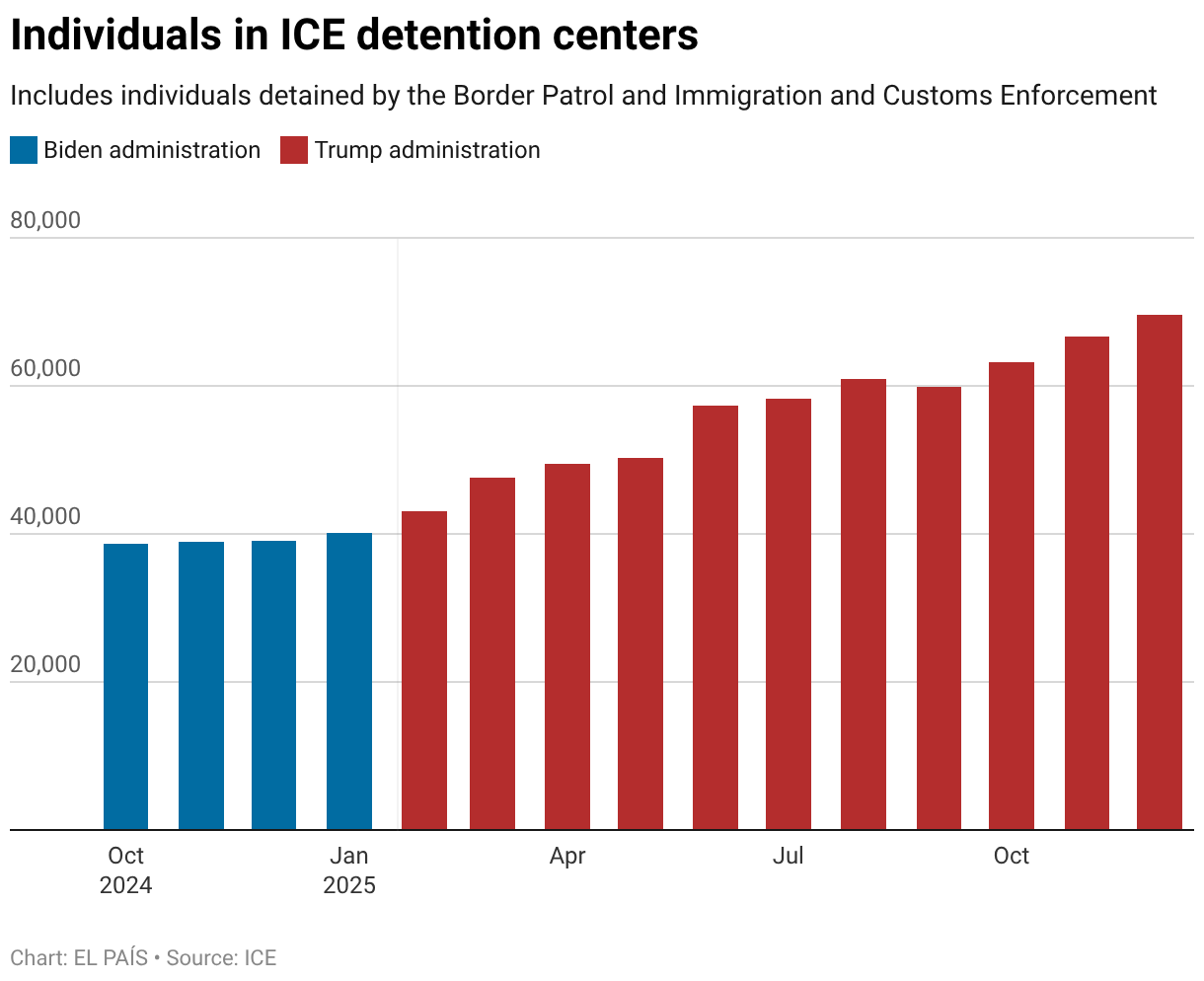
The Department of Homeland Security, headed by Kristi Noem, maintains that immigration agents detain “the worst of the worst” for deportation, but statistics show that over 70% of those detained have no criminal record. Meanwhile, ICE detention centers hold around 70,000 people who have committed no crime other than being undocumented. Reports of inhumane conditions — without access to doctors, nutritious food, or basic hygiene — are constant.

Migrant advocates also report daily violations of detainees’ rights: they are denied communication with their families and access to legal counsel. One of the administration’s tools for increasing deportations is expedited removal, without allowing detainees access to lawyers or the opportunity to present their case before a judge.
Last March, Trump invoked the Alien Enemies Act of 1798, which has only been used in wartime, to send more than 200 Venezuelans and Salvadorans to El Salvador without trial. The government accused them without evidence of belonging to the Tren de Aragua and MS-13 criminal gangs, and they were imprisoned in the Terrorism Confinement Center (CECOT), a prison notorious for human rights abuses. A court ruling later suspended the application of the law, but the nearly 250 deportees endured months of torture in the Central American country, according to accounts they gave after they were finally transferred to Venezuela in July.
The legal battle over the use of the Foreign Enemies Act adds to the growing list of measures adopted by the administration that are being challenged in court, as the judiciary is inundated with lawsuits over the government’s controversial immigration decisions. One of the most contentious is the proposed elimination of birthright citizenship — a right enshrined in the 14th Amendment to the Constitution — that the president seeks to suspend.

One thing Trump has succeeded in is gaining control of the border. Monthly encounters with Border Patrol agents between February and November 2025 dropped to 700. A year earlier, there were up to 88,000 crossings per month, with a peak of 250,000 in December 2023. Trump used the chaos caused by the massive arrival of migrants during Joe Biden’s presidency to accuse him of pursuing an “open-door” policy. Many of the Republican’s initiatives have aimed to cancel the programs Biden used to admit migrants for humanitarian reasons.
TPS and humanitarian parole
The Trump administration has eliminated programs like Temporary Protected Status (TPS) and humanitarian parole, created to protect citizens of countries experiencing crises such as armed conflict or natural disasters, leaving more than a million people who previously lived and worked legally vulnerable to deportation. The cancellation of these programs affects migrants from at least 13 countries, including Venezuela, Haiti, Nicaragua, Cuba, South Sudan, and Afghanistan. The reasons for these actions rarely reflect improvements in conditions in those countries, where many of the deported continue to face persecution and violence.
“Every time a major event occurs, they add a new ban,” says David Bier, director of migration studies at the Cato Institute. “So, every time an Afghan commits a crime, Afghans are banned from entering the country, and not just Afghans. I fear this is setting a precedent for the future, as there will always be some negative incident from some country, committed by some unbalanced individual, and that will serve as justification for imposing more and more restrictions.” Trump banned Afghans from entering the country after a migrant from that country killed a National Guard member and wounded another in an attack last November on Washington, D.C.
The type of immigration Trump wants in the country is that of the wealthy or white. That is why one of his latest measures has been to prohibit entry for citizens of 39 countries, mostly in South America, Africa, and Asia. In addition, he has imposed bonds of up to $15,000 for citizens of 38 countries to obtain a visa and has suspended immigrant visas for 75 countries.
In exchange, he grants refugee status exclusively to Afrikaners from South Africa and offers permanent residency in record time to foreigners who invest $1 million. This is Trump’s so-called Gold Card visa, which precedes the platinum visa. Beneficiaries of the platinum visa can spend up to 270 days in the United States without paying U.S. taxes on income earned abroad, in exchange for a $5-million investment. A new type of migrant for the new era of the United States.
Credit:
Graphics by Patricia San Juan.
Sign up for our weekly newsletter to get more English-language news coverage from EL PAÍS USA Edition









































