
Trump government uses ICE shooting in Minneapolis to target a familiar foe: The press
The Department of Homeland Security accuses the media of lying in its coverage of the incident, while journalist associations warn of an increase in assaults on reporters by federal agents
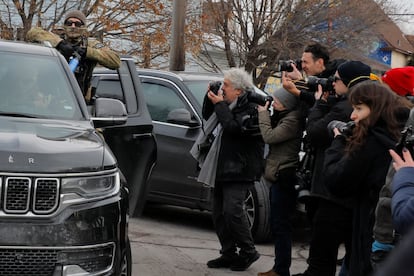

As soon as the first videos of Renee Good’s death began spreading uncontrollably on social media, Donald Trump’s government was determined to dominate the narrative. It was no easy task — the footage showing an immigration agent shooting a woman in a car on a Minneapolis street spoke for itself. Even so, just a couple of hours after three shots ended Good’s life, Homeland Security Secretary Kristi Noem, wearing a cowboy hat at a press conference from the Texas–Mexico border, called the actions leading up to the shooting “an act of domestic terrorism.” In the days that followed, nobody in the administration has veered from this message.
But they have adapted and expanded it in response to the work done by the news media they consider their enemies — outlets that have analyzed the evidence and presented the incident as a killing, not an act of self-defense. For the government, it is no longer just a matter of putting forward the idea that the victim was actually the agent who pulled the trigger — while the government initially never identified Good, Noem claimed the officer who shot her had been dragged by a vehicle in June— but of accusing anyone who says otherwise of lying, of spreading “fake news.”
Vice President J. D. Vance deployed this line on Friday morning. Speaking angrily at a White House press briefing, Vance described the work of journalists who covered Good’s death and its aftermath as “an absolute disgrace.” “You guys are meant to report the truth. How have you let yourself become agents of propaganda, of a radical fringe that’s making it harder for us to enforce our laws?” he said, addressing the press present.
“If people want to have a serious conversation about what she was really doing, that’s reasonable,” Vance said. “What’s not reasonable is plastering across the media that this was an innocent woman and that the ICE agent committed murder,” he added, overlooking rigorous media analysis. And in classic Trump-style hyperbole, he continued: “The reporting on this has been one of the biggest scandals I’ve ever seen in the media. I’ve never seen a case so misrepresented and so misreported.”
On its social media accounts, the Department of Homeland Security (DHS), which oversees ICE, has also been busy pointing at and openly answering the press. “The media continue to fail the American people in their coverage of the events in Minneapolis. […] The evidence speaks for itself. Legacy media have lost the trust of the people,” reads a post on the official DHS account on X, accompanied by a recording that until then had not been public, allegedly showing the entire incident from a house vantage point rather than from the street like earlier videos, including the one shot by the agent.
Defend the Homeland. Protect the American way of life.
— Homeland Security (@DHSgov) January 11, 2026
The nonstop lies and smears from the FAKE NEWS are meant to tear down our brave men and women who protect our homeland every day. pic.twitter.com/UEkruVc4pf
In another video posted on Sunday, the DHS raised the stakes. Speaking to the camera, DHS Deputy Assistant Secretary Lauren Biss introduced herself and said: “I am here to set the record straight on false reporting surrounding our brave law enforcement.”
The roughly three-minute recording goes on to attack outlets such as The Washington Post and HuffPost for publishing “garbage” about the events — for example, that Good was not given immediate medical attention or that the car never hit the agent who fired. However, both of those points can be corroborated in witness videos.
The DHS post continues and moves on to the shooting in Portland that happened on Thursday. It accuses the media of portraying the two injured people there as innocent, when they are allegedly linked to the Tren de Aragua. “How does CNN choose to portray these suspected gang members? ‘Innocent married couple shot by border patrol.’ Give me a break!” Biss says — although in the screenshots shown of the CNN website, the word “innocent” does not actually appear. And while the description of the couple as affiliated with the Tren de Aragua was initially attributed to DHS, once local authorities corroborated the information, it was accepted as valid.
The enhanced and revitalized accusations against the press by the government —and by Trumpism more broadly, which amplifies them — include the argument that it’s the media’s fault, and the fault of opposition politicians, that there has been a dramatic increase in assaults on law enforcement officers and police. DHS claims agents have seen an increase of more than 1,000%. Independent investigations by Los Angeles Times and NPR, however, have found that the figure is closer to 25%.
At the same time, the Freedom of the Press Foundation, which monitors and tallies arrests and attacks on journalists, found that in 2025 there were 174 reported aggressions against the press, mainly by law enforcement at protests against the government’s immigration policies. In 2024, the figure was 87. The foundation says it only reports “incidents that can be verified through first-person testimony or cross-checked with multiple journalistic sources.” Part of that increase, they note, is simply because there were more protests.
Currently, there is a temporary federal judge’s ban on DHS agents dispersing anyone they know to be a journalist without probable cause to believe they committed a crime other than failing to obey an officer’s order. There is, however, no limitation on the rhetorical attacks they can level at the media — and over the past week, those attacks have increased dramatically.
Sign up for our weekly newsletter to get more English-language news coverage from EL PAÍS USA Edition









































