
Being ‘American’
Today, the United States is a fascist country; there’s no other way to describe it. But there are Americans who resist and create havens of beauty and culture
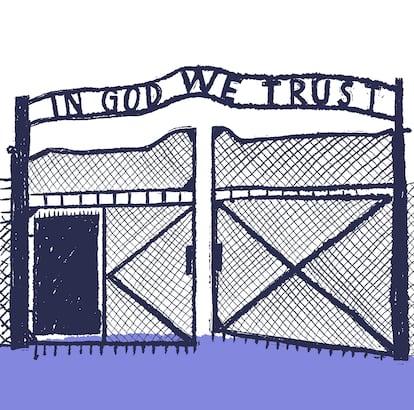
When, 40 years ago, in December 1985, I first set foot in New York, I wasn’t aware that I had just embarked on a one-way journey. Without intending to, the center of gravity of my life had shifted forever to the other side of the Atlantic, which I have since crossed some three hundred times. Two-thirds of my life have been spent in New York, a city that has indelibly marked me: here I earned a doctorate in literature, won a professorship at an elite college, and was publicly born as a writer with a novel that won the Nadal Prize in 2006, Call Me Brooklyn. That same year, I was appointed director of the Cervantes Institute in the city, a position I held until 2011. Since arriving, I have closely observed American culture through a dual lens: observing the state of the Spanish language and the current state of U.S. literature. Decade after decade I have been reporting on both issues through the pages of this newspaper.
Regarding literature, I’ve had in-depth conversations with Joan Didion, Janet Malcolm, Toni Morrison, Anne Carson, Siri Hustvedt, Norman Mailer, Philip Roth, John Updike, Paul Auster, David Foster Wallace, Don DeLillo, Salman Rushdie, and Richard Ford, among other prominent figures. I later had to write obituaries for many of them. If those conversations reveal anything, it’s that the contradictions that have always violently shaken this country are enormous. Since I arrived, seven presidents have occupied the White House: Ronald Reagan, George H.W. Bush, Bill Clinton, George W. Bush, Barack Obama, Joe Biden, and Donald Trump. The mere act of writing the last name has a paralyzing effect, given the atrocities his administration perpetrates incessantly.
As for Spanish, the attack on our language is head-on. Simply speaking Spanish makes you a suspect and a potential target for deportation, though that’s not the end of the story. Spanish arrived in what is now North American territory before English, and no one will ever be able to eradicate it; on the contrary, it will only grow stronger. It’s worth noting that Trump is the embodiment of a trend that has always been present in American history; one need only recall the Ku Klux Klan or the Joseph McCarthy era.
Immediately after Trump took office for the second time, many people in my circle who had been legally residing in this country for decades — mostly artists, writers, and filmmakers, many of them Spanish — decided to become U.S. citizens. One major reason was insecurity, but it was not the only one. At a deeper level, it was the precariousness of democracy in a country founded on the inviolability of democratic values. Norman Mailer was the first to make me aware of the danger to democracy itself when I interviewed him during the Gulf War in 2003. Since then, the situation has only deteriorated to the point we are at today.
The United States today is a fascist country. There is no other way to characterize what we are experiencing. It’s worth clarifying again. Fascism has not taken over the United States monolithically. In many places, New York being one of them, there is a profound sense of repulsion toward what is happening, which has given rise to resistance movements. My two most recent contributions to this newspaper deal with Thomas Pynchon’s latest book and Mike Wallace’s account of New York’s history in the 1930s and 1940s. The common thread between the two is resistance to fascism. That is also what underlies the decision so many of us have recently made, invoking an eloquent (if not entirely accurate) title from Gertrude Stein: to become “Americans.”
Becoming one isn’t exactly an easy process. In its final stage, after completing all the formalities, I had to attend an interview at the grim building located at 26 Federal Plaza, near Broadway, in Lower Manhattan. As you approach, the first thing that catches your eye is a sign with the ominous initials ICE — Immigration and Customs Enforcement. At dawn, people form endless lines, exposed to the wind and cold, unsure of what fate awaits them when authorities review their cases.
A chilling article published not long ago in EL PAÍS recounted atrocities perpetrated by ICE agents against immigrants, whom they handcuffed after throwing them to the ground in hallways or elevators. I didn’t see any of that, although I know it’s true because it’s widely documented. My experience at Federal Plaza was completely different from what I expected. What I saw highlighted the enormous dysfunction we are experiencing in this country today. In my experience, those in charge of assisting immigrants were extraordinarily friendly and eager to help.
While I waited, I observed the most diverse variety of people imaginable, men and women of all races, languages, and social statuses. Something that particularly struck me was the considerable proportion of Hispanics in the line and the fact that the officials spoke Spanish to communicate with them. The tone of the conversations underscored their willingness to help. The reason most frequently mentioned was the precarious situation of non-citizens and the difficulties that those aspiring to become citizens will face in the near future, once even stricter measures than those currently in place take effect.
The interview I had reinforced my impression of the officials’ solidarity. The last question that the person reviewing my case asked me, as part of the so-called civic exam, was: “What is the name of the president of the United States?” When he heard my answer, he smiled enigmatically. He didn’t say so, but it was clear that he felt a deep antipathy for the individual who was the subject of his question.
A few days ago, the solemn ceremony took place in which over 150 people were granted citizenship. It wasn’t in Federal Plaza, but on Pearl Street, the street where Herman Melville was born and lived for many years. The ceremony was presided over by a judge of Latin American origin who delivered a speech denouncing the hostility of Trump’s immigration policy. “This is a nation that, since its inception, has been built on the shoulders of immigrants,” she declared passionately, recounting the story of her parents, who arrived at Ellis Island fleeing poverty without speaking a word of English, and noting that despite their humble origins, she had become a federal judge.
When I told my friends that I had become a naturalized U.S. citizen (without losing my Spanish citizenship), their reaction was always polite, but with a great deal of reservation. They identified the United States with the image projected by the current administration. But the United States is not Trump, just as Germany wasn’t Hitler, Italy wasn’t Mussolini, and Spain wasn’t Franco — execrable figures whom history has erased, as it will with Trump. Only a few of those who congratulated me were able to discern this.
The United States is Martin Luther King, Angela Davis, Rosa Parks, James Baldwin, and Zohran Mamdani, the mayor of my city, a socialist and Muslim immigrant born in Uganda, who became a citizen eight years ago. To be able to vote for people like him and support him in his fight against fascism, it’s important to take the same step.
Sign up for our weekly newsletter to get more English-language news coverage from EL PAÍS USA Edition









































