
Shootings of drivers: How ICE sows terror in the United States
As part of a growing pattern of violence, immigration agents have shot more than a dozen people in the past year, including the woman killed in Minneapolis this week
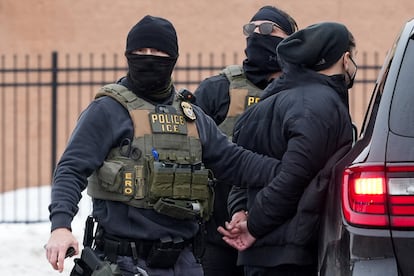

They are masked, with only their eyes visible, often dressed in civilian clothes, though they wear bulletproof vests and carry weapons. They travel in unmarked cars, but when they get out of them, almost no one doubts who they are: they are agents of Immigration and Customs Enforcement, or ICE, an acronym that has become synonymous with the terror that Donald Trump has unleashed in the United States over the past year as part of an unprecedented persecution of migrants.
As soon as they spot the officers arriving, activists, volunteers and neighbors honk their horns and whistles to warn of the start of an immigration raid. Some record and confront the agents, demanding they leave their neighborhood. Others block their path with their vehicles. It’s a scene that has been repeated in different cities across the country where the U.S. government has launched large-scale operations to detain undocumented immigrants: Los Angeles, Chicago, Minneapolis… In the latter city, however, one of these confrontations resulted in the death of a woman on Wednesday.
Her name was Renee Nicole Good. The 37-year-old U.S. citizen, a poet and a mother of three, was shot and killed by an ICE agent in a neighborhood south of downtown Minneapolis. According to videos recorded by witnesses at the time of the shooting, Good was inside her SUV, parked in the middle of a street, apparently blocking the passage of several ICE vehicles, when two agents approached her and ordered her to get out of her car, even attempting to open the driver’s door.
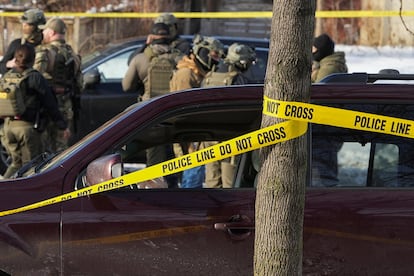
A third officer filmed the scene and circled the SUV, positioning himself in front of it. After the officer failed to open the vehicle’s door, Good backed up slightly before turning right, seemingly attempting to flee in the opposite direction from the officers. At that moment, the officer who had been filming drew his weapon and fired at Good through the windshield and then a couple more times through the window. The vehicle accelerated away from the officers before crashing a few seconds later.
The shooting — which the government has justified by insisting that the agent acted in self-defense after Good tried to run him over — and the death of a woman described as a “loving, forgiving and affectionate” mother and “an incredible human being,” has shocked a society terrified by an immigration agency emboldened by a president who intends to carry out the largest deportation campaign in U.S. history.
Although Good’s case has shaken the nation and sparked protests that have led authorities to call for calm and Minnesota Governor Tim Walz to activate the state’s National Guard as a precaution in the event of unrest, this was not the first time an agent fired a weapon during an immigration operation since Trump’s return to power. Nor was it the last: just over 24 hours after Good’s death, officers from another immigration agency, the Border Patrol, shot two people in Portland, Oregon.
One pattern: killed while driving
Since Trump returned to the White House nearly a year ago, immigration agents have shot or pointed a gun at someone during an immigration enforcement operation almost 30 times, according to a count by The Trace, an independent, nonprofit news outlet that covers gun violence in the U.S. More than a dozen of those incidents were shootings, and “at least four people have died,” The Trace reports.
A clear pattern has emerged in these shootings. As in Good’s case and the one in Portland on Thursday night, the vast majority of people were inside their vehicles when they were shot by federal agents. In response to the incidents, authorities have claimed that the agents fired in self-defense, fearing they would be run over—a claim the Trump administration has reiterated following Good’s death.
“the woman driving the car was very disorderly, obstructing and resisting, who then violently, willfully, and viciously ran over the ICE Officer, who seems to have shot her in self-defense,” Trump himself claimed. This is despite videos and images from the moment of the shooting showing that Good did not run over any officer.
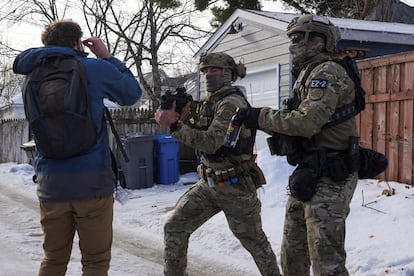
Before the incident in Minneapolis, two of the most high-profile cases took place in Chicago, the scene of another large deployment of immigration agents, which began in September and lasted several weeks. That same month, Silverio Villegas-González, a Mexican migrant, was detained by agents while driving on the outskirts of Chicago, in a predominantly Latino neighborhood called Franklin Park. According to the official version, the man resisted arrest, attempted to flee in his car, and dragged an ICE officer before being shot and killed.
In October, also as part of what the government called “Operation Midway Blitz,” during which more than 1,600 people were arrested in Illinois’s largest city, a woman named Marimar Martinez was driving through another Latino neighborhood in Chicago, Brighton Park, warning residents that a raid was coming. She was shot five times with an assault rifle for doing so. Martinez survived and was charged with assaulting the officers. Department of Homeland Security officials labeled her a “domestic terrorist,” as they have done with Good.
In Martinez’s case, however, the officer who shot her boasted about it in a text message exchange that was later used in court — he wrote he had “fired 5 rounds and she had 7 holes. Put that in your book boys” — and prosecutors dropped the charges they had filed against her.
In response to the growing ICE presence in U.S. cities, which has led to an increase in confrontations between civilians and agents, thousands of citizens have voluntarily received training on how to react to agents. This is why residents of the neighborhood where Good was killed carried whistles to warn of the start of a raid, a tool that has been used in other cities. On the very day the mother of three was killed, one of these training sessions took place. More than 500 Minnesotans attended.
The biggest budget in history
Under Trump, ICE has become the primary instrument of the Republican president’s anti-immigrant offensive. Thousands of its agents have been deployed in various cities governed by Democrats to detain as many migrants as possible. They lie in wait outside immigration courts to arrest migrants attending appointments that until recently were routine. They patrol predominantly Latino neighborhoods and detain people based on their accent or physical appearance.
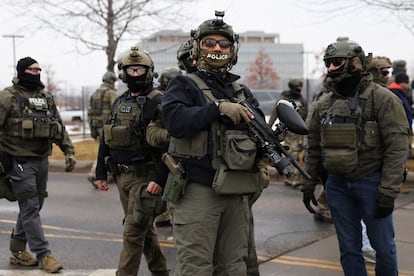
Since last summer, agents have been arriving in waves across cities, arresting hundreds or even thousands of people wherever they go. They first descended on Los Angeles, then Washington D.C., Portland, Oregon, Chicago… until reaching Minneapolis, the latest focus of their operations. Last Monday, it was revealed that the Department of Homeland Security, which oversees ICE, would be sending 2,000 agents to the Twin Cities area for what ICE’s acting director, Todd Lyons, called “the largest immigration operation ever conducted.”
Now, following Good’s death, the government plans to send more than 100 Customs and Border Protection (CBP) agents to the two cities to support ICE’s efforts in Minnesota, The New York Times reported on Thursday.
The rise of ICE under Trump has been meteoric, mirroring Trump’s demands to streamline the U.S. deportation machine. The Immigration Service now boasts the largest budget for any agency in the country’s history, exceeding the funding allocated to the FBI, the DEA, and other federal entities, and surpassing the annual defense budgets of countries like Italy or Brazil. This is thanks to the Republican’s tax reform passed last July, under which ICE received over $100 billion to dramatically expand its operations and capabilities through 2029.
Sign up for our weekly newsletter to get more English-language news coverage from EL PAÍS USA Edition









































