
United States trains to face off with ICE: ‘We’ve gone from fear to action’
With whistle codes, workshops and rapid-response groups, neighbors are training to combat the Trump administration’s assault on immigrants


Lily Rodríguez approaches a woman selling elotes outside a subway station in Queens. She buys one, but what she’s truly looking for is to earn the vendor’s trust, and find a way to offer her a whistle. Rodríguez was accompanied by other volunteers who were similarly engaged in passing out whistles to every passer-by, distributing more than 200 of the instruments meant to make noise on the New York City streets. The United States is a country learning how to protect itself against the masked agents of Immigration and Customs Enforcement (ICE), to intimidate them through noisemakers, cameras, and confrontations with neighbors.
In January, Donald Trump was preparing to return to the White House and 39-year-old Rodríguez, the daughter of migrants, felt like she had to find a way to channel her anger. She came across an ICE Watch workshop, part of a movement that has recently taken on new force and looks to keep immigrant communities safe against raids and detentions by federal agents. Today, Rodríguez is a local volunteer for the organization, visiting small businesses to show owners how to deal with the presence of agents, and passing out whistles to alert undocumented individuals.
“ICE is getting stronger and more aggressive every day,” she says. “Being in community and getting to know the people around us is more important than ever. Real protection is born out of everyday interaction, of talking to the woman on the corner who sells tamales, the young man at the bodega, the barbers in the Dominican barbershop. Knowing the people who make up the fabric of our streets.”
On the day her team heads out to distribute whistles in the Queens neighborhood, they are also passing out instructions on how to use them: three short blasts to communicate that there are agents nearby, a long and continuous one to indicate that someone is being detained.
In cities throughout the country, businesses hand out free whistles, and packages of them are sometimes hung from utility poles. They’ve been so effective that U.S. authorities have acknowledged that their noise presents a challenge to their work. Even so, Tricia McLaughlin, assistant secretary of the Department of Homeland Security, stated that her “officers are highly trained” and “not afraid of loud noises and whistles.”
The warning whistle now forms part of the soundtrack of the cities where ICE showed up most fiercely this year. First, federal agents and troops were deployed in Los Angeles, then they descended on Washington D.C. Later, they disembarked in Chicago and Portland, via the National Guard. Now, they have set up shop in New Orleans with Operation Catahoula Crunch, and have begun to have a more marked presence in New York. All are major cities, all lean Democrat, and little by little, their residents have had to train themselves to confront the violence of ICE arrests and the presence of Border Patrol, whose officers have gotten more and more aggressive faced with this community response.
“Yes, it’s clear that ICE is acting however it wants and when it wants. But the people still have the power,” says Rodríguez. “The government tries to criminalize this kind of work, but it is our right to know our rights. It’s our right to record. It’s our right to ask questions and demand responsibility from officers.”
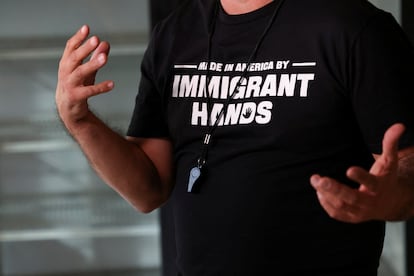
Rapid response
Artemio Arreola, director of community relations of the Illinois Coalition for Immigrants and Refugee Rights, says that activist and neighbor groups have spent the last year learning how to organize and defend themselves. They have been pioneers in coming together to confront power. The first step, he says, was to educate people about their rights: to remain silent, to not show identification, to not sign certain documents, and to seek help from lawyers and organizations. “Schools, hospitals and churches have been affected, and this is how we are defending ourselves,” he says.
After federal agents were deployed in Illinois with military uniforms and rifles, spraying teargas, descending from helicopters, and even shooting people — leaving one individual dead — ICIRR began to hold a series of workshops in different languages. Up to 900 people connected online to learn about not only how they can respond to such operations, but also how to then navigate the country’s legal system.
In these times of detentions and arrests, rapid-response groups have saved and accompanied many migrants. In Chicago, some 30,000 people were trained on how to record and document ICE detentions, compiling details like the time and place of detentions, size of raids, the kind of uniform worn by agents, and license plates. “This is how we have been able to call out the violation of many people’s civil rights, particularly when they were arrested without being told their rights, or without a judge’s order. When we can document, we have proof,” says Arreola.
Another kind of training held by the group is “Eyes on ICE”, which is focused on empowering volunteers to verify where agents are located and if they are carrying out an arrest. A telephone line open 16 hours a day receives hundreds of reports and complaints, which are then channeled to Signal groups whose members activate to provide an on-the-ground response.
Some 100 of the ICIRR’s member organizations have been training their volunteers, the majority of whom are U.S. citizens — which reduces their risk in participating in the actions. “The idea is to protect the most vulnerable,” says Arreola. “That’s not to say that citizens have nothing to lose. They can also mark your criminal record, send you to jail, serve you with federal charges.” Some U.S. citizens who have been detained while participating in such operations.
At 60 years old, José Luis Gutiérrez recalls the day on 59th Street, in West Chicago, when he was alerted that ICE agents were besieging a group of individuals who had been traveling in a gardener’s truck. Gutiérrez is a member of an ICIRR rapid-response group, and he soon arrived on the scene. “We began to record and that distracted the agents, they don’t like it when you record them,” he says. One of the undocumented men was able to run away, escaping arrest.
But sometimes, reality comes at you too fast. On another occasion, Gutiérrez was monitoring a gas station and saw a man get out of his car, only for ICE to arrive. There was little he could do. “I didn’t have time to record, we only got the empty truck,” he remembers. He began to look for information on the detained person’s identity, and was able to alert his family that he had been arrested.
Self-defense is contagious
North of San Francisco in Marin county, Steve Friedman, a 66-year-old U.S. citizen and schoolteacher, is also part of a rapid-response network. “We receive text messages from people who suspect an ICE action is taking place, and we can respond along the way, if we’re able to get there,” he says. “I signed up because what is happening with Trump is bad. I am Jewish and lost my family in the Holocaust, so I can’t ignore this massive injustice. I also have friends who are being directly affected, so I’m going to defend them.”
Friedman’s state was among the first to implement strategies to support migrant communities, and share information on how to do so with others. That was how ICIRR members learned in Chicago. “We talk with similar organizations, so they can help us with how they did it, how they solved it, what to do and what not to do, and we are doing the same with others,” says Arreola.
Community self-defense can be contagious. In New York, organizations are also getting on the defense. Though the city’s mayor-elect, Zohran Mamdani, and Trump discussed the topic of immigration in their recent meeting, the president has not ruled out the possibility of sending troops to the city. “Right now things are escalating, we think that they will become similar to Chicago, and that’s why you’re seeing campaigns among these organizations, because the community is asking for it,” said an anonymous member of the community group Mixteca who has lived for 12 years in the Sunset Park, Brooklyn area.
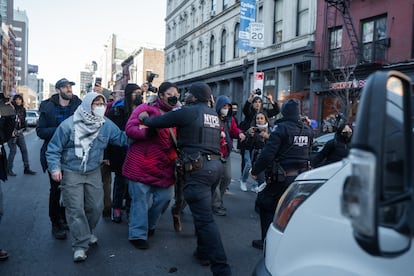
According to this individual, the group began with workshops to raise awareness on immigrant rights, but people wanted more. “We realized that these workshops were no longer useful to the community. They were saying, ‘Yes, but these rights are being violated, they don’t respect our community,’” says the activist.
Even as federal cuts have affected the financing of many advocacy groups, resulting in the loss of staff and fear of losing further funding by taking on ICE, such actions are echoing across the country, neighborhood to neighborhood. People in Sunset Park are now learning from the experience of rapid-response groups in Jackson Heights.
In other parts of the nation, community actions work differently, according to María Asunción Bilbao, a campaign coordinator in Florida for the migrant defense group American Friends Service Committee, which provides weekly assistance outside ICE offices in Miramar, offering accompaniment to migrants and their families. Though cities like Miami have yet to see large, sustained raids like those that have taken place elsewhere, measures like the 287(g) program allows ICE to collaborate with local law enforcement, as well as authorized arrests through highway patrol. In such cases, Bilbao says, the group operates a volunteer-run phone line designed to help in the case of being stopped while driving.
Little by little, cities are forming a national network of support. Last month, the first national ICE Watch virtual training session was attended by more than 500 people. There are people getting trained in places like Memphis and New Orleans, which are now dealing with the presence of hundreds of immigration officers. The representative from Mixteca has seen that more and more, neighbors want to be a part of the response: “I think that the moment has arrived in which we’ve gone from fear to action. People want to be active participants.”
Translation by Caitlin Donohue.
Sign up for our weekly newsletter to get more English-language news coverage from EL PAÍS USA Edition









































