
Activists use GTA V and Fortnite to educate gamers on how to respond to an ICE raid
The New Save Collective simulates scenarios in which video game users must confront immigration agents
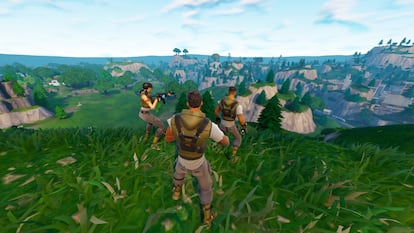

Some people have found a safe space in two video games known for their violence: Fortnite and Grand Theft Auto (GTA) V. New Save Collective, a group of gamers, is using the former to recreate raids like those carried out by Immigration and Customs Enforcement (ICE) agents as a way to educate people about their rights when confronted by officers in the real world and, above all, to create a safe community of virtual gamers.
“Right now, there are a lot of people who are isolated and scared,” says the user known as PitaBreadFace, who has asked to remain anonymous for security reasons and who is responsible for organizing these events, via video call. “I’ve been organizing different groups of gamers for 11 years.” In Grand Theft Auto V, the information and community spaces are run by the Immigrants Belong Collective and SteveTheGamer.
In Fortnite, the event took place on November 21. Several users took on different roles: ICE agents, lawyers for those apprehended, and some were simply witnesses. The agents are played by members of the collective. The mission is to detain or interrogate “vulnerable” civilians, a term often used in real-life ICE raids.
PitaBreadFace says that the New Save Collective was formed with the idea of building deeper relationships between online players. “We thought it would be a good idea [to simulate raids] because we started to see a lot of anti-immigrant sentiment in the community. Basically, we saw that ICE and the Department of Homeland Security were using images from Pokémon or Halo to try to advertise gamers to be more complicit with ICE.”
It was because of this that they decided to do something that would be both fun and informative. “We definitely wanted it to be fun, because it’s a game. We wanted people to have a good experience, but we also wanted to contribute more tangible things that could be applied to real life,” says the organizer. He adds that they are planning to hold another event during the second week of December: the information will be shared on their social media accounts.
The independent news outlet 404Media shared some videos taken during the event. In one of them, the “agents” ask a “civilian” for official identification; other people approach to see what is happening while the supposed agents ask them to leave because, he says, it is none of their business, but they defend themselves: “We have the right to record,” they say. The pressure from the crowd causes the officers to quickly leave the scene. “The scenario does not compare to what is experienced on a daily basis, but it helps people become familiar with the circumstances,” PitaBreadFace told 404Media at the time.
The organizer told this newspaper that more attention should be paid to the video game industry, since it is bigger than both music and film. Between 2018 and 2021, there was an increase of 500 million online gamers worldwide; by 2023, it grew by another 400 million. And in 2024, it generated more than $184 billion. “Most gamers don’t know they are gamers,” he says. The idea people have is of a gamer is a white heterosexual man sitting alone in front of the television. “But the industry is changing,” he says.
At first glance, the collective’s mission may seem to focus on ICE and online “drills.” But for PitaBreadFace, it’s a deeper issue. “There are what we call ‘opposition forces,’ which would be the right wing, sometimes the military. What they do is create a strong narrative that gamers are people with a certain identity; like this activity is only for men, for example,” he says.
PitaBreadFace argues that this is false and that what they want to do is “fight” against these opposition forces. “We must build equally large institutions within the gaming community. They have been louder, but they are not the majority.”
Sign up for our weekly newsletter to get more English-language news coverage from EL PAÍS USA Edition









































