
The silent witness to hundreds of detentions in a Florida immigration court
William Botsch has been attending Miami courthouses weekly since May, where he has witnessed and documented the systematic arrests of migrants seized after attending appointments that were routine prior to Trump 2.0
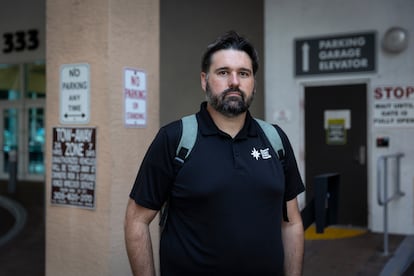

At 7 a.m., when many people are driving to work or dropping off their children at school, William Botsch is already on the train, on his way from his home in Broward County to the immigration court in downtown Miami, a little more than an hour away. The commute has been part of his routine for months. After getting off at the Government Center, he walks through the noise of construction works and car horns to the glass building by the river, through the metal detectors before taking the elevator to the sixth floor.
He has not been summoned to appear in court; he is going as an observer for the pro-immigrant organization American Friends Service Committee. He has been doing this since May, when the first reports of immigrants being seized by ICE agents in immigration courts surfaced, including violent scenes and families being separated by masked officers.
In a waiting room where several grave-looking individuals are holding folders filled with papers, the hearing calendar is taped to the wall. Botsch examines it carefully, scanning lists of names and nationalities. Then he chooses, enters one of the courtrooms quietly and sits in the back row.
Over the past few months, he has witnessed how the immigration court has become a macabre machine perfectly orchestrated to trap people who have applied for asylum and attend their hearings in good faith. Their cases are dismissed at the request of government prosecutors, and as they leave the courtroom, Immigration and Customs Enforcement (ICE) agents are waiting to arrest them in the hallway.
Botsch, 43, was born in Cayucos, a small coastal town in San Luis Obispo County, California. He moved to Florida in 2019, when his wife got a job as a public school teacher. Botsch carries out his work in the courts and in support activities for immigrants almost entirely on a voluntary basis.
His presence in court and his subsequent encounters with the families of detainees offers a unique look at a newly developed chaotic system of law enforcement that plays out behind closed doors; where judges act under pressure from the Trump administration to dismiss the cases being presented to them.
This is clearly reflected in the preliminary hearings, which are collective and fast-moving. There are about 20 people. For most, this is the first time they have appeared in a U.S. court, and many have seen arrests on the news, and know that their lives can change at any moment.
Some have red eyes from crying. Others wipe the sweat from their hands.
After giving instructions collectively, the judge begins to call each person separately, starting with those who have arrived with a lawyer, either in person or by video call. He schedules a new appointment for each one in two or three years, depending on his calendar.
The relatives present are tense as they follow the hearing. What they can’t see is that outside the courtroom, six ICE agents without uniforms or identification are waiting to pounce. One holds a tablet that he checks frequently. According to Botsch, the agents clear the area and “make everyone go back to the lobby to wait, including the families, to avoid any kind of scene.”
Inside the courtroom, a man in his fifties is asked by the judge if he needs more time to get a lawyer and is told he will be given a new appointment for February 2027. Then, a prosecutor from the Department of Homeland Security (DHS), sitting in front of a computer, intervenes to say that “it is not in the interest of the United States government” to continue with the case and asks that it be dismissed.
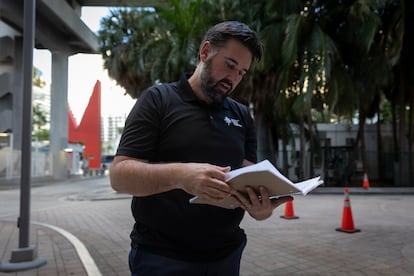
If the judge dismisses the case, the man will be arrested upon leaving the hearing. The statement baffles 50-year-old man. The judge explains that if he accepts, when he walks out the door, the government can subject him to expedited deportation. Instead, he could ask for 30 days to respond in writing.
Clutching a folder bulging with documents, the man looks at the judge, looking perplexed, and says he does not understand. Then someone in the courtroom shouts at him to take the latter option, the one that gives him 30 days.
He has been saved. Before the hearing is over, the ICE agents have left. “There’s so much subjectivity in the process that, really, it all comes down to which judge you get,” says Botsch, who has been taking notes during the hearing.
The same procedure is repeated twice more that morning, all with the same result. Since May, Botsch has documented more than 170 arrests in the Miami courthouse. His notes reflect a clear pattern: The detainees are men who come to court alone, mostly fresh from Cuba. They have applied for asylum and are now being funneled out of the justice system into expedited deportation.
Court arrests are coordinated days in advance to meet quotas, government officials told The Associated Press, with little regard for the particular details of each case. Botsch has also noticed patterns among the judges. “Some just say, ‘Okay, your case is dismissed,’ without giving any explanation,” he says. Others do an individual evaluation of the case to see if the person could receive any type of protection. Some offer a voluntary way out.
Immigration courts decide the fate of thousands of people each year and it is estimated that there is a backlog of about 3.5 million cases in the U.S. system, as well as a pronounced deficit of judges. The agency within the Department of Justice in charge of oversight is the Executive Office for Immigration Review (EOIR), which is not part of the Judiciary but of the Executive, and operates under the Attorney General. In recent months, the Trump administration has fired nearly 100 immigration judges who have been branded lenient.
During the arrests, “there’s a lot of commotion,” Botsch says. One day he saw a man about to be arrested who grabbed his own neck with both hands as if he wanted to strangle himself. “Some people resist or break down. The relatives are desperate. It can be very hard, very difficult to witness,” he explains.
“People understand perfectly what is happening. They know what it means to be detained, which is like being in prison. It’s horrible,” he says. “A lot of the people come from Cuba, Nicaragua, Venezuela, and they’re really afraid to go back to their country. They think that something could happen to them, that they would be in danger, and the idea is devastating to them,” he adds.
Immigration detention centers in Florida have been singled out by human rights organizations for their “dehumanizing” conditions, overcrowding and lack of transparency. They have also been subject to lawsuits for a lack of due process.
Botsch warns that having a lawyer doesn’t necessarily save anyone from having their case dismissed or being arrested on leaving the hearing. The only practical difference is that an attorney can more easily file a motion for the person to appear remotely through the court’s Webex system. “If the hearing is by videocall, there is nobody physically there to arrest them,” he notes.
Around 5 p.m., as the court is about to close for the day, Botsch sees the ICE agents exit through a door leading to the garage where they load the detainees into an unmarked white minivan. If he sees the minivan, he knows there will be arrests. Seven men were arrested that day, but he does not know from which hearing. Although he has been in court all day, he can only watch one hearing at a time, he points out.
After 5 p.m., people begin to arrive at the court house to ask about their relatives. Many of these were not in court and do not know what happened; They have not heard anything for hours. Some dropped their relative off for their hearing and hoped to pick them up later, but could not find them. Others were waiting in the lobby all day and have not yet received information. Many are desperate, their faces soaked with tears.
Botsch tries to calm them down with his soft, even-tempered voice. He tells them that they have probably been arrested and shows them where to stand on the sidewalk to try to see them through the fencing around the garage as they are taken away. “That makes a huge difference: being able to physically see your family member or, in some cases, wave or kiss them when they get into the van,” he says.
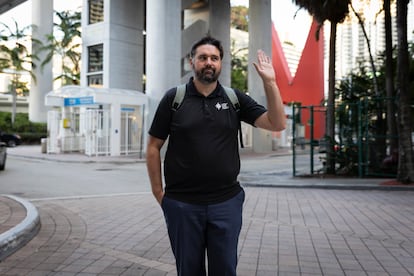
Botsch goes on to explain that they will be taken to the ICE offices in Miramar, north of Miami, and that they will not be allowed to make a phone call until later that night. He gives relatives the link to the ICE locator and explains that, at some point, their family member will turn up there and they will be able to see which detention center they were sent to. He also gives them a list of pro bono attorneys and contacts for organizations that help immigrants.
Botsch doesn’t talk about the enormous emotional toll this work takes on him every day. Instead, he focuses on the migrants. He says he’s noticed that even “those in charge of carrying this out are under a lot of stress.… It’s like everybody knows what they’re doing in court is wrong,” he says. “I’m sure even ICE prosecutors and judges experience some kind of conflict.”
Neither the DHS nor the EOIR responded to a request for comment.
The Miramar Protection Circle
On Wednesdays, Botsch does not go to court, but meets instead with the Miramar Protection Circle, a group of volunteers from various religious and pro-immigrant organizations that has met outside the ICE office in that city about 18 miles (30km) north of Miami since 2017.
They place a table, folding chairs and posters with pro-immigration messages on the sidewalk, and offer relatives of those arrested free coffee, water and pastries. An imposing figure among the volunteers, Botsch serves coffee to a woman who has been waiting for news of a family member for several hours. Meanwhile, members of the Circle watch as dozens of people wait to enter the office across the street. Most come to report for an annual routine checkup, but in recent months, many have been arrested, volunteers say.
In recent weeks, they have noticed an increase in arrests. They say that some are being summoned on weekends, and when they show up, they are arrested. The Circle members are concerned that they are being held there for several days, in a facility that was not designed as a long-term detention center – minimum conditions, such as toilets and beds, are not met.
Next to the volunteers, relatives stand anxiously, staring at the door and the parking lot, trying to see their loved ones. Suddenly, a woman breaks down in tears: her partner has just called to say that he has been arrested. Some try to console her, and others purse their lips wondering if they will suffer the same fate. This happens almost every day now. And volunteers like Botsch can only watch in silence.
Sign up for our weekly newsletter to get more English-language news coverage from EL PAÍS USA Edition









































