
How Trump is shaping the immigration justice system to suit his goals
The White House is exercising unprecedented control over immigration courts, firing experienced judges and replacing them with military lawyers as part of the overarching objective of speeding up deportations


On August 22, Chloe Dillon went to the San Francisco immigration court, as she had every day since being hired in September 2022. Nothing led her to believe that, just a few hours later, she would be walking out the door with all her belongings and an order never to return. At 3:30 p.m., as she headed to her office during a break in the asylum case she was judging, a terse, three-sentence email from the Executive Office for Immigration Review (EOIR) brought her career to an end.
“I didn’t expect not to be able to finish the hearing that day. I felt sad to be leaving a job I had dedicated so much effort and care to. And, of course, I felt uncertain about what would happen next in my life,” she recalls in a telephone interview with EL PAÍS. She had an hour and a half to gather her belongings and leave the courthouse. Dillon was her family’s main source of income, and they had health insurance thanks to her job. She still doesn’t understand why she was fired, as the email offered no explanation.
Hers is not an isolated case. In San Francisco alone, the Justice Department has fired seven judges since April, 25% of the total, and in the Sacramento court, only around half of the 11 judges remain. This area of California has been hit hard by the unexplained dismissals ordered by the Trump administration, which have occurred throughout the country. Of the nearly 800 immigration judges, 139 have been fired, taken an early-out offer, or been involuntarily transferred, according to recent estimates from the Migration Policy Institute (MPI).
The pattern has been similar in many cases. In early September, the day before her two-year term at the Annandale immigration court in Virginia was set to expire, Judge Anam Petit received the notification on her computer. After seeing the message, she briefly left the courtroom where she was presiding over a hearing, then returned to the bench and, with a trembling voice and shaking hands, delivered a complex ruling without revealing what had happened, she told this newspaper via email. She cannot say for sure what the reason for her dismissal was, because she was never told, but she emphasizes that many of the judges who were terminated had experience defending immigrants.
In addition to firing officials responsible for immigration cases, in its first months the Trump administration also eliminated protections against deportation, canceled grants that provided legal representation to minors, and transferred detainees to remote locations, including prisons outside U.S. jurisdiction, thus transforming the immigration justice system to suit its purposes. All of this was done in the name of achieving the largest deportation in history.
“The Trump administration’s policies, including expedited removal procedures and politicized interpretations of asylum laws, have resulted in a lack of due process,” says Dana Leigh Marks, who was an immigration judge in San Francisco for 35 years and is now retired.
Marks has been advocating for years for the independence of immigration judges who, contrary to popular belief and unlike the rest of the country’s judiciary, fall under the power of the executive branch. Although judges have always demanded independence from the government, they had never before denounced the politicization of their work. But since Trump took office the administration has sent them directives forcing them to expedite proceedings and dismiss asylum cases.
“Judges are supposed to act independently and not receive instructions or orders on how to rule in cases. That was the policy during the previous administration: to rigorously exercise judicial independence and rule in each case according to the facts and the law. That’s why it’s confusing to receive so many memos and directives that give clear instructions on how judges should rule in particular cases,” Dillon explains.

The mass firings of judges, amid a backlog of 3.4 million cases in immigration courts, defy practical explanation. From within the judiciary, however, it is understood as a way to remove judges who disagree with the anti-immigration policies imposed by the Trump administration. “It appears that the vast majority of the judges who have been fired were hired during the Biden administration or had experience in private law practice or with non-governmental organizations that assisted immigrants, rather than coming from a Department of Homeland Security prosecutorial background,” Marks posits.
The work of immigration judges is very complex, and in the past, to practice it, one had to have at least 10 years of experience in the field of immigration. The dismissed judges are being replaced by others without experience and even by U.S. army lawyers.
On October 24, the Department of Justice announced the hiring of 11 permanent and 25 temporary immigration judges. Most of those with immigration experience gained it as prosecutors or worked for the Border Patrol or Immigration and Customs Enforcement (ICE), the agencies responsible for arrests and deportations.
Among the temporary staff there are military lawyers from the Marine Corps, Navy, Army and Air Force. Earlier this summer, the Pentagon authorized about 600 military lawyers to work for the Justice Department, which changed the requirements for temporary immigration judges, eliminating the need for prior experience in immigration law.
Express deportations
One of the most radical changes to the immigration justice system concerns expedited deportations. Before Trump, these were reserved for migrants who entered the country illegally and were apprehended at the border. Their deportation can now be ordered by an immigration officer; that is, they are not required to go through a full legal process with a lawyer before a judge.
Additionally, these deportations have extended to people who have been living in the country for years and — contrary to the government’s claims that they are expelling criminals — the majority of those deported have no criminal record. Many of them lack legal status, but they could be eligible for immigration benefits if they were allowed to stay while their cases are resolved, which was the practice followed by immigration judges before Trump. Now, for example, if someone entered on a student visa and overstayed, they can be deported even if they have married a U.S. citizen and are eligible for residency.
“The Trump administration is changing the interpretation of certain legal terms that have been well established in the past, and by doing so, it is preventing people from having full removal proceedings. Instead, it is subjecting them to expedited removal proceedings,” Marks explains.
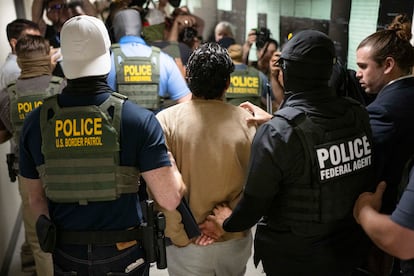
Previously, individuals who were undocumented or even had deportation orders were not a government priority for deportation. They regularly attended their immigration court appointments for routine check-ins. Now, court visits to comply with immigration requirements have become ambushes. ICE agents wait outside and detain people who arrive for their appointments. Scenes of masked officials forcibly taking people away and separating parents from their desperately crying children have become commonplace.
Detentions in immigration courts have also changed the way lawyers work. “This is something new we’re seeing across the country: immigration lawyers who need to prepare habeas corpus petitions for their clients who attend their regular reviews with ICE are concerned that those interviews could end in detention,” explains Cristina Vélez, director of law and policy at Asista, an organization that advises and trains professionals, including lawyers who defend migrants who have been victims of abuse and domestic violence.
“Because the scope of detention law enforcement has expanded enormously and reached people who previously would not have been detained, our members and professionals, who previously did not specialize in federal court litigation, now have to train, expand their skills, and find funding to do that work,” she adds.
Another radical change in immigration justice is the elimination of the possibility for ICE detainees to be released on bond. Instead, they are sent to detention centers in often remote locations, where access to family and lawyers is nearly impossible.
Adding to all this is the lack of funding for the immigration court system, something highlighted in an analysis by the Migration Policy Institute published this week. While immigration enforcement agencies have received massive budget increases in recent decades — most recently, $170 billion over four years through Trump’s tax reform — immigration courts have received a tiny fraction of that total: $844 million this year, just 2.5% of what ICE and the Border Patrol receive.
Sign up for our weekly newsletter to get more English-language news coverage from EL PAÍS USA Edition









































