
Trump administration targets unaccompanied migrant children
A new initiative seeks to have local and state authorities share information with ICE to facilitate the arrest and likely deportation of suspects
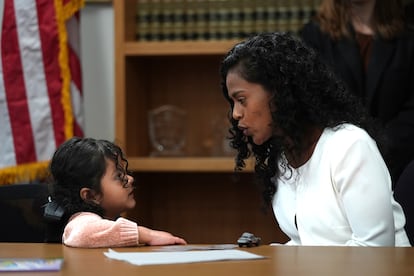

U.S. Immigration and Customs Enforcement (ICE) plans to open a call center with a specialized unit to locate unaccompanied migrant children. The idea is for local and state authorities to collaborate by informing the immigration agency of the whereabouts of these undocumented minors, thus facilitating their apprehension and subsequent deportation.
The measure is part of the Trump administration’s campaign against migrants, which has not spared children. In addition to locating those aged under 18, it would also target people who entered the country illegally as minors but are now adults.
The center would provide information to federal authorities, according to the document, published Tuesday on a government contracting website and reported by Reuters. ICE is seeking to create a 24-hour operations center capable of handling 6,000 to 7,000 immigration-related calls daily.
The contract document indicates that the facility would be located in Nashville, Tennessee, although it does not explain the reason for choosing that city. CoreCivic, one of the two largest private prison companies that operate ICE detention centers, is headquartered in Nashville.
In fiscal year 2024, approximately 98,000 children crossed the U.S. border alone, fleeing poverty, violence, or abuse in their home countries. The Republican government has criticized the previous administration for losing track of thousands of minors who were sent to live with sponsors in the United States, putting them at risk of falling into human trafficking networks. Child advocates are wary of the intentions behind the search for these children. “I don’t think ICE needs to know where these children are, because it’s very clear that what ICE is doing across the country has nothing to do with helping people, much less unaccompanied children,” says Scott Bassett, an attorney with the organization Amica.
Unaccompanied minors have been a target of Trump’s anti-immigration crusade since the beginning of his second term. Several initiatives have been aimed at facilitating their deportation. Shortly after taking office, the president attempted to suspend federal legal services for unaccompanied minors, cutting funding to the organizations that represent them and assist them in the asylum process.
Although a federal court has temporarily blocked this suspension while the case is being resolved, the attempt to undermine child protection is deeply concerning. “Legal representation can mean the difference between safety and danger. Children with legal representation obtain redress in 73% of cases, compared to only 15% without lawyers,” according to the International Rescue Committee (IRC).
Trump is unhappy with the pace of deportations, which are not on track to reach the goal of one million in his first year, so any strategy to increase the numbers is being explored. That now means searching for children, or those who arrived in the United States as children, even if it means bypassing the necessary legal processes.
$2,500 to self-deport
Last month, it was revealed that the Department of Homeland Security (DHS) would offer $2,500 to unaccompanied minors over the age of 14 in custody to self-deport. Critics, who dubbed the plan Operation Freaky Friday, denounced the coercion the minors would face. “If they truly wanted to help, the best way to do so is to provide them with lawyers to protect their rights in court,” Bassett stated. A few days ago, he visited one of the shelters where children are being held in the custody of authorities to explain the proposal, which involves waiving their right to seek asylum in the future.
The DHS defended the initiative as an incentive for children to return to their families, but child advocacy organizations denounce that in many cases they are fleeing precisely from the abuse they suffer in their homes.
The DHS used that same justification in August to put 76 Guatemalan children, who had arrived alone in the United States, on a plane in the middle of the night with the intention of returning them to the country they had fled. A judge blocked the transfer. The judge did not believe it was a case of family reunification, as the government’s lawyers claimed, since the families had not requested it and the children did not want to return to their countries. The administration planned to deport more than 300 children to Guatemala in total.
The changes to immigration policy for minors since Trump returned to the White House have completely transformed the treatment migrant children receive. “It’s a whole different world now,” says Bassett. His organization visits shelters almost every two weeks to explain all the changes. On his last visit, a little girl asked him: “Why are they still doing this to us? What have we done wrong?”
Sign up for our weekly newsletter to get more English-language news coverage from EL PAÍS USA Edition









































