
Two trials in Chicago reveal the brutality inside and outside the Broadview migrant detention center
A judge orders that sleeping mats and toilet paper be provided for detainees, while witnesses denounce the brutal tactics of federal agents
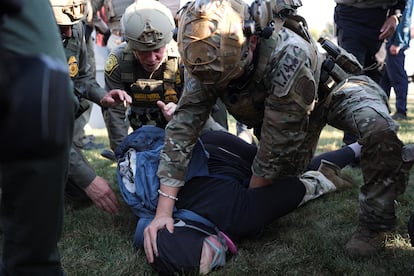

A federal judge in Chicago on Wednesday ordered authorities to improve conditions at an immigrant detention center in response to a lawsuit filed by a group of detainees denouncing the “inhumane” conditions in which they are being held. The center is located in Broadview, a suburb west of Chicago, and is operated by Immigration and Customs Enforcement (ICE). A concurrent lawsuit documented how last month, as part of the Trump administration’s massive immigration operation in the city, Broadview was the scene of police brutality as federal agents confronted protesters demonstrating against the raids, arrests, and the conditions in which detainees were being held.
The order will be in effect for 14 days and requires officials to provide detainees with a clean sleeping mat and sufficient space to sleep, soap, towels, toilet paper, toothbrushes and toothpaste, menstrual products, and prescription medications. They must submit a report to the judge this Friday. “People shouldn’t be sleeping next to overflowing toilets,” declared Federal Judge Robert Gettleman. “They should not be sleeping on top of each other,” he added, as reported by the Associated Press.
The order stipulates that the center’s holding rooms must be cleaned twice daily. Detainees must be able to shower at least every two days and receive three full meals daily, as well as bottled water upon request. Gettleman demanded that authorities allow detainees to call lawyers privately and free of charge, and provide them with a list of lawyers offering free services in English and Spanish. Furthermore, officers are prohibited from presenting detainees with deceptive documents to sign.

On Tuesday, Judge Gettleman had already described the conditions in which the migrants were being held as “unnecessarily cruel” after hearing testimony from those detained. The plaintiffs testified that they had no beds to sleep on, that the toilets overflowed due to blockages, and that the water they drank “tasted like sewage.”
The center was designed for stays of approximately 12 hours, but some people have been held there for several days as a result of the increase in anti-immigration raids. Migrants and the organizations that advocate for them have denounced the overcrowding and poor conditions of ICE detention centers since the Trump Administration began its anti-immigration campaign and overwhelmed the facilities’ capacity.
Police brutality
Several testimonies presented Wednesday in another Chicago court painted a dramatic picture of the brutality with which immigration agents responded to protesters demonstrating outside Broadview. District Judge Sara Ellis heard the testimonies in a hearing regarding a lawsuit filed by media outlets and protesters against the Department of Homeland Security (DHS) for abuses committed by agents in Chicago.
Brendan Curran, a priest and co-founder of Priests for Justice for Immigrants, said there were “federal agents … in camouflage, unbadged, completely covered up — I’m assuming they’re federal agents — hurling projectiles at people.” He described how his eyes and nose were watering after being hit by tear gas himself, according to AP.
Emily Steelhammer, executive director of the Chicago News Guild, also testified, recounting how union members reported being attacked with rubber bullets, pepper balls, and chemical weapons, including tear gas. The incidents occurred primarily at protests outside a detention center in Broadview, on the outskirts of Chicago, but also in other parts of the city. “Our journalists have been very careful to identify themselves as press,” Steelhammer said.

In October, Judge Ellis issued a temporary injunction prohibiting federal agents from using riot weapons against journalists and protesters unless there was an immediate and grave threat of physical harm to the agents or others. After finding that officials were not complying with her orders and continued to use excessive force, she mandated that agents wear body cameras during police operations in Chicago.
The plaintiffs in the case have submitted several testimonies of incidents that they claim demonstrate the Department of Homeland Security (DHS) is still violating the court order. The lawyers presented a video of an incident that occurred last Friday in Evanston, Illinois, which allegedly shows officers confronting protesters and people involved in a collision with a police vehicle.
“I can’t breathe”
Videos recorded during the incident show a federal agent pressing a man’s head against the ground for nearly two minutes, while the man cries out, “I can’t breathe.” A witness stated that she saw an agent “slam his head against the pavement at least twice.” The witness further stated that she saw the agent “strike the young man in the head with his hand or fist at least two more times.”
In a statement regarding the Evanston incident, DHS Deputy Secretary Tricia McLaughlin stated that agents were being aggressively harassed by a vehicle that rammed them. Another witness, David Brooks, who recorded the incident, testified that a Border Patrol agent pointed a gun at him.
Gregory Bovino, the CBP chief in charge of operations in Chicago, was interviewed privately by the judge on Monday. Due to the aggressive tactics used by agents in Chicago, Judge Ellis ordered him last week to appear before her daily to give an account of the day’s operations. An appeals court overturned her decision.

Bovino, who until now was the head of CBP in El Centro, California, has risen to prominence since Trump sent him to lead the raids in Los Angeles at the beginning of the summer. The official has stood out for supporting the most aggressive methods against migrants and protesters, which has earned him the president’s favor.
In videos recorded during the confrontation in Chicago, Bovino himself appears throwing a tear gas bottle at the protesters, violating Judge Ellis’s order that prohibited its use.
Sign up for our weekly newsletter to get more English-language news coverage from EL PAÍS USA Edition









































