
Juan Luis Landaeta, visual artist: ‘For the first time I realized I’m the one being threatened, and I decided to talk about it’
The Venezuelan lawyer-turned-artist’s new exhibition, ‘Confinement is a Vocabulary’, tells the stories of migrants who, like himself, face persecution from the Trump Administration
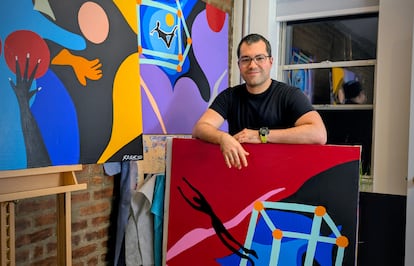
In January of last year, as the United States welcomed back the Trump administration, Venezuelan artist Juan Luis Landaeta began to feel like the walls were closing in on him. The president had announced his decision to cancel Temporary Protected Status (TPS) for thousands of Venezuelan migrants, effective November 7th, and Landaeta recalls feeling trapped, almost petrified, in a transparent cage the size of the United States. This cage allowed him to move around freely, even to see what was outside, but it made him feel captive.
“For the first time in my entire life, I realized that I’m the one being threatened,” acknowledges Landaeta, 37, in an interview at his home and studio in the West Harlem neighborhood of New York City. “My passport is expired, Venezuela doesn’t have a consulate or embassy here, my family is far away, and many of my relatives have TPS. It feels like I’m trapped because I can’t travel, I can’t move around freely. But it’s also a very effective kind of confinement because I can go out into the street and leave the state, yet I still feel trapped.”
Seeking to express what he was feeling, he turned to the canvas, and what seemed vague began to take shape in Confinement is a Vocabulary, his new exhibition opening at UNAM’s Chicago campus starting November 13. In it, Landaeta explores, using silhouettes and vibrant colors characteristic of pop culture, scenes that portray the threats faced by migrants in the United States. “I decided to talk about myself and what was happening to me,” he says.
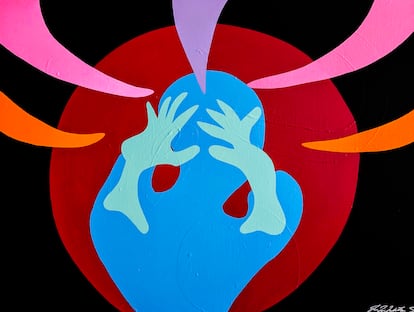
His work displays a dissonance between color and the scenes depicted. The pieces in this collection are a compendium of bodies threatened by sharp objects, pawed at by claws, or enclosed in large glass boxes. They are, however, painted in colors like the pink of Princess Aurora’s dress in Sleeping Beauty, the blue of Superman, or the red of Elmo from Sesame Street. For Landaeta, this is not a contradiction, but a conscious decision.
Just as pills with a chemical taste are encased in a cellulose capsule to mask the unpleasant flavor so people can ingest them and, in doing so, relieve pain, cure an illness, or heal wounds, Landaeta chooses bright colors to address the threats faced by migrants, especially Venezuelans, at the hands of the Trump administration. “If pop art and its colors are unanimously considered superficial, that’s tempting for me,” Landaeta says. “After all, color simply exists; it’s up to you to interpret it.”
Since January, under Trump’s directives, Immigration and Customs Enforcement (ICE) has carried out a campaign of mass deportations, including arrests at courthouses where migrants go for routine appointments on their immigration status, as well as large-scale raids. Officials in the Republican administration and Trump himself have insisted on the falsehood that the then-Republican candidate repeated in the months leading up to the 2024 election: that immigration has contributed to the rise in crime in the U.S. and that Venezuelan immigrants in particular should be expelled from the country due to their alleged ties to the Tren de Aragua criminal gang.
Landaeta portrays this reality in his work with silhouettes that suggest bodies. If he omits elements like hair, eyes, or clothing, it’s because this allows him to convey his message without distractions. The sharp objects that threaten these bodies rarely touch them; rather, they are displayed as a way of exerting control. “I felt targeted by everything that’s been happening, and I thought, ‘What do you use to target? Arrows.’ Then, trying to draw an arrow, a fang came out,” the artist explains.
Landaeta immigrated to New York in 2013, after Hugo Chávez died and Nicolás Maduro assumed the presidency of Venezuela. That year, the opposition called for massive protests, and there was increased government pressure on human rights defenders, along with a consolidation of the courts in favor of the executive branch. At the time, Landaeta was working as a lawyer in Caracas and decided to apply to universities abroad to leave Venezuela. When he finally received a scholarship to New York University to pursue a master’s degree in Creative Writing in Spanish, he left his country. At that point, painting was just a hobby.
Although Venezuela’s humanitarian and economic crisis was already erupting in 2013, not so many Venezuelans had yet arrived in New York. At that time, there were about 9,000, according to city data. By comparison: in just the last three years, since the surge in immigration to New York in 2022, it is estimated that half of the more than 200,000 migrants who have arrived in the Big Apple are Venezuelan.
After arriving in New York, Landaeta, like most Latinos in the United States seeking familiarity within their communities in the diaspora or exile, began to connect with other Venezuelans in the city and, over time, forged a close friendship with contemporary artist Jacobo Borges. “I didn’t study art, but I had Jacobo,” he says. “When he heard about me, I was a writer, an interviewer at best. But I began to understand formal and technical terms; that’s when I understood the things I had intuited and became a visual artist.”
Going to New York not only gave him the opportunity to become a visual artist and meet great figures of the Venezuelan artistic tradition, it also reconnected him with Venezuela: “New York brought me closer to myself, to the fact of being Venezuelan. In New York I’ve heard Venezuelan music that I never heard in Venezuela. Folk songs, master musicians, singers from the coast, incredible people I discovered in the East Village.”
For Landaeta, the exhibition Confinement Is a Vocabulary has been an opportunity to find the language that best suits his experience as an exile. For a long time, he felt pigeonholed into telling stories about migration, but his early collections were far removed from this and focused on abstract art. “I was worried, but my artwork didn’t convey that very well because it definitely wasn’t figurative. I wanted to say something, and the first thing I had to do was find my own vocabulary,” Landaeta explains.
It’s a unique, highly personal language, but one that encourages reflection, allowing the public to reach their own conclusions and imagine other possibilities. “Everything in his work is distorted, and that’s an invitation to connect with others through their experience, their perspective, and their bodies,” says the exhibition’s curator, Ionit Behar.
“For me, imagination is the ability to represent new realities that didn’t exist before you,” Landaeta maintains. For the artist, if the oppressor, whether it be Trump himself or his government, manages to stop people from imagining, the battle will be lost: “There’s something there that isn’t just about empowerment; it’s about getting closer to our shared humanity.”
Sign up for our weekly newsletter to get more English-language news coverage from EL PAÍS USA Edition









































