
Latinos cornered by Trump: Immigration crackdown and federal shutdown put families at risk
The Hispanic community is one of the hardest hit by the stalled federal budget, which jeopardizes their access to essential food and health subsidies

As if being the target of an immigration crackdown, in which racial profiling has been endorsed by U.S. President Donald Trump, were not enough, the partial shutdown of the U.S. government — which began on October 1 and is on track to surpass the historic 34-day record set in the winter of 2018–2019 — has put access to crucial food and health subsidies for a large portion of the U.S. Latino population in jeopardy. Millions of workers have gone without pay because of the shutdown, and it has also cut funding for programs that provide nutrition and healthcare assistance to the most vulnerable. Latinos represent a significant share of this group.
“This government shutdown is a direct assault on Latino families who keep the country running. From federal workers and small business owners, to families relying on nutrition and health programs, more than 15 million Latinos are being hit hardest by Washington’s dysfunction,” warned the organization Voto Latino.
Among the federal employees whose pay is at risk — since the government has only guaranteed the salaries of those considered essential — there are roughly 300,000 Latinos, or 10.5% of all federal employees.
The biggest obstacle in the negotiations concerns cuts to public health programs such as Medicaid, which serves low-income populations, and Medicare, for older adults, as well as the elimination of subsidies that make health insurance more affordable. Democrats have refused to support budgets that would leave millions without healthcare, while Republicans have falsely claimed that the opposition wants to extend these benefits to undocumented immigrants.
The dispute is disrupting essential services for the Latino community, which relies on them heavily. One example is telehealth. About 30% of the population that depends on it for medical needs is Latino, meaning that if the shutdown continues, two million Latinos could face obstacles to accessing essential medical care, according to Voto Latino.
Nearly 18% of non-elderly Latinos are uninsured, and 55% are underinsured, meaning disruptions to Medicare and community clinics will hit Latino families particularly hard.
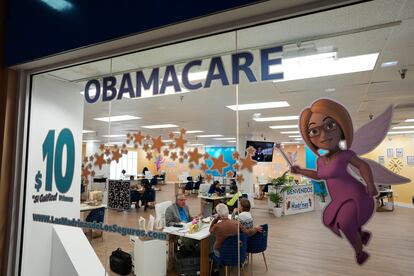
At stake in the struggle between Democrats and Republicans is the continuation of subsidies approved during the pandemic to reduce health insurance costs in a country where medical bills can reach astronomical amounts that low-income families cannot afford. Thanks to the subsidies available through the insurance marketplace of the Affordable Care Act (ACA), the program created by Barack Obama (commonly known as Obamacare), millions of Latinos working in low-wage jobs without health benefits can access medical care. Since the ACA’s enactment, the number of Latinos purchasing insurance through this marketplace has tripled, reaching over five million people.
Thousand dollars more a month
If the subsidies are cut, Latino families would face an average increase of $1,000 per month for their health insurance, and many would be forced to go without coverage, according to the Latino organization UnidosUS.
“For the Latino community, the stakes could not be higher,” said Janet Murguía, president of UnidosUS. “These tax credits aren’t just numbers on a page, they are the reason a parent can take their child to the doctor, a worker can refill their prescription, or a grandmother can go to the doctor without skipping meals,” she said last week at a conference with other organizations and Democratic lawmakers warning about the risks of cutting these supports.
The budget the Trump administration wants to pass includes tax cuts for the wealthy in exchange for the largest funding cuts ever to Medicaid. Latinos would be among the most affected. About 20 million Latinos, or roughly 30% of all Medicaid beneficiaries, rely on the program for healthcare, even though Latinos make up only 20% of the U.S. population. “Our community depends on Medicaid to meet its needs, and without it, families will face devastating consequences,” Murguía added.
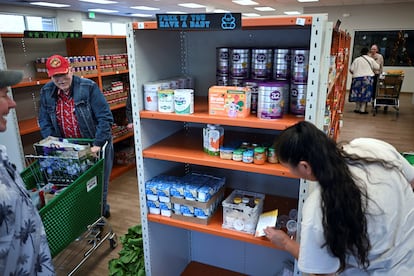
Two other programs facing cuts and funding shortfalls due to the government shutdown also disproportionately affect Latinos: SNAP (Supplemental Nutrition Assistance Program), which provides food vouchers to low-income families, and WIC (Special Supplemental Nutrition Program for Women, Infants, and Children), which provides vouchers for infant formula, fresh fruits and vegetables, low-fat milk, and other essential healthy foods often out of reach for low-income households.
Gina, a Honduran woman living in Jackson, Mississippi, said that many of her Latino friends depend on SNAP to put food on the table. At a time when they are trying to avoid encounters with immigration agents, the program is more necessary than ever. “Many receive SNAP vouchers and now fear losing them, because it’s what helps feed their children, especially during a difficult time like the current one. People are afraid to go to work, and the economy is tough,” she told EL PAÍS by phone.
Three million Latinos benefit from WIC, and another 10 million rely on SNAP to feed their families. “Every day the shutdown continues, their access to these essential benefits becomes more uncertain,” said Murguía.
Sign up for our weekly newsletter to get more English-language news coverage from EL PAÍS USA Edition









































