
US government shutdown breaks records with no end in sight
The partial closure, now in its third week, has already become the second-longest in history. Public opinion is on the side of the Democrats, according to polls
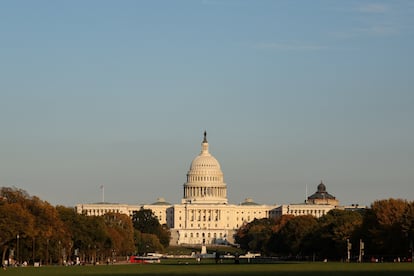

The partial shutdown of the U.S. government reached its third week on Wednesday, with no signs of a reopening anytime soon. The positions of Democrats and Republicans in the Senate remain locked on the same issues that triggered the shutdown on October 1, which has now become the second-longest in history, surpassed only by the previous one that lasted 34 days during the winter of 2018–2019, when Donald Trump was also president.
The Senate, which requires a qualified majority of 60 votes, has voted against the Republican proposal to temporarily fund the administration until November 21 a total of 11 times. But even with the extension, the underlying issue would still persist: to approve the budget, the Democrats are demanding the Republicans commit to extend certain subsidies under Obamacare, a law that improved health coverage for citizens without private insurance. Those benefits were introduced during the pandemic and are set to expire at the end of the year. Democrats are also insisting that the Medicaid cuts included in Trump’s so-called “big, beautiful bill” — his major tax reform passed in July — not be implemented.
Traditionally, the party that takes the harder line in negotiations leading to a government shutdown is the one that ends up paying the political price, as the public tends to disapprove of using the threat of a government closure as a bargaining tool. But this time — at least so far — that pattern does not seem to be repeating itself. Polls on whom citizens blame for the halt in government funding are, for now, favoring the Democrats. The latest survey, released on Tuesday, shows that 50% of respondents blame the Republicans, compared to 43% who blame the Democrats.
That same poll also shows that the Democrats’ demands in the Senate are popular: 72% of Americans want the healthcare subsidies to be extended. Even among Republicans, a majority (51%) shares that view.
The question now is how long the Democrats can hold out in this standoff, in which — for the first time — they are showing signs of standing up to Trump’s agenda, nearly after a year after losing the November elections. During the past 12 months, many in rank-and-file Democrats have wanted the party to be more assertive in opposing Trump.
Senate Republican Majority Leader John Thune stated on Tuesday: “People keep saying, ‘Negotiate!’ — Negotiate what? I don’t know what that is right now. The government needs to open up, and then we’re happy to sit down and talk about any other issues the Democrats want to talk about."
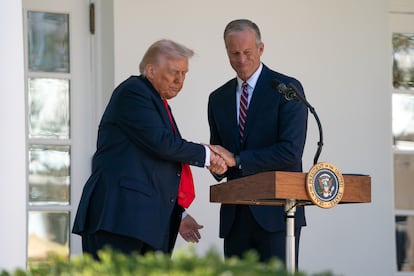
Thune spoke after a luncheon in the White House Rose Garden, where Donald Trump thanked members of his party for their unwavering support of his policies — everyone except Senator Rand Paul of Kentucky, who has voted against the conservative proposal every time. Shortly afterward, the U.S. president responded to a question about whether he would be willing to meet with Democratic minority leaders in the Senate and House of Representatives, Chuck Schumer and Hakeem Jeffries — whom he had previously insulted with racist remarks and AI-generated memes featuring Mexican hats at the beginning of the shutdown — saying he would “only meet if they let the country open.” “People want to go back to work,” he declared.
Trump was referring to the roughly 750,000 federal employees who have been furloughed without pay for the past three weeks. During a government shutdown, public employees fall into two categories: those whose work is deemed “essential,” who must continue working without pay, and the rest — about those 750,000 — who stay home and likewise receive no salary. In principle, and if the current administration follows precedent, both groups are later compensated for the wages lost once the shutdown is resolved.
Over the past few weeks, the U.S. president has made certain exceptions during the shutdown — an event he has also used to fire thousands of federal workers (a move blocked by a judge), permanently cut funding for certain programs he considers bastions of the Democratic Party and push forward his long-standing goal of eliminating the Department of Education without congressional approval.
Among those exceptions, Trump last week authorized both the Pentagon and the White House Budget Office to use “any funds” left over from the current fiscal year to bankroll the paychecks of active-duty military personnel.
Meanwhile, numerous public services remain suspended: food safety inspections are not being carried out, unemployment data are not being calculated, and Washington’s public museums and national parks across the country are closed or poorly maintained. Analysts estimate that the shutdown will reduce annual economic growth by 0.1% to 0.2% for each week it continues — equivalent to $7.6 to $15.2 billion per week, according to Oxford Economics.
Sign up for our weekly newsletter to get more English-language news coverage from EL PAÍS USA Edition









































