
Venezuelans react to the elimination of TPS: ‘On November 7th I lose everything’
A psychologist and a musician, two of the 250,000 Venezuelans who are about to lose protection from deportation, tell EL PAÍS how the life they have built in the US is collapsing
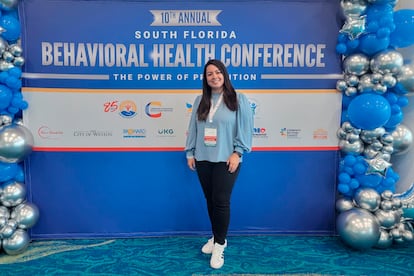

María Fernanda Angulo, or Mafe, as she prefers to be called, is anxiously counting down the days until November 7. On that date, 250,000 Venezuelans who, like her, live and work in the United States as beneficiaries of Temporary Protected Status (TPS), will become undocumented. “That day I lose everything: I lose my driver’s license, I lose my status, and I lose my work permit. And deportation proceedings may be initiated against me, which would separate me from the family I’ve built here,” she says in a video interview with EL PAÍS.
On October 3, the Supreme Court, in a ruling of just three paragraphs, reiterated a decision it had made in May and put 350,000 Venezuelans who had been granted TPS in 2023 at risk of deportation. The decision will now affect another 250,000 Venezuelans whose temporary residence permit expires on November 7.
The TPS case for Venezuelans remains unresolved in the courts. Upon returning to the White House, Donald Trump enacted several measures aimed at eliminating programs that had previously allowed immigrants to reside in the country. Among these was TPS, which his predecessor, Joe Biden, had granted in 2021 and 2023 to Venezuelans fleeing the worsening political and economic situation in their country. The Democrat, just a few days before the end of his term, extended the permit for 18 months to October 2026, but the Trump administration’s Secretary of Homeland Security, Kristi Noem, revoked it.
Advocacy organizations took the case to court, and on September 5, District Judge Edward M. Chen ruled that Noem’s attempt to eliminate TPS for Venezuelans and Haitians was illegal. The Secretary’s actions in reversing the previous administration’s order and terminating TPS “are unauthorized by law, arbitrary and capricious, and motivated by unconstitutional animus,” Chen wrote.
The government has appealed the ruling, but while the Ninth Circuit Court of Appeals resolves the case, the Supreme Court has left the 600,000 Venezuelans who resided legally in the country without protection.
A salary to buy a Coke and chips
Mafe, 33, arrived in the United States in 2019 to reunite with her mother and other relatives, and in 2021 she was granted Temporary Protected Status (TPS). Congress created this program in 1990 to protect from deportation citizens of countries experiencing armed conflict, natural disasters, or other extraordinary and temporary conditions. Biden included Venezuela due to the worsening conditions under Nicolás Maduro’s regime.
For Mafe, as for hundreds of thousands of Venezuelans, life in her country was unbearable. The lack of freedom and the repression of any opposition to the government were compounded by the economic crisis. “My last salary from my job at the time as a primary school psychologist was literally only enough to buy me a two-liter bottle of Coca-Cola and a bag of potato chips,” she explains. By the end of 2018, before traveling to the U.S., the situation had worsened, and “many people were eating whatever they could find in the trash. It was very common not to eat any protein, only vegetables, even spoiled food,” she recalls.
The government’s iron fist intensified in a bid to keep the opposition in check, and repression filled the prisons with political prisoners. “You love your country, but the truth is that since ’99 Venezuela has ceased to be a real country to live in,” she says with sadness.
Mafe lives in South Florida with her partner and two stepchildren. Temporary Protected Status (TPS) allowed her to work for an organization that helps other immigrants. “I’ve been here working legally, doing things the right way,” she says, but as soon as she learned that Trump had won the November 2024 election, she began to worry. “I saw it coming,” she says, because TPS is only a temporary status and doesn’t provide a path to permanent residency or citizenship. Since then, her life has changed. “It’s been a really tough year, very difficult psychologically.” Mafe has suffered from anxiety and has needed the help of a psychologist.
The fear of migrant raids, which have proliferated across the country and in Florida are carried out with the assistance of local law enforcement, has terrified her since January. “I went to the beach one day with my boys and some border patrol vehicles drove by. Even though I had legal status, I felt terrified. I thought, ‘That’s it.’ There’s an uncertainty and a fear that you live with all the time, even if you don’t want to.”
Mafe fears being arrested and having her whole life fall apart. She’s also afraid of returning to Venezuela. “I’m terrified of going back to Venezuela, I’m even terrified of giving you this interview and that it could result in legal proceedings against me if I go back to Venezuela,” she admits. One of her close friends is imprisoned for having participated in the campaign for María Corina Machado, the opposition leader to Maduro who recently received the Nobel Peace Prize.
Trump has justified his crusade against immigration by saying that migrants arriving in the United States, particularly those from Venezuela, are criminals or come from institutions for the mentally ill.
“It’s very easy to say that 600,000 Venezuelans are bad people, who came here to do harm, but the truth is that they are people who want to do things the right way, to work to be able to provide their families with a different future,” Mafe maintains.
Neither criminal nor crazy
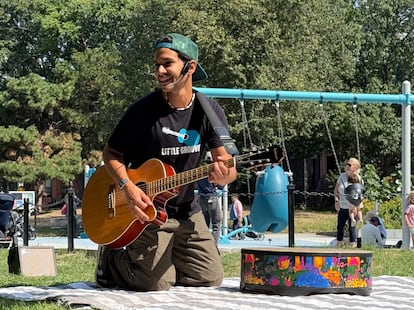
Mariano Santana cannot be classified as a criminal, nor as mentally ill. This 29-year-old Venezuelan arrived in the United States in 2014, right after graduating, to study music at the renowned Berklee College of Music in Boston. It was a dream he had longed to fulfill, one that was precipitated by an incident in Caracas, where he was born. The month after graduating from high school, in August 2014, he was the victim of an armed robbery that could have turned, like so many others, into a kidnapping. It was just one more example of the insecurity plaguing his country. The experience convinced his family that Mariano should leave to seek a better life in the United States.
Despite the trauma, Mariano felt empathy for his assailant. “I thought about what reality is like in a place where so many people reach that point. That says a lot about the country. In the end, it’s all about survival,” he says.
At age 10, a visit to New York City left a lasting impression on him. “Two hours after arriving, I fell in love with the city and told my mom, ‘I want to live here when I grow up.’ And, thank God, I did,” he tells EL PAÍS via video conference from Boston. Both his dream of studying at Berklee and of living in the Big Apple came true. Now, however, everything he has built in the last 11 years is teetering on the brink.
Mariano is also a TPS beneficiary and will lose his work permit on November 7. A professional musician, he combines performing with composing and teaching music to children. Among his artistic achievements is his participation in a three-month tour with the Mexican band RBD in 2023, which included 30 concerts in large U.S. stadiums and sold-out shows at Madison Square Garden on both nights.
Before obtaining TPS, he combined student visas with scholarships and tried various avenues to obtain a work permit that would allow him to support himself. The bureaucracy was cumbersome and slow. He almost lost his residency permit when he was about to graduate and faced financial difficulties.
He suffered from depression and anxiety at the thought of having to return to Venezuela. When Biden authorized Temporary Protected Status (TPS) for Venezuelans in 2021, he applied and was able to work. He earned enough to support himself and send money to his parents, who, years after he left, also settled in the United States.
A deep religious faith and an optimistic nature allowed him to overcome the difficulties he encountered along the way, where he met other migrants carrying even worse traumas. “In New York, I connected with other people who left their country on foot, crossed the jungle with babies, with children, seeing dead bodies, really terrifying things. I feel blessed because I left Venezuela by plane,” he recounts.
Mariano applied for TPS renewal this year, though he admits that since Trump’s election victory, he knew difficult times were ahead. “I invested in the renewal knowing it might be worthless, that I was going to lose my money,” he says. Now he feels a great deal of uncertainty, but he tries not to let it paralyze him: “I don’t let it eat away at me, because if it does, I’ll freeze up.” He’s grown accustomed to living with fear and not letting it control him. “Living in Venezuela, there was always panic. Everything was about survival. And I feel like I have that built into my system. It’s already part of me.”
Now he finds parallels between what he left behind and the current reality of the United States. “What I feel now is that there are many similarities with Venezuela. In terms of corruption, in terms of fascism, in terms of having no interest or compassion for human beings,” he reflects.
Sign up for our weekly newsletter to get more English-language news coverage from EL PAÍS USA Edition









































