
Nicaragua’s Ortega and Murillo release and parade political prisoners in whitewashing operation for US
The Sandinista regime is using this tactic to avoid getting expelled from the CAFTA free trade agreement or the introduction of 100% tariffs

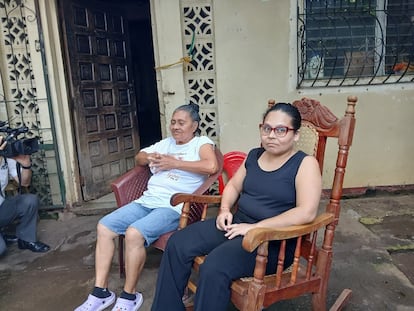
Nicaragua’s co-presidents, Daniel Ortega and Rosario Murillo, resorted on Tuesday to an old whitewashing tactic: releasing and parading political prisoners who had been forcibly disappeared. The move comes on the eve of a crucial decision for the Sandinista regime: the Trump administration will have to determine whether to expel the country from the Dominican Republic–Central America–United States Free Trade Agreement (DR-CAFTA) or impose 100% tariffs, due to systematic human rights violations that are “a burden on U.S. trade”—according to an investigation by the Office of the U.S. Trade Representative.
Throughout the morning, Sandinista propaganda outlets displayed images of the journalist Fabiola Tercero, one year and four months after her arrest, the raid on her home, and her disappearance from public view. “Another lie falls apart for the traitors of the homeland,” the official media headlined, in an attempt to discredit all those who have demanded to know the journalist’s whereabouts.
In a tactic previously used by the co-presidential regime, and categorized by human rights organizations as “forced confessions,” Tercero, egged on by pro-government journalists, stated that “in recent years I have been living at home with my mother in the William Díaz neighborhood, District II of Managua.” Four days earlier, the regime also quietly released five other political prisoners, including the journalist Leo Cárcamo.
In previous months, the U.S. Embassy in Managua campaigned on behalf of Tercero and Cárcamo, demanding proof of life from the Managua regime and the disclosure of their whereabouts. Political analysts consulted by EL PAÍS interpret this release and the public display of these individuals as an attempt by the two-headed presidency to once again use political prisoners as bargaining chips for its own benefit. On November 19, the Office of the United States Trade Representative (USTR) will conclude a public consultation phase of its investigation, which concludes that the regime’s “acts, policies, and practices” are “unreasonable and burden or restrict U.S. commerce,” according to the determination issued under Section 301 of the Trade Act of 1974.
What the USTR will put on the Oval Office table are options that represent a lethal blow to the Nicaraguan economy, whose main trading partner is Washington: expulsion from DR-CAFTA, a crucial trade agreement for Nicaragua, and the imposition of 100% tariffs. This is a measure that has always been feared in Managua, but most especially by U.S. businesspeople in the textile, tobacco and coffee sectors with interests in the Central American country who have lobbied heavily in Washington to avoid such a devastating blow, regardless of the serious human rights violations in Nicaragua.
“And this is where political prisoners are once again used as bargaining chips,” Salvador Lucio Marenco, a human rights lawyer with the Nicaragua Never Again Collective, tells EL PAÍS. “Besides the deliberations on the free trade agreement, there is another important event: for the first time in a long time, the dictatorship faced the international community before the United Nations Third Committee, when the Group of Experts presented its report on crimes against humanity. During that session, Nicaragua’s deputy ambassador expressed the regime’s concern about the sanctions and economic measures.”
Will the United States fall for the trap again?
This is not the first time the Ortega-Murillo regime has released political prisoners to ease pressure or obtain concessions from the international community. In this regard, former opposition congressman Eliseo Núñez believes these recent sudden releases are an attempt to initiate negotiations—or strengthen existing ones—to circumvent Nicaragua’s expulsion from the DR-CAFTA agreement and the tariffs.
However, the opposition leader, who was stripped of his citizenship, warns that it could also be a Sandinista ploy “to buy time” while it consolidates its relationship with China, following the creation of Special Economic Zones that are costly for Asian interests. “To allow Chinese companies to export to the United States under the CAFTA umbrella, bypassing sanctions and tariffs,” Núñez explains. “As I’ve said before, keeping Nicaragua in CAFTA would be a mistake.”
Juan Carlos Gutiérrez, a researcher and also stripped of his citizenship, warns the United States: the release of political prisoners is an old tactic that produces no fundamental change, he insists. When the Ortega-Murillo regime gains an advantage, they retreat back into repression. “What they are doing is managing the terror they have already sown in a significant part of the population, because these releases serve three purposes simultaneously,” he points out. And he begins to list them: “Reducing the political cost of keeping hundreds of people unjustly imprisoned, decreasing the economic expense of keeping them in prison, and shifting the psychological and material burden onto their families. They release people who are afraid, like Fabiola Tercero; unable to communicate, unemployed, and under constant surveillance.”
So far, the latest political prisoners released have refused to speak with anyone, least of all their families, and must report daily to a police station to sign an attendance sheet. Meanwhile, Nicaragua’s economic future—more than 55% of its trade with the United States—will now be in the hands of President Trump, mediated by Secretary of State Marco Rubio.
Sign up for our weekly newsletter to get more English-language news coverage from EL PAÍS USA Edition









































