
Ortega breaks silence on Trump after Washington calls the Nicaraguan regime an ‘adversary’
The Nicaraguan leader reacted to a US State Department report by sharply criticizing Washington’s immigration policies, calling them ‘horrendous crimes’

After more than 100 days of caution and silence on Donald Trump, Nicaraguan President Daniel Ortega finally broke his silence. On the eve of May 1, during an International Workers’ Day rally in a public square, the Sandinista leader launched into a tirade against the Republican president.
Ortega’s attack came just hours after the U.S. State Department released a self-congratulatory report marking Trump’s first 100 days in office, which listed Nicaragua’s regime among its “adversaries.”
Until that moment, Ortega’s government had quietly pursued a cooperative stance — receiving planeloads of deportees without protest and withdrawing from the South African-led case at the International Court of Justice accusing Israel of genocide to align with Washington. This week, however, marked a sharp reversal.
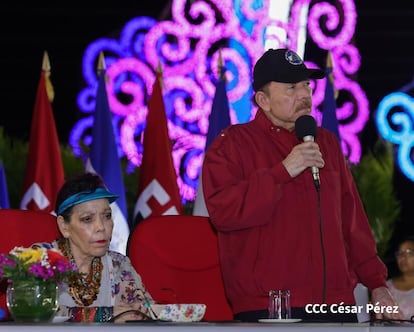
Ortega railed against Trump for over half an hour, denouncing the Republican president’s anti-immigration policies, trade tariffs, expansionist ambitions, and authoritarian posturing.
“These are already horrendous crimes — horrendous like holding a two-year-old girl in prison, kidnapped, and attacking her poor mother,” declared the Sandinista leader, referring to a Venezuelan woman who was deported and lost contact with her young daughter in Miami.
As part of its self-congratulatory assessment of its first 100 days, the Trump administration hailed Secretary of State Marco Rubio for executing a “decisive and focused America First foreign policy agenda.”
Among its listed achievements in a section titled “Combating Our Adversaries,” the State Department singled out Nicaragua. “Holding the Nicaraguan Ortega Murillo Authoritarian Dynasty Accountable: Imposed visa restrictions on more than 250 Nicaraguan regime officials to hold them accountable for depriving the Nicaraguan people of their fundamental freedoms and forcing many into exile," states the document.
The State Department report clearly struck a nerve with the Ortega-Murillo regime, which had until then maintained complete silence regarding U.S. actions.
The dictatorial couple had remained cautious, awaiting clearer signals before repositioning themselves within the chaotic and shifting geopolitical landscape triggered by President Trump, who, since coming to office, has made overtures to Vladimir Putin’s Russia while distancing himself from the United States’ historical allies, such as Europe. This is in line, in some ways, with Ortega’s Moscow-aligned foreign policy.
However, on the eve of May Day, Ortega not only returned to his pro-Palestinian stance, but also sharply criticized Trump’s deportations —particularly targeting Salvadoran President Nayib Bukele’s cooperation in returning migrants to El Salvador.
Ortega also mentioned Nicaraguans who had been deported via Guantánamo Bay, Cuba, noting that more arrivals landed at Augusto C. Sandino Airport on April 30, though he offered no further details. Additionally, he condemned the tariff war that has affected Nicaragua, citing the 18% tax imposed by Washington.
“Another bomb has fallen on the world, and it comes from the president of the United States, who has launched a package of economic measures [tariffs] without consulting any country,” said Ortega, breaking his silence on Trump’s second term. In the same speech, he voiced full support for China and heaped praise on President Xi Jinping.
“He simply decided to do it, and there it is: threatening the global economy and also threatening the American economy. The American people themselves are already beginning to rebel. Why? Because they’re feeling the impact of the rising cost of living,” Ortega continued.
The Nicaraguan also condemned what he called the U.S. government’s “criminal attitude” toward migrants: “Persecuting and imprisoning all those who have worked there for years — who have shed sweat and blood so that country could have more wealth,” he said, referencing the recent wave of deportations.
Ortega — whose regime has tortured thousands of political prisoners in Nicaragua’s prisons, showing blatant disregard for the Nelson Mandela Rules — accused Trump of violating due process for deportees.
“Without any law, [Trump is] disregarding the decisions of the United States’ judicial branches. In other words, he’s acting as if in the United States, with his coming to power, all powers disappeared and he alone holds the power. And he decides what is done and what is not done,” said Ortega, seemingly unaware he was describing his own despotic rule.
Manuel Orozco, a researcher at the Inter-American Dialogue, told EL PAÍS that the Ortega-Murillo regime once again miscalculated its political messaging.
“They leaned on a moralistic narrative, aligning themselves with international criticism of President Trump and assuming they were part of that global protest. But these leaders lack political tact. Having been labeled as pariahs — enemies of humanity — there’s already a playbook for dealing with them. A waiting list ready for action,” Orozco explained.
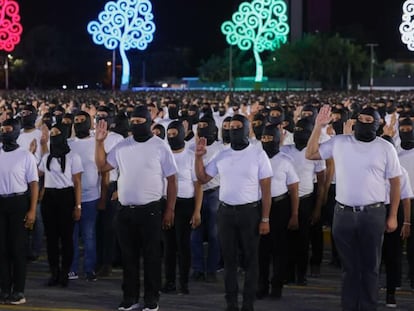
Ortega and his “co-president” Rosario Murillo presided over the May Day event in Managua, flanked by police, military forces, and a legion of hooded paramilitaries. In a world tilting toward authoritarianism, the image of thousands of masked men and rifles in the public square was a reminder of the authoritarian backslide that began in Nicaragua in 2018 with the commission of crimes against humanity
Long before Trump’s return to power — and the global spread of his MAGA-fueled far-right ideology — Nicaragua had already descended into repression. So while Ortega’s criticisms of Trump may have sounded apt on the eve of May Day, it was like hearing the Sandinista strongman describe himself.
Sign up for our weekly newsletter to get more English-language news coverage from EL PAÍS USA Edition









































