
Eduardo Padrón: ‘What is happening to immigrants in the US is unacceptable and shows a lack of respect for human dignity’
The Cuban-American academic and president emeritus of Miami Dade College joins a public campaign denouncing Trump’s ‘dehumanizing’ immigration policies
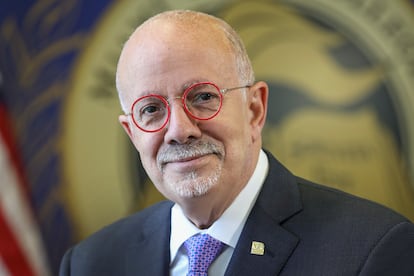

Eduardo Padrón, 81, is a former president of Miami Dade College. He speaks with the serenity of someone who has dedicated his entire life to education. But when he describes the treatment that many migrants receive in the United States today, his tone shifts to one of restrained indignation. “What’s happening is unacceptable; [it’s] cruel mistreatment that shows a lack of respect for human dignity,” he says, in a conversation with EL PAÍS. “And I feel we have an obligation to raise our voices, because we’re immigrants,” he adds. Padrón was born in Santiago de Cuba and arrived in the United States as a refugee in 1961.
His conviction led him to join other prominent members of the community in the “Four Voices, One Miami” campaign. The initiative includes billboards and social media videos denouncing the immigration policies of the Trump administration, stating that they “dehumanize” immigrants and force them to live “in fear.”
In addition to Padrón, journalist Michael Putney, television journalist Leticia Callava and former Miami Herald editor David Lawrence Jr. are participating in the campaign.
The initiative is funded by Keep Them Honest, Inc., a non-profit organization that has launched campaigns criticizing South Florida Republican politicians for failing to defend immigrants who have fled dictatorships. Some of the ads say “Deporting immigrants is cruel,” accompanied by images of the legislators. Cuban-American philanthropist Mike Fernandez recently revealed that he has contributed millions of dollars to the campaign.
The Trump administration has promised mass deportations. There have been intensified raids on workplaces, arrests at traffic stops, and detentions in immigration courts. The climate of fear has separated numerous families, directly impacting the large Latin American diasporas in South Florida. Many individuals have been left in immigration limbo, after the federal government canceled their temporary protections or terminated humanitarian programs that had allowed them to live and work legally in the U.S.
Florida, under the leadership of Republican Governor Ron DeSantis, has passed laws that criminalize undocumented immigrants who enter the state. New detention centers have been built, while agreements have been signed between local law enforcement and federal agencies to arrest immigrants.
DeSantis has also pushed through Trump’s presidential library project in Miami, which involved the rushed transfer of land from Miami Dade College to the state, something that Padrón has publicly criticized.
On its website, Keep Them Honest directly points the finger at three South Florida congresspeople: Mario Díaz-Balart, Carlos Giménez and María Elvira Salazar. The campaign accuses them of “remaining silent” while legal protections are being stripped away from Cubans, Nicaraguans, Venezuelans and Haitians. “Too many politicians act like they’ve forgotten where they came from,” the site reads.
Padrón insists that his involvement isn’t intended to attack anyone. “My sole purpose is to defend the rights of immigrants, to fight against abuses and the ways in which the laws are not being properly applied in the treatment of immigrants,” he clarifies.
Padrón emigrated from Cuba to Miami as a teenager through Operation Peter Pan, a mass exodus of unaccompanied minors. He led Miami Dade College for nearly 25 years and, in 2016, he received the Presidential Medal of Freedom, the nation’s highest civilian honor. He recalls that many of the people who have made significant contributions to the United States came from other places, just like him.
Padrón acknowledges that migrants, like citizens, have “the obligation to obey the laws, to behave appropriately.”
“There should be no exceptions simply because we’re immigrants. We have to set an example,” he says. But he acknowledges that this conversation is often disconnected from reality.
“What worries me is that, when you look at police records, the percentage of crimes committed by immigrants is very small compared to the rest of the population,” he explains. “And that’s never spoken about. Currently, given the way that this [situation] is presented to the American public, it’s as if immigrants were criminals, undesirable, responsible for all kinds of abuses. When, in reality, it’s the complete opposite.”
For Padrón, Miami is the most visible proof of this contradiction. The city was built by migrants who came from all over the world, seeking freedom and opportunity. “It’s something that should be celebrated, not punished,” he sighs.
What pains him most is the climate of growing cruelty in the application of immigration laws. He describes the practices as “disrespectful and discriminatory,” often based solely on appearance or accent. “If someone looks Hispanic – whether because of their skin color or their accent – that’s often cause for them to be stopped, to have their car destroyed, to be arrested, or to be thrown on the ground. These are fascist-style practices that have no place in a country like this,” he asserts.
Sign up for our weekly newsletter to get more English-language news coverage from EL PAÍS USA Edition









































