
Death penalty in the US: Where it applies and how many people have been executed
Oregon and Wyoming are the only two states in which no one has received this sentence
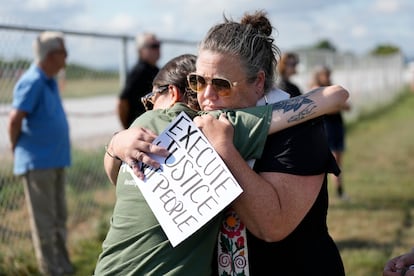

Since 1976, the United States has executed 1,682 people. More than a third of them — 602 — were executed in a single state: Texas.
The U.S. is a country that imposes the death penalty in 27 states and has abolished it in 23 others. It is also a country where public support for the death penalty — which reached 80% in 1994 — fell to 52% in 2025, its lowest level in more than half a century.
These are the figures and the context behind one of the most controversial practices in the U.S. justice system.
A divided map
Capital punishment remains in effect in 27 states, although in practice the map is smaller: only 21 can carry out executions, because the other six have moratoriums in place.
In the remaining 23 states and in Washington, D.C., the practice has been abolished. Between 2011 and 2021, seven states took that step: Illinois, Maryland, Delaware, Washington, New Hampshire, Colorado, and Virginia.

At the federal level
The federal government can also impose the death penalty. In 2019, Donald Trump’s Department of Justice announced that it would resume executions, and on July 14, 2020, Daniel Lewis Lee became the first person executed by the federal government since 2003.
A total of 13 federal prisoners were executed, all during Trump’s first term. The last execution was that of Dustin Higgs on January 16, 2021.
That year, Attorney General Merrick Garland imposed a moratorium. On December 23, 2024, Joe Biden commuted the sentences of 37 of the 40 federal death row inmates to life in prison without parole, leaving three on death row.
On January 20, 2025, Trump, back in the White House, signed an executive order, and as a result, then-attorney general Pam Bondi lifted the moratorium on February 5. Her memorandum also instructed the Department of Justice to strengthen the death penalty and seek it whenever reasonable.
What crimes are punishable by death?
Each state legislature decides which circumstances make a homicide eligible for the death penalty. For example, about half of the states with the death penalty include the murder of a child as an aggravating factor. All prisoners currently on death row, and all those executed in the modern era, were convicted of homicide.
Historically, the death penalty was widely applied for rape, particularly against Black defendants when the victim was white. When it was reinstated in 1976, the Supreme Court left open the possibility of applying it to other crimes, such as rape or even armed robbery, but shortly thereafter declared it unconstitutional to impose the death penalty for the rape of an adult without a death occurring.
That prohibition was extended to any rape not involving homicide in the decision Kennedy v. Louisiana, in which the Supreme Court further held that the death penalty can no longer be imposed for any crime against a person in which no one has died. What remains unresolved is whether it could be used for crimes against the state, such as treason or espionage.
Executions by state since 1976
According to data compiled by Rick Halperin of Southern Methodist University, updated as of September 23, 2026, these are the execution figures by state over the past 50 years.
- Texas: 602
- Florida: 140
- Oklahoma: 132
- Virginia: 113
- Missouri: 102
- Alabama: 85
- Georgia: 77
- Ohio: 56
- South Carolina: 50
- Arizona and North Carolina: 43 each
- Arkansas: 31
- Louisiana: 29
- Mississippi: 25
- Indiana: 23
- Tennessee: 17
- Delaware and the federal government: 16 each
- California: 13
- Illinois and Nevada: 12 each
- Utah: 8
- Maryland, South Dakota, and Washington: 5 each
- Nebraska: 4
- Idaho, Kentucky, Montana, and Pennsylvania: 3 each
- Oregon: 2
- Colorado, Connecticut, New Mexico, and Wyoming: 1 each
Public opinion
In October 2025, a Gallup poll found that support for the death penalty fell to 52% — one percentage point lower than in 2024 and its lowest level since 1972 — while opposition is at its highest level in nearly six decades.
The decline is primarily due to reduced support among Democrats and independents, as well as among younger generations: only 41% of adults aged 18 to 34 and 46% of those aged 35 to 54 support it, compared with 62% of those over 55. The partisan divide stands at 49 points: 81% of Republicans are in favor, nearly the same as in 2000 (80%), while among Democrats, support has dropped from 56% to 32%.
Sign up for our weekly newsletter to get more English-language news coverage from EL PAÍS USA Edition









































