
Florida carries out its first double execution in more than 60 years
Among those executed Tuesday was an 80-year-old man, the oldest in the state since capital punishment was reinstated
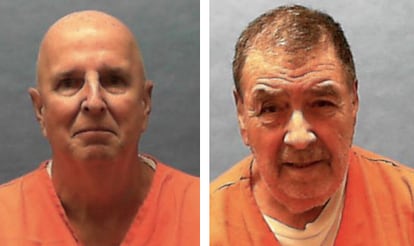

Florida carried out two death sentences Tuesday at the state prison in Starke, about 50 miles southwest of Jacksonville in the northern peninsula, marking the first time the state has ordered two executions in a single day since 1964. One of the condemned, Dominick Occhicone, 80, is the oldest person executed in Florida since the state reinstated the death penalty in 1976.
The executions of James Duckett, 68, and Occhicone, just six hours apart, were the 11th and 12th in Florida so far this year. Another execution is scheduled for August 18. The state is at the forefront nationally in carrying out capital punishment, with three times as many as Texas, which follows with four executions. Before Occhicone, the oldest person executed in Florida had been Dennis Sochor, 74, two weeks earlier.
Last year Florida executed 19 people, nearly half of the 47 carried out nationwide, an acceleration that contrasted with just three executions authorized by Governor Ron DeSantis between 2023 and 2024, amid a national resurgence of the death penalty under the administration of Donald Trump. While former president Joe Biden commuted the sentences of nearly all federal death-row inmates, Trump has encouraged state prosecutors to seek new death sentences.
In line with that trend, the Republican-controlled Florida Legislature passed laws on the death penalty in 2023, one of which allows a jury to recommend the death penalty without unanimity, with only eight of 12 votes — the lowest threshold in the country. Only one other state, Alabama, allows a non-unanimous capital punishment recommendation, though it requires at least 10 votes.

Duckett was executed after midday for the 1987 murder of 11-year-old Teresa McAbee. His execution had been stayed in March by the Florida Supreme Court to review DNA evidence that his attorneys said would prove his innocence, a bid that did not succeed. DeSantis rescheduled his execution on July 14. The victim’s mother, Dorothy Tula, told reporters she had waited 40 years for that moment.
Occhicone was executed later Tuesday for the 1986 murders of his former partner’s parents. At his trial, the jury recommended the death penalty by seven votes to five, a margin that would not be sufficient under current law. Occhicone filed legal challenges based on his age and against the lethal injection method to halt the process.
Both cases had juries split on death recommendations.
“In the case of James Duckett, we are putting to death a man against whom the evidence is, at best, circumstantial and whose jury was split eight to four in recommending death. Six hours later, we will execute an 80-year-old man whose jury was split seven to five. If Mr. Occhicone were tried today, he could not be executed. Even people who support the death penalty feel uncomfortable with this wave of executions when asked to examine the details of each case,” said Abraham Bonowitz of Death Penalty Action, one of the groups that organized vigils and last-minute appeals to the state Legislature in Tallahassee. The organizations denounced what they called an “out-of-control and unnecessary pace of executions in the state.”
“Most Floridians have no idea that these executions are taking place or of how far Governor DeSantis is going with this,” Bonowitz said.
Robin Maher of the Death Penalty Information Center questioned the secrecy of the process. She told The Guardian that DeSantis has been setting execution dates almost every two weeks, “an extraordinary pace,” with no explanations or “any sort of institutional check on his authority.”
Activists warn that carrying out multiple executions on the same day increases the risk of errors and suffering. They also question the use of a paralytic in the lethal injection that, they argue, could mask signs of pain and whether the condemned is dying in agony.
Opponents of capital punishment also point to the risk of executing the wrongfully convicted. Last month a Louisiana man, Jimmie “Chris” Duncan, was released after spending nearly 30 years on death row, accused of killing his ex-partner’s daughter in 1993. His conviction was overturned after new evidence emerged and a jailhouse informant recanted.
Sign up for our weekly newsletter to get more English-language news coverage from EL PAÍS USA Edition









































