
Trump’s Great Persecution: ICE Raids Ignite Business Fears
EL PAÍS and Puente News are launching a series that delves into Trump’s crackdown on immigrants, which has dealt a severe blow to the industries that rely most heavily on them. There’s no solution in sight for workplace chaos unleashed by one of the largest immigration dragnets since the Great Depression
This story was co-published with El Pais and Puente News Collaborative a bilingual nonprofit newsroom, convener and funder dedicated to high-quality, fact-based news and information from the U.S.-Mexico border. KTEP News is a founding member of Puente News Collaborative.
In McAllen, Texas, home builder Mario Guerrero had grown so frustrated with immigration raids on contractors’ worksites across the state’s southern reach that he traveled to Washington, D.C. earlier this year to lobby for help from federal officials.
He returned home empty-handed.
“They literally told us they are going after every ethnicity that is not an American,” said Guerrero, head of the South Texas Builders Association, recalling his meetings with officials from ICE, the United States Immigration and Customs Enforcement agency. “I said, ‘Well, what is an American?’”
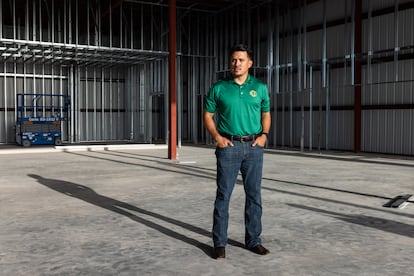
Fast-forward from those futile winter meetings, and it now takes builders twice as long to finish a starter home because of a scarcity of workers, immigrant or U.S.-born, Guerrero said. The 33-year-old, who voted for Donald Trump three times, warned of greater trouble ahead for home builders and the country’s economy. Mom-and-pop builders must repay construction loans within a year, he said, and a slowdown will trigger a cascade of problems. One McAllen-area concrete company has already filed for bankruptcy, citing ICE raids.
The Trump administration’s fierce crackdown on immigrants has punched hard at the nation’s immigrant-heavy industries like home construction, restaurants, food production and health care. And there are no solutions in sight for workplace chaos unleashed by one of the largest immigration dragnets since the Great Depression. U.S. food production alone is highly vulnerable. A 2020 analysis of Census data found that 43% of frontline food workers nationwide were immigrants – and often worked in Trump-voting counties.
This impact on the U.S. economy is a headline consequence of Trump’s drive to rid the country of every undocumented person and immigrant deemed unwanted. The campaign has led to tragedy – even death. It’s also fostered a sense among Latino and other immigrants that they face unprecedented persecution in a country that had thrived on their hard work and politicians once boasted was “a nation of immigrants.”
The push against immigrants, and the pull of their vital role in the U.S. economy, has business leaders wrestling with contradictions. Many support Trump. They’ve leaned into his tax-cutting, deregulation agenda, even as they’ve warned that mass deportations would yank away valued workers, trigger bankruptcies and fuel higher consumer prices.

For decades, the U.S. Chamber of Commerce has pushed for pro-immigration solutions. It’s joined labor unions to urge Congress to create a path to legal permanent residency – and eventual citizenship – for longtime undocumented workers. The Chamber and the newer American Business Immigration Coalition also argue that there are too few immigrant visas for employers to sponsor people to enter legally and fill shortages in year-round, less-skilled but essential jobs.
But Trump rose to power vowing to deport “bad hombres,” falsely blaming immigration for depressing U.S. wages. Today, he’s supercharged deportations. And the only foreign workers he seems warm to are temporary guest workers. In fact, Trump companies have a history of hiring foreign workers, including undocumented laborers and legal, foreign guest workers.
Records show that the U.S. Department of Labor approved a request for 175 seasonal guest workers at Trump’s Mar-a-Lago Club in Florida. That made the winter White House the fifth-largest recipient in Florida of approvals for workers on nonimmigrant H-2B visas. When employers in 2025 protested a sudden uptick in ICE raids at worksites, Trump floated the idea of letting employers take charge of undocumented workers who might be detained. “They can pay taxes,” he said, hastening to add: “They’re not getting citizenship.”
Facts about the foreign-born population in the U.S.
Share of the labor force
Almost one-fifth of the U.S. civilian labor force was born abroad.
Almost 1 in 5 workers
Labor force participation of men, 2025
Foreign-born men participated in the labor force at a much higher rate than U.S.-born men.
Approximate figures.
Earnings
U.S.-born workers earn more than foreign-born workers at most education levels.
Qualitative comparison, by education level.
Age
Foreign-born workers are younger.Almost 70% are between 25 and 54 years old, compared with 63% of U.S.-born workers.
Source: U.S. Bureau of Labor Statistics (BLS), May 2026. bls.gov/news.release/forbrn.nr0.htm
The losses grow
It’s hard to precisely measure the impact raids have had on the U.S. economy. Inflation remains high, along with food and gas prices. A vexing war with Iran is disrupting global energy markets. A boom in the artificial intelligence business masks the gloom. But in certain industries, bosses predict that more ICE raids will be disastrous.
In Los Angeles County, where nearly half the population is Latino, about 95% of Latino entrepreneurs report financial stress a year after violent ICE raids on workplaces and homes. A UCLA study found $3.2 million in accumulated losses in the first two weeks after the 2025 raids. And in Chicago’s La Villita, an immigrant-dense neighborhood, business has nosedived after raids there last year. “Worse than Covid,” said Michelle Macias of Carnicería Aguascalientes, citing a 60% slide in revenue. Macias added a message for ICE agents:
“Go away, please go away … We have suffered enough.”
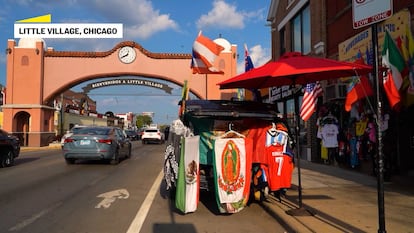
In Texas, where many immigrants’ first jobs are in restaurants, a survey by the Texas Restaurant Association found more than a third of restaurateurs said they lost employees this year to immigration enforcement. Half said they were already reeling from losses in 2025.
Nationwide, the construction industry needs to attract about 350,000 new workers this year to meet demand, according to the Associated Builders and Contractors organization. In 2027, that number is expected to jump to more than 450,000.
Labor experts warn of the myth that every immigrant worker deported means a U.S. worker can fill the job. Quite the reverse happens, said Elizabeth Cox and Chloe N. East, professors at the University of Colorado at Boulder. Their research found no evidence that bosses are increasing wages to attract U.S.-born workers.
Despite economists’ research, Treasury Secretary Scott Bessent told Fox News recently that real wage growth is coming and that the immigration crackdown is returning jobs to U.S. workers.
A U.S. Department of Homeland Security spokesperson also brushed off complaints that the crackdown was selectively hurting business sectors.
“Let’s be clear, if there was any correlation between rampant illegal immigration and a good economy, Biden would have had a booming economy,” the spokesperson said.
Foreign-born workers are concentrated in certain industries and occupations
Each grid represents 100 workers in the sector.
Source: Migration Policy Institute (MPI), July 2026.
Families, businesses wrecked
A deportation or detention can wallop a family business and shatter a family. That happened to Jason Quiroga, a U.S. citizen, when his Cuban-born wife was picked up by ICE at a scheduled check-in with immigration officials in Dallas. His construction business employed 16 people, but it floundered when he had to care for his toddler daughter and elderly father, roles his wife Niury had held.
Quiroga said he took on his detained wife’s legal case, filing pleadings himself after a bad experience with attorneys. The immigration system’s complexity astounded him. “Something has to change,” he said.
Lydia Gonzalez, a veteran caterer who runs the Latino Culinary Institute and Association, echoed the need for change. Immigrants from Mexico are the core of many restaurants’ staff, she said. No matter the soundtrack in the dining room, it’s Mexican rancheras and corridos in the kitchen.
But at a recent hearing on the ICE crackdown, co-organized by the Texas Civil Rights Project and others, Gonzalez testified in a crowded Dallas church that fear has overcome the local restaurant trade. Some employers now go out and pick up employees fearful of being stopped during work commutes. Others have cut hours because of shrinking staffs.
“It is going to continue to impact us for generations to come because we are being racially profiled and the heads of households are being deported on a regular basis,” Gonzalez said.
Pumping the brakes
This summer, Markwayne Mullin, Homeland Security’s top cop, appeared to signal that tapping the enforcement brakes was ahead in industries like agriculture. “Because this narrative that it steals American jobs is true in some industries, it’s not true for all industries,” Mullin said in a chat with Oklahoma Gov. Kevin Stitt at a meeting of the National Governors Association.
If not enough Americans are filling jobs, “we can plug those holes,” Mullin said, implying foreign workers could fill gaps.
The blowback was swift. Greg Bovino, former commander of the Border Patrol, said in an online post that Mullin “delivered a masterclass in how to give terrible answers.”
Mullin walked back his comments, saying “No amnesty for illegal aliens. Ever.”
But while it might not please the MAGA base, Trump has gone out of his way to plug some holes, as Mullin said. The administration increased H-2B visas, permits for lesser-skilled guest workers – the kind Mar-a-Lago employs. The permits are for seasonal, nonagricultural labor, like hotel work. Congress caps the permits at around 66,000 a year. But the Trump administration used its authority to add more than 64,700 “supplemental” emergency visas for businesses claiming they’d face irreparable harm without foreign workers.
Immigrants sustain food production across much of the country
Share of frontline farm and food processing workers who were born abroad, by county. Nationwide, it is more than 4 in 10.
Foreign-born, % of workers in the sector
Includes workers aged 16 and over in 10 agricultural and food processing industries. Estimates are calculated for census areas (PUMAs) that can span several counties, so neighboring counties may show the same share, and small counties should be read with caution. Data from 2014‑2018.
Source: Center for Public Integrity analysis of the Census Bureau’s American Community Survey (ACS), via IPUMS USA. publicintegrity.org
Joe Del Bosque, an organic melon and tomato farmer in California’s Central Valley, is a grower who worries about his crops. In full harvest, Del Bosque had dozens of workers from El Salvador working under Temporary Protected Status, traditionally granted to people whose home countries are deemed unsafe. With harvest winding down and after money-saving layoffs, his TPS workforce is now down to around two dozen.
After weeks of uncertainty over the future of TPS, the protection has been retained for 170,000 Salvadorans nationwide. But it’s been pulled from others. Some 350,000 Haitian workers in the U.S. lost their protection and their rights to work and stay in the country.
Why are Salvadorans treated differently? One answer might be the support – like access to a notorious maximum-security detention center – the Salvadoran government has given to Trump’s rampant deportation drive.
“Some … people have been with us for more than 20 years,” Del Bosque said. “They have families and have already sent their kids to college. They have bought homes. They have lives here.”
The H-2A seasonal farm guest worker program isn’t much of an alternative, Del Bosque said, because it requires employers to provide housing – a proposition too expensive for many farmers.
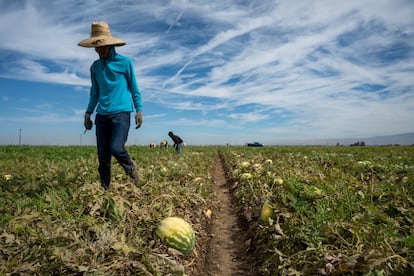
“It almost gives us fear to stand up and say we need some immigration reform because there are so many people who are adamantly against that,” Del Bosque said. “They refuse to admit that Americans won’t do this (work).”
Trump, however, has suggested that he agrees that Americans won’t do farm work, raising eyebrows with a remark that foreign migrants do grueling labor “naturally.”
The president has also tried to roll back some H-2A rules to cut farmers’ costs. With executive directives, he eliminated required wage rates and has tried to let employers deduct housing from workers’ wages. (Housing is free, by law, for H-2A workers.) A federal judge has challenged both Trump directives.
Like H-2B visas, Trump is familiar with the H-2A program. Records show that Trump Vineyard Estates in Virginia, owned by his son, Eric, received approval to bring in 36 H-2A workers in 2026. These guest worker permits do not create a path for workers to legally settle in the U.S.
A changed landscape
A few short years ago, scenes of migrants at the Rio Grande on the Texas-Mexico border were unforgettable. Some immigrants said touching U.S. soil was the best day of their lives, while people around the country were horrified by images of a Border Patrol agent on horseback, pushing back Haitian immigrants.

By mid-2024, the unauthorized immigrant population peaked at almost 16 million, up from about 11 million a decade earlier, according to the nonprofit Migration Policy Institute. Before Trump’s America First rhetoric became policy, President Joe Biden expanded humanitarian parole during his presidency, including issuing more TPS permits.
At the Dallas Federal Reserve, vice president and labor economist Pia Orrenius said the current crackdown is pushback to what many voters saw as an extreme migration surge.
“These extremes generate backlashes,” the economist said.
The growth of the unauthorized and temporarily protected immigrant population
The Migration Policy Institute (MPI) estimates that the unauthorized population grew by almost 5 million in five years, from 2020 to mid-2024.* It had remained fairly stable between 2010 and 2020.
* MPI counts as unauthorized certain populations with temporary protections, or whose protections were withdrawn. They include people who received humanitarian parole and those who had or still have Temporary Protected Status (TPS).
Source: Migration Policy Institute (MPI), July 2026.
See data table
| Year | Unauthorized population |
|---|
In Florida, businesses dependent on Haitian immigrants, like care providers for seniors, are scrambling to draw up a plan B.
Jewish Community Services of South Florida reluctantly laid off 18 Haitian homecare workers when their TPS expired. Now, with deportation flights underway, they’re at risk of being sent home to one of the Western Hemisphere’s most violent, impoverished nations. The nonprofit agency employs more than 300 homecare workers who serve hundreds of older people, including Holocaust survivors.
The service now struggles to fill vacancies in an industry already beset with worker shortages and rising overtime for remaining staff.
“We are heartbroken we had to do this,” spokeswoman Alicia Vigil Blanco said of the layoffs. “Some of them had been employed by us for years.”
Vigil Blanco said clients of Jewish Community Service, many of them homebound seniors, were saddened and confused by the sudden loss of beloved companions. Immigrant workers helped them bathe, dress and eat, and listened to their stories. They even prayed with them and took them to doctor appointments.
“A good number of our clients don’t have any family left and have no one else nearby to help them,” Vigil Blanco said.
Denise Belville, executive director of the Home Care Association of Florida, said two agencies closed after TPS ended for Haitian workers. Each company terminated at least 80 employees.
Belville said Florida’s home and health care industries have been battered by the end of TPS for 113,000 Haitians. Their clients are also devastated, with “no one now to take care of them,” she said.
Cascading problems
In Mission, Texas, Eliud Cavazos, CEO of 57 Concrete, felt the worsening sting of ICE raids. In filings to support the company’s Chapter 11 bankruptcy, he said his business was hit with a “sudden and sustained decline” in orders from residential builders that coincided with increased ICE enforcement.
Builders experienced “acute labor shortages, work stoppages, and project suspensions,” said the CEO’s court filing.
In a phone interview, Cavazos added, “They are just going to residential areas and hunting people in subdivisions.”
To adjust, he’s drummed up new business in commercial construction, which hasn’t yet faced the same enforcement scrutiny. He’s working in Brownsville, where Elon Musk is expanding SpaceX rocket operations and a liquefied natural gas storage project is underway.
Fear of more ICE interference has led to desperate theater. The South Texas Builders Association recently took to social media with a video featuring the group’s head of government relations, Benny Melendez, dressed like an ICE agent at a construction site.
Facing the camera, he takes off his balaclava and says, “Only cowards hide under a mask.” Then he strips off a heavy bulletproof vest and dons an orange construction vest and white hard hat, a hammer in hand.
“Our cities and especially our industry are being really affected by ICE operations…Sooner than later, we will all feel the negative impact on our wallets.”
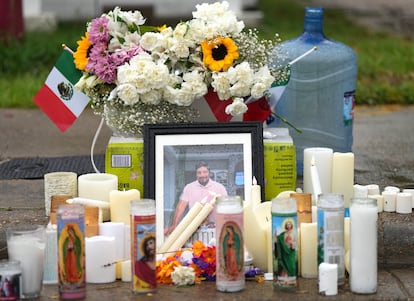
Melendez then invokes Lorenzo Salgado, the Mexican construction crew boss whose July 7 killing by an ICE agent provoked demands for accountability. “What happened to Lorenzo Salgado in Houston, Texas, just crossed all the lines,” Melendez says.
A dream deferred
Across the border, in Mexico, deported workers try to build new lives.
Ivan Parras, a 33-year-old brought to the U.S. as a child from Mexico City, was a Dreamer. Like 495,000 others, he benefited from Deferred Action for Childhood Arrivals, or DACA. Parras held a work permit, became a member of the Teamsters union, and drew a good salary building temporary structures for trade shows in Las Vegas.
Then, a drunk driving charge mushroomed into a deportation.
He left behind a partner and a daughter.
“I always had a really good job installing booths,” said Parras, now a call-center worker in Mexico City. “I always had a good salary, cars, money. I still help provide for (my family), but making pesos isn’t the same as dollars.”
Alfredo Corchado contributed to this story, reporting from Chicago.
Dianne Solis wrote for The Dallas Morning News and The Wall Street Journal, collectively for more than three decades. She is now an independent writer and editor based in Dallas, specializing in immigration, justice and borders.
Anita Snow spent more than 35 years with The Associated Press covering Latin America and the U.S. Southwest. She is now an independent writer based in Tucson, Arizona, focused on immigration, the border and the environment.
Susan Ferriss has covered immigration for more than 30 years, as a reporter for newspapers in California, a Mexico correspondent for the Austin-American Statesman, and an investigative reporter at the Center for Public Integrity. She is a senior editor at the Pulitzer Center on Crisis Reporting.