
Homeland Security secretary says ICE could be at polling places during November elections
Mullin says agents will not patrol voting sites but could go there if there is a threat or to execute an arrest warrant
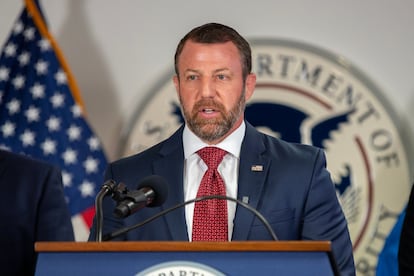

For months, Donald Trump’s administration has sought to dispel concerns about a possible presence of immigration agents at polling places during the November elections. But new comments from Homeland Security Secretary Markwayne Mullin have left the door open: although Immigration and Customs Enforcement (ICE) will not be deployed to patrol polling locations, its agents could go there if they determine there is a threat or if they need to arrest a wanted person. The possibility that this could happen has been viewed by some as a potential scenario for voter intimidation amid the election process.
Mullin sought to draw a distinction on Tuesday during a news conference in New York. “ICE isn’t there to patrol the polling places. We’re there to enforce specific threats,” he said. When asked under what circumstances agents could go to a polling location, he was more specific: “The only reason why we would be at polling places is if there is a threat to that polling place or we’re serving a warrant on someone that we have been actively tracking down.”
The secretary insisted that the agents’ duties would not change simply because it was Election Day. “ICE’s job is immigration, customs enforcement. That’s their job … if we’re serving a warrant we will be where we need to be,” he added.
The comments contrast with assurances that the Department of Homeland Security had offered months earlier. In February, Heather Honey, then DHS assistant deputy secretary for election integrity, told state election officials during a call that ICE would not be present at polling places during the midterm elections. “Any suggestion that ICE will be present at polling places is simply misinformation,” she said, according to participants in the meeting. “There will be no ICE presence at polling places,” she added at the time.
DHS now maintains a position similar to the one expressed by Mullin. The department said ICE “is not planning operations targeting polling locations” and that its agents conduct intelligence-driven, targeted enforcement operations. If an active public safety threat endangered a polling location, the department added, a person could be arrested as a result of that operation.
In addition, a senior DHS official told NBC News that ICE agents have not received instructions to do anything beyond their regular duties on Election Day in November. In other words, there is no order to deploy them to polling places, but neither is their presence there ruled out if the circumstances described by Mullin arise.
The possibility has raised concerns among Democrats and voting-rights groups, which have warned for months that the presence of federal agents could intimidate voters and depress turnout. Those concerns grew after Steve Bannon, a former Trump adviser, said on his podcast that in November, “we’re going to have ICE surround the polling places.” The White House, for its part, has played down the possibility of such a deployment, although Trump has not explicitly ruled out federal agents being near polling locations.
The discussion also comes as the Trump administration seeks to intensify scrutiny of voter rolls in search of noncitizens who may have voted, something studies have shown to be extremely rare. In July, Mullin said: “We will scrub all election records, looking for illegal aliens and those who are ineligible to vote.”
Trump and Mullin have also claimed, without providing evidence, that more than 250,000 noncitizens are on voter rolls in several states. State authorities have challenged some of these initiatives, and several election officials have resisted turning over private voter-roll data that can include personal information.
The administration has devoted federal resources to investigating the alleged voting of people who are not eligible to participate in elections. But the evidence presented so far does not support the scale of some of its claims. In Nevada, for example, DHS officials initially said there could be about 16,000 noncitizens registered to vote, but later acknowledged that only 185 could be confirmed as people who were actually noncitizens.
Meanwhile, Joint Chiefs Chairman Dan Caine recently told Sen. Elissa Slotkin that the military also has no plans to deploy troops to polling places during the November elections. “The joint force has no plans to send federal military personnel or federalized members of the National Guard to polling places during the 2026 elections,” he wrote.
Sign up for our weekly newsletter to get more English-language news coverage from EL PAÍS USA Edition









































