
Judge orders return of Mexican cartel witness deported three times by ICE
The migrant was a witness in cases against drug traffickers before being sent first to Guatemala and then twice to Mexico
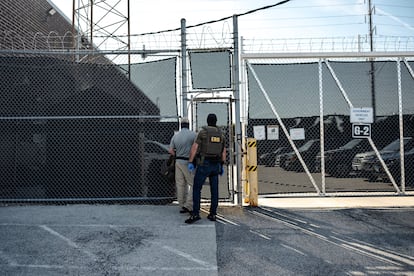

The fact that a Mexican migrant had risked his life by providing information to the U.S. government and testifying against cartel members did little to help him. U.S. Immigration and Customs Enforcement (ICE) nevertheless held him in custody for six months and then deported him three times: first to Guatemala and then twice to Mexico, most recently to an area with significant drug-trafficking activity, according to a lawsuit filed in a Maryland court.
The Justice Department cooperating witness, identified in court filings under the standard pseudonym “John Doe,” was removed to Mexico in early August. “He has been in hiding since that date, fearing that the cartels that he provided information against will find him and torture or kill him before he can return to the United States,” according to a memorandum issued by U.S. District Judge Stephanie A. Gallagher.
On August 21, a day after John Doe sued Trump administration officials in federal court in Baltimore, Gallagher found that the witness faced a substantial risk in Mexico and gave the government 14 days to “take active steps [...] to facilitate Doe’s return to the United States.”
“There is an immense public interest in ensuring that persons who risk their personal safety to assist the government in prosecuting wrongdoing are not placed in harm’s way by the very entity they assisted,” Gallagher wrote in the 16‑page memorandum.
Attorneys for John Doe were not available to say whether the court order has already been carried out. The Department of Homeland Security (DHS), meanwhile, did not respond to a request for comment.
People who cooperate with U.S. authorities may receive a range of benefits, depending on the circumstances and the value of the information they provide: from reduced sentences and avoiding prison time, to obtaining immigration status or entering the witness protection program, which relocates them to safe sites within the United States, provides temporary financial support and gives them new identities. Family members may also be included in the protection measures.
The government has relied on such programs for decades to encourage cooperation from individuals who assist in investigations and prosecutions involving drug traffickers, organized crime figures and gang leaders.
An odyssey across three countries
John Doe, the father of two children, provided testimony “against defendants affiliated with Mexican drug cartels,” according to the lawsuit. In July 2024, an immigration judge granted him protection from removal under the Convention Against Torture (CAT) after finding it was possible that he “was more likely than not to be tortured by the government or by individuals acting with the acquiescence of the government if he were returned to Mexico.” The court filings do not specify the criminal cases in which he cooperated or why Mexican authorities might be involved.
ICE released him at the end of that year. But in January 2026, when he appeared for a routine immigration check-in, the agency took him back into custody. He spent six months in a Louisiana detention center, during which his attorney filed a habeas corpus petition requiring the government to justify his continued detention before a judge. The effort proved futile.
What followed was an odyssey through three countries and a series of detention cells. Without prior notice, he was deported to Guatemala on July 10. Guatemalan authorities refused to accept him and turned him over to Mexican officials for transfer to Mexico. But after John Doe’s attorney informed them that his client was protected under the Convention Against Torture, Mexican authorities decided to return him to the United States.
Upon arriving at an airport in Texas, he was again taken into custody without being allowed to speak to either his family or his attorney. On July 15 or 16, he was deported for a second time, this time to Mexico. Mexican authorities again refused to accept him and sent him back to the United States. He then spent 10 days in detention before being taken to the Texas border on August 1 and deported to Mexico for a third time, “without his phone or other personal belongings.”
The lawsuit argues that the Trump administration placed him in extreme danger. John Doe “was sent to a region of Mexico where there is cartel activity, without any of his money […] reliant on the help of strangers while attempting to remain in hiding,” the filing says.
Judge Gallagher ordered that if John Doe is detained again, he must be held at a facility no more than 200 miles from Baltimore and be given access to his attorney.
Sign up for our weekly newsletter to get more English-language news coverage from EL PAÍS USA Edition









































