105-year-old suspect in Nazi crimes case dies during investigation
Prosecutors were investigating J. S. on suspicion of complicity in murder during the four months he served at a German prisoner-of-war camp
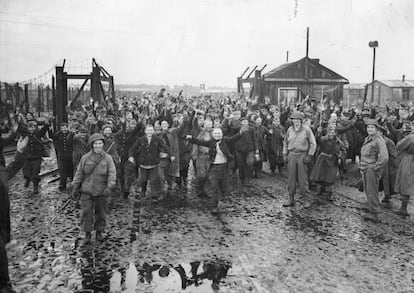

J. S. was one of the best-known residents of a small town in western Germany. At 105, he regularly featured in local media reports marking his birthdays, and the mayor honored him as a revered centenarian. What many of his fellow townspeople did not know was that he had also served as a guard at Germany’s largest prisoner-of-war camp during World War II: Stalag 326. At least 15,000 inmates, most of them Soviet soldiers, died there under inhumane conditions, although some estimates put the real death toll as high as 70,000.
Since September, prosecutors in Dortmund had been investigating J. S. on suspicion of complicity in murder during the four months he served at Stalag 326. The investigation ended with his death on October 12. His family, which declined to speak to EL PAÍS, later informed local media of his passing. EL PAÍS contacted the prosecutor’s office twice after that date, but officials did not disclose that the suspect had died.
Two court cases, in 2011 and 2016, transformed the way the German justice system could pursue Nazi crimes. The first resulted in the conviction of Ivan Demjanjuk, a guard at the Sobibor concentration camp in occupied Poland; the second involved Oskar Gröning, an accountant at Auschwitz. These two cases established that prosecutors no longer had to prove a defendant’s direct involvement in a specific killing to bring charges, so long as they had contributed to the functioning of a camp where systematic murder took place.
Following these two convictions, criminal liability was no longer limited to those who planned the crimes, issued the orders, carried them out or directly assisted in them, such as the person who pulled the trigger or forced victims into the gas chambers. Potentially, anyone who played a role in the operation of a camp could be held responsible. The new legal reasoning was that such individuals formed part of the Nazi killing machinery, were aware of its purpose, and nevertheless chose to remain part of it.
Time is running out for Germany’s Central Office for the Investigation of National Socialist Crimes. Since 1958, the agency has been responsible for identifying suspected Nazi perpetrators and passing its findings to prosecutors in the country’s federal states. Time is running out, stresses its director, Attorney General Thomas Will, because very few people connected to that era, whether perpetrators or victims, are still alive. According to the Federal Statistical Office, only 17,900 people aged over 100 remain in Germany today, meaning they were adults when the war ended.
Will says the office focuses its investigations on camps where mass killings took place. The most recent case made public by the Central Office is that of J. S. Will did not say how investigators identified him, but explained that his department cross-references information from multiple archives, including its own records, the German Federal Archives, files consulted in Russia before the invasion of Ukraine, and archives maintained by concentration-camp memorial organizations, among others.
Living 3 miles from the camp
One of the most striking aspects of J. S.’s case is that he lived in his hometown only three miles from Stalag 326. Oliver Nickel, director of the camp’s memorial site, speculates that J. S. may have been sent back home for health reasons and, while still formally in military service, assigned to guard duty at the camp. Wounded or ill German soldiers were often reassigned to such duties rather than returned to combat.
On October 4, relatives of J. S. gave the regional newspaper Neue Westfälische their account of his wartime service. The paper did not identify either the suspect or his family, and EL PAÍS is likewise withholding their names because J. S. was never formally charged and was not a public figure.
A lathe operator by trade, J. S. was drafted into the Wehrmacht, the German armed forces, at the age of 21 in 1942. His family maintains that he was never a member of the Nazi Party, and his name does not appear in public records on Nazi Party affiliation.
He was initially deployed to Ukraine. According to the family’s account in Neue Westfälische, the centenarian was traumatized by his experiences on the Eastern Front throughout his life. In early 1943, he contracted malaria in Odesa and was sent to a military hospital in Vienna. The family says he was later declared unfit for frontline service and, in 1944, transferred as a guard to the Staumühle camp, a forced-labor satellite facility of Stalag 326 located near his hometown.
Andreas Brendel, Dortmund’s chief prosecutor, told EL PAÍS that investigators had established that J. S. served at Stalag 326 itself. He also said that J. S. was stationed there earlier than his family claims, from December 1943 to April 1944. Beyond that, Brendel declined to comment on other details of the family’s account.
In interviews with local media marking one of his recent birthdays, J. S. said he had been captured by U.S. troops at the end of the war in May 1945. “Grandfather is a great storyteller. When he talks about the war, you can tell he experienced it firsthand,” one of his grandsons told the newspaper Westfalen-Blatt in 2024.
Murder has no statute of limitations under German law. Had J. S. lived to stand trial, he would have become the oldest person ever prosecuted for crimes linked to the Nazi era. In a statement, the Dortmund prosecutor’s office added that it had been pursuing a similar case since 2025 involving a 99-year-old man who died shortly thereafter. The same has now happened in the case of J. S.
The oldest person ever convicted of Nazi crimes was Josef Schütz, a former guard at the Sachsenhausen concentration camp, who was sentenced in 2022 at the age of 101. He received a five-year prison sentence but never served it; he died in 2023.
“It’s incredible that this man is alive, a local, and we cannot count on his testimony; perhaps it would be more useful to put him on trial,” Nickel said before learning of J. S.’s death. The director of the Stalag 326 memorial said he was unaware of J. S. ever having visited the site, but stressed the importance of obtaining first-hand testimony about what happened at the camp. “We cannot say what he did, but we do know what he witnessed,” Nickel adds. “The prisoners’ conditions, especially those of Soviet prisoners, were dire because of hunger, tuberculosis and other deadly diseases.”
One complication is that suspected Nazi perpetrators have generally been far less forthcoming than survivors. That pattern was evident in numerous trials, including that of Bruno Dey, who was convicted in 2020 and given a two-year suspended sentence for aiding and abetting the murder of more than 5,000 Jews. Dey had been an SS guard at the Stutthof camp when he was 17. Declared unfit for frontline service because of health problems, he was assigned to the camp, which was notorious for its gas chamber, crematorium and the mountain of shoes confiscated from victims that greeted new arrivals. He was 93 when the verdict was handed down.
In Last Verdict, his account of the Dey trial, journalist Tobias Buck describes the striking contrast between the defendant’s professed lack of memory and the vivid, detailed testimonies of survivors.
Buck uses extensive information to illustrate the “paradigm shift” brought about by the Demjanjuk ruling. He also explores the sense of unfairness it can create for defendants such as Dey, given that thousands of Nazis who bore far greater responsibility than rank-and-file camp guards were never convicted, or even prosecuted.
In Last Verdict, Buck presents stark statistics. In 1949, the year the Federal Republic of Germany was founded, 4,000 former Nazis were charged and 1,474 were convicted. Five years later, the number of trials had fallen to just 49. By 1984, nearly four decades after the end of World War II, only one person was convicted of Nazi crimes. In the two decades that followed, just 33 people were prosecuted, resulting in 18 convictions.
The “paradigm shift” has helped revive the work of the Central Office for the Investigation of National Socialist Crimes. Between 2011 and 2026, it referred 131 cases to prosecutors, though only 15 proceeded to trial and five ended in convictions.
Another argument frequently raised by defendants such as Dey is that refusing to obey orders was impossible. “Would I have acted differently if I had been 17 in Nazi Germany? Would I have had the moral conviction and civil courage to climb down from the watchtower, lay down the weapon and say ‘enough’?” Buck asks.
According to his family, J. S. was compelled to join the military. At public events marking his birthdays, he appeared to be in good physical and mental health. He was due to turn 106 in three months. Asked by Neue Westfälische in January about the secret of his longevity, he said it was daily exercise — these days in an electric mobility scooter — and allowing himself small pleasures, such as a shandy or a glass of liqueur. Above all, he said, he had simply been fortunate: “I’ve just been lucky in life.”
Sign up for our weekly newsletter to get more English-language news coverage from EL PAÍS USA Edition