
The SS policeman who hunted his criminal comrades from within the Nazi system itself
A biography recounts the extraordinary career of Konrad Morgen, who brought 200 SS members to trial, including concentration camp commandants, and even dared to investigate Adolf Eichmann

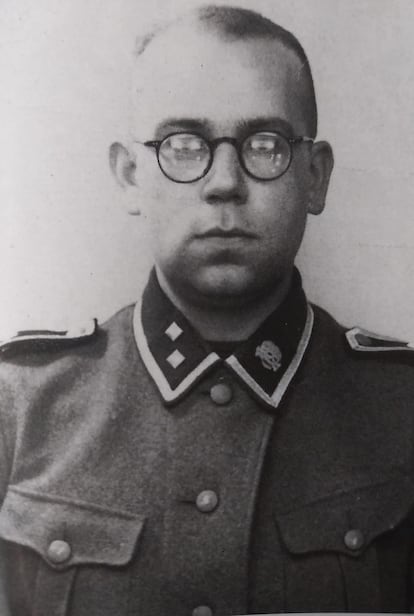
Konrad Morgen, with the face of a gray-haired office worker or a high school nerd, who did not immediately appear intimidating even when squeezed into his SS uniform, bears no physical resemblance to the tough fictional detective Bernie Gunther, created by the late writer Philip Kerr, who also investigated crimes from within the police system of the Third Reich. But that man with the bottle-bottom glasses and the air of a bland bureaucrat was someone real. A judge and SS policeman who lived an extremely dangerous life acting against his own comrades on the razor’s edge of the perverse Nazi judicial system and using what remained of the law in the corrupt and amoral Hitlerian universe to investigate and bring to justice a whopping 200 members of the organization.
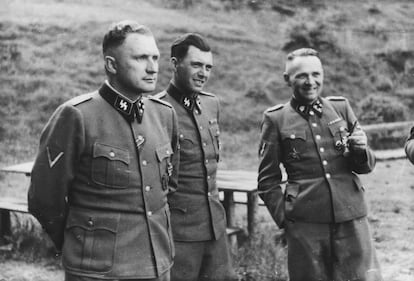
Morgen’s list includes high-ranking officials and even concentration camp commandants, the elite of the SS, of whom he personally arrested five, two of whom were executed. He acted against such lethal figures as Oskar Dirlewanger, leader of the most brutal and degenerate brigade of combatants in the Waffen-SS; Karl-Otto Koch, commandant of Buchenwald (he also arrested his wife, Ilse Koch, notorious for her cruelty and lasciviousness); Colonel Hermann Fegelein, Hitler’s future brother-in-law, or Amon Göth, commandant of the Kraków-Plaszów camp, portrayed by Ralph Fiennes in Schindler’s List. He even dared to put Adolf Eichmann, the architect of the Final Solution, under his microscope and went to Auschwitz to investigate corruption and murders (at Auschwitz!), confronting its exasperated commandant Rudolph Höss, who could not understand the point of a police investigation in the midst of the greatest crime committed in the history of humanity.
Morgen (Frankfurt, 1909-1982) managed to deliver justice — or at least a little of it — in a world where justice seemed impossible. How he did it, somewhat like The Untouchables and Al Capone, is one of the most extraordinary stories of the Nazi era and World War II.
A recent biography of Konrad Morgen, Hitler’s Crime Fighter (Biteback Publishing, 2024), by the British historian David Lee, analyses the figure of the unusual judge and SS police official and, without avoiding the controversial aspects of his career and personality (which have predominated in other examinations of the character), opts for a favourable verdict, considering that his role as a true SS cog concealed a genuine moral indignation at the Holocaust and even an attempt, to the extent possible, to put a spoke in the wheels of that atrocity.
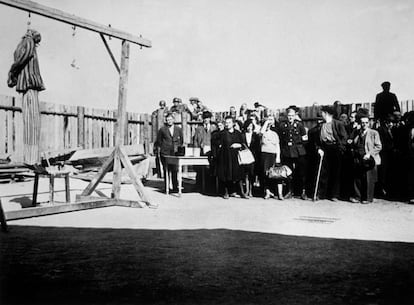
Praised by scholars such as historian Helen Fry, the book delves into Morgen’s surprising career — he miraculously survived his dangerous work and the Second World War — and exposes the reader to the mind-boggling string of 800 cases opened due to his tenacity within the SS against its own members. It is difficult to explain how, within the Third Reich, in an eminently criminal state, it was possible to investigate and prosecute (and even condemn to death: Karl Koch was shot) people who were part of the regime’s own repressive and murderous apparatus. But Morgen took advantage of the legal loopholes remaining in Hitler’s Germany, where two legal systems overlapped: the mainstream, customary in all civilized countries, and Nazi laws. Morgen couldn’t investigate and prosecute members of the SS for the genocide they were perpetrating, but he could, paradoxically, do so for corruption or for illegal killings (that is, outside of orders issued by the Reich leadership, especially Heinrich Himmler and ultimately Hitler). It’s almost laughable (the black, sardonic laugh of a Bernie Gunther) to imagine the expression on the face of an SS officer whom Morgen called to testify for an unjustified murder while he was working flat out in the Majdanek extermination camp, where 360,000 people were killed, an average of 250 a day for four years. This stupefaction is perceptible throughout all the investigations and cases carried out by the SS investigator. The accused are incredulous: so, we can kill hundreds of thousands of people in a thousand horrendous ways, but not that one? Can we steal like crazy all over Europe and strip the victims of even their gold teeth, even though we can’t keep anything for ourselves?
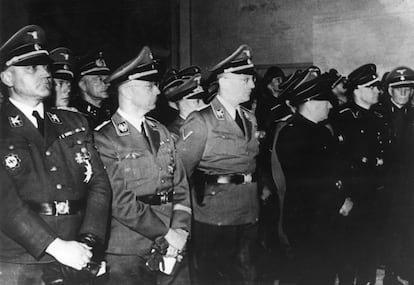
In Himmler’s insane logic, Lee recalls, quoting Peter Longerich, the great biographer of the Nazi leader, the SS had to act “decently,” even in crime. And, of course, all the profit derived from the persecution and murder of the Reich’s enemies had to go, without exception, to the state coffers (and the SS treasury). Himmler didn’t want to be robbed, of course, what villainy. That’s what Morgen was clinging to, acting on the direct orders of the Reichsführer-SS to pursue SS members who flouted the organization’s rules and code of honor. One of the problems Morgen — a thorn in the side of the SS — faced was that his prosecution witnesses quickly disappeared.
Himmler forced him to desist several times, as in the case of the Eichmann investigation over some stolen diamonds: he could not be stopped since he was carrying out, he was told, a secret task of the utmost importance to the Führer.
It is debatable (and some scholars have questioned his motives) what ultimately guided Konrad Morgen, an SS officer (he held the rank of Sturmbannführer, or major), a member of the party since 1933, and a man completely enmeshed in the Nazi police and judicial mechanisms. He has been painted as a crusader of Himmler’s extravagant morality and was even accused of having assisted in a medical experiment using poison on Russian prisoners of war. What is indisputable is that he risked his neck by confronting powerful and extremely dangerous senior officials in the organization — his main nemesis was Oswald Pohl, head of the SS’ economic and administrative department — and even by provoking the anxieties of truly diabolical figures who were beyond his real punitive capacity. Several times he was stopped in his tracks — ultimately the regime could not do without its best assassins — and on one occasion, in 1942, he was even stripped of his rank and sent to fight on the Eastern Front as a private in a very tough Waffen-SS combat unit with a very high casualty rate (the SS Panzergrenadier Regiment Germania, part of the Viking Division), a way of getting rid of the annoying, nosy, pain-in-the-ass bureaucrat.
Surprisingly, Morgen (a character who is crying out for a film) returned from the front line in May 1943 — Himmler had called him back for another job, investigating corruption at Buchenwald: his career is very reminiscent of that of Kerr’s detective — not only alive but as a soldier who performed to the best of his ability and even received the Infantry Assault Badge.
Morgen’s fascinating career in the SS judicial section, which Lee follows meticulously case by case — among the most mind-boggling is that of the Buchenwald doctor Waldemar Hoven — allows us to observe the unique twists and turns of police action and justice in the Third Reich. The real-life doppelganger of Bernie Gunther, Kerr’s detective, of whose novels David Lee professes to be a devoted admirer, faced similar moral challenges, even having the same superiors, such as Arthur Nebe, who saw no contradiction in being a senior detective in the criminal police (Kripo) and commander of an extermination group, Einsatzgruppe B, with 45,000 deaths to his name. After the war, Morgen, who was denazified in 1948, continued his work in the field of justice and testified as a witness in various trials against Nazi criminals, including those at Nuremberg. His research allowed Morgen to witness Nazi atrocities firsthand, such as the tour organized for him of the extermination machinery at Birkenau or the results of the massacre of Jews during Operation Harvest Festival, Aktion Erntefest, in Lublin in 1943, while he was investigating Christian Wirth, head of the death camps in Poland.
His personal life was marked by his affair with a woman, Maria Wachter, whom the SS refused to allow him to marry because she opposed the regime, and whom he married after the war. David Lee points out that Morgen, who described himself as a Gerechtigkeitsfanatiker (a “fanatic for justice”), would not have seemed as attractive a figure as Bernie Gunther: he lacked his cynical Berlin sense of humor and existentialism, and his turbulent love life; he was deeply rooted in traditional German values and had a strong sense of honor. But both — the real and the fictional police officer — put their detective talents at the service of the most terrible employers imaginable, and had the audacity and courage to break their rules.
Sign up for our weekly newsletter to get more English-language news coverage from EL PAÍS USA Edition









































