
‘Riefenstahl’: The lies of a visionary filmmaker who created the epic visual of Nazism
A highly recommended documentary delves into previously unpublished archives of the director of ‘Triumph of the Will’ to decipher one of the most influential and uncomfortable artists of the 20th century


There will never be a consensus on Leni Riefenstahl — some of us will never even be able to resolve our own feelings on her. The woman who created the epic visual of Nazism, the evil witch of film history, is one of those hateful people who, just as her movies, is ultimately fascinating. Andres Veiel’s highly recommended documentary Riefenstahl is now available on streaming platforms. On the Spanish service Filmin, it was presented alongside two of the most important pieces of propaganda in the history of German film, Riefenstahl’s Triumph of Will and Olympia, two movies whose technical and aesthetic influence continue to this day.
Veiel’s documentary clears up many of the lies told by a restless woman who spent half of her life (born in Berlin 1902, she died in 2003 at 101 years old at her home in Bavaria) trying to justify the unjustifiable in the name of art. Beginning in the 1960s — when she embarked on her project with the Sudanese Nuba people — Riefenstahl began to appear on interview programs to speak about her life. A large part of the televised footage that Veiel utilizes comes from those years, during which the filmmaker made a forced attempt to paint herself as innocent, even as her tortured facial expressions gave her away.
Riefenstahl shows a tenacious, manipulative woman who, along with her spouse and business partner — director of photography Horst Kettner, 40 years her junior — recorded telephone calls and collected letters from her numerous ardent followers. Those anonymous admirers justified Riefenstahl’s mantra: she only had been as Nazi as 90% of all Germans, and found out about the atrocities of the Third Reich after the war. Veiel’s documentary dismantles that theory through scrutinizing unpublished material from the 700 boxes of the filmmaker’s personal archives, which fell to the care of the state-run Berlin foundation Preßischer Kulturbesitz after her death.
After a childhood characterized by an authoritarian and abusive father who left her hardened for life — and who surely cauterized her compassion for others — Riefenstahl was left with only lies to keep her afloat. In The Wonderful Horrible Life of Leni Riefenstahl (an essential 1993 documentary by Ray Müller) the actress, director and editor insists on comparing herself to her compatriot Marlene Dietrich. The careers of both women took off in parallel in the late 1920s, and according to Riefenstahl, when Dietrich was filming The Blue Angel, its director Josef von Sternberg pointed out how much the two had in common.
There were certainly similarities; both were perfectionists to the point of madness, with astonishing strength and determination. But their differences wound up being more important. With all the talent in the world, the two made opposite life choices: Riefenstahl stayed in Germany, making a deal with the devil. Dietrich went into exile and denounced the seeds of hatred and destruction that had been planted by the Third Reich.
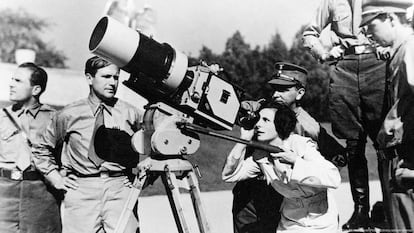
That story about the words of Von Sternberg forms part of the lies and half-truths that Riefenstahl told herself and others throughout her long life. Müller’s documentary — which was sponsored by Riefenstahl herself, and therefore enjoyed privileged access — was broadcast when Riefenstahl was 90 years old, at a time when her name still verboten in Germany. That film’s echo resounds in Veiel’s work through previously unseen outtakes in which, for example, we see Riefenstahl lose her temper when Müller contradicts her version of her relationship with the Third Reich’s Minister of Propaganda, Joseph Goebbels.
Riefenstahl chillingly paints Nazism in a positive light, and it is impossible, despite her best efforts, to separate her films from their context. But her work during the 1960s and 1970s with the Nuba people is revealing, and perhaps even more fascinating. Riefenstahl’s obsession with the African body had in fact started during the making of Olympia, when she observed the Black American athlete Jesse Owens run. But it was a photograph of two nude African women, and apparently, her reading of Hemingway’s Green Hills of Africa that led her to live with the tribe for months in Sudan, capturing their physical perfection.
Her project with the Nuba (whose execution was also sprinkled with little white lies) did not provide the exoneration for which Riefenstahl hoped. In her obsession with perfect beauty, the Nuba became the subject — according to a renowned analysis by Susan Sontag — of “the third in her triptych of fascist visuals.” Once more, her fixation on myth over truth and history unmasked her real self.
'Riefenstahl'
Director: Andres Veiel.
Genre: documentary, Germany, 2024.
Runtime: 115 minutes
Translated by Caitlin Donohue.
Sign up for our weekly newsletter to get more English-language news coverage from EL PAÍS USA Edition









































