
Hunting down a Nazi with AI
The use of artificial intelligence in an investigation into the disappearance of an SS officer did not lead to the expected results

I’ve spent a few intense days hunting down an old Nazi. In a prime example of new-new journalism, I enlisted the help of AI, but I have to say things didn’t go as planned: AI can really mess things up. It all stemmed from reading Revenge of Odessa, the posthumous sequel to Frederick Forsyth’s celebrated novel, and also from stumbling upon an old 2001 film on Netflix in which a rather clumsy fellow reinvents himself as a journalist.
The film is The Shipping News, based on the beautiful 1993 novel of the same title by Annie Proulx, which has lines that keep you thinking for a long time, such as “one of the tragedies of real life is that there is no background music,” “the sky a net, its mesh clogged with glowing stars,” or, more relevant to our discussion: “Where are the reporters of yesteryear, the nail-biting, acerbic, alcoholic nighthawk bastards who truly knew how to write?”
In the film, the shy and downtrodden Quoyle (played by Kevin Spacey) ends up in Killick-Claw, a small fishing village in Newfoundland, his family’s ancestral home, and gets a job at a local newspaper, The Gammy Bird, where he’s hired as a writer despite his only experience being as an inker at a New York daily. A seasoned veteran journalist, Billy Pretty (Gordon Pinsent), gives him invaluable professional advice for getting ahead. “You have to find the center of your story, its beating heart,” he tells him. He advises him to start by making up some headlines, “short, impactful and dramatic.” And he invites him to look at the horizon and say what he sees. “Is the horizon filled with dark clouds?” Quoyle suggests. “An imminent storm threatens the town,” Pretty corrects. “But,” Quoyle questions, “what if no storm comes?” “Town safe from a deadly storm.”
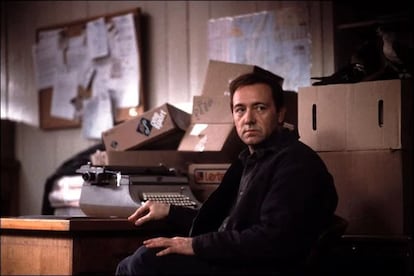
Our man learns quickly and triumphs with a story about Hitler’s former yacht, which, acquired years after the war, supposedly ended up one day in the local port. The success of the story affords Quoyle the privilege of having his own column about ships, “The Shipping News,” a subject he actually knows nothing about, since he’s even afraid of the sea: a superb metaphor for how far you can go in a newspaper.
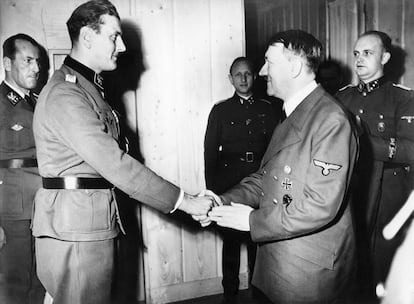
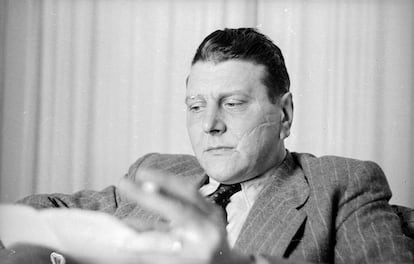
Reflecting on the film, I thought about how I could return to the essence of my profession while simultaneously taking a qualitative leap in my craft. And then came Odessa. Reading the sequel about the Nazi organization led me to reread the original novel, published in Spanish in 1973. And an absence caught my attention: was it possible that Otto Skorzeny, the former Waffen-SS colonel who took refuge in Spain and has always been considered one of the key figures in the Nazi escape network, didn’t appear in the plot? Skorzeny, Hitler’s former commando chief and famous for his role in freeing Mussolini from his confinement on Gran Sasso, was even placed at the center of the Odessa (Organisation Der Ehemaligen SS-Angehörigen, or Organization of Former SS Members) web by Almudena Grandes in her novel Los pacientes del doctor García (The Patients of Dr. García). How did Forsyth overlook mentioning him in his novel, for which he conducted in-depth research that revealed the escape routes of the treacherous Nazis and cited Eichmann, Mengele, SS General Bruno Streckenbach, Bishop Hudal, or the novel’s central brown-shirt protagonist himself, the Austrian captain Eduard Roschmann, commandant of the Riga ghetto — a real-life figure (though his many crimes did not include plotting to devastate Israel with deadly rockets, as in Odessa)?
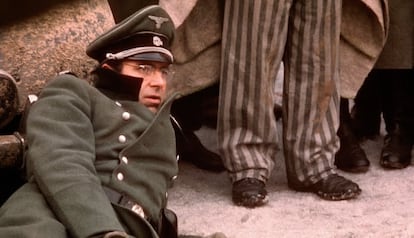
It’s true that Forsyth made some inaccuracies in his novel, such as using SS General Richard Gluecks, who had actually died at the end of the war, as a key figure in the shadow Nazi organization. But Skorzeny’s absence, even though there’s a scene in the novel set in Madrid, aroused suspicion in my sharp journalistic instincts, usually quite excited when it comes to hunting Nazis. Then I had a sudden inspiration. What if Skorzeny did appear in Forsyth’s original novel and had been omitted from the Spanish edition, published during the final years of the Franco regime?
Thanks to a thoughtful and kind reader, Evelio Montes, I learned that the translation contained glaring errors and what appear to be acts of censorship. For example — I’ve checked — the Spanish version states that Peter Miller, the protagonist journalist, wakes up in bed next to his girlfriend, the beautiful stripper Sigi, positioned so that “the woman’s back was pressing against the base of his stomach,” while in the original, it’s her buttocks that are pressing against him, which, it must be said, is a different situation. And there’s no trace of Forsyth’s emphatic line that follows, “automatically he began to erect.”
I have found other similar omissions, such as Sigi liking Peter to caress her “crotch,” her inner thigh, or the scene in which he starts kissing her breasts, to which she responds with a series of “long mmmms” (we already knew from The Day of the Jackal that Forsyth knew how to heat up his thrillers).
Ok, if we’re talking about Nazis, we’re talking about Nazis, but those omissions in the translation made me think that perhaps Skorzeny’s absence was a similar, premeditated omission. And that’s where my recourse to AI comes in. I used Google’s, which comes up by default when I search for something. I decided to try and asked, just to cut to the chase, “Does Otto Skorzeny appear in Odessa?” The AI’s response, whoever it was, thrilled me. “Yes, Otto Skorzeny appears and is a key figure in the novel’s plot” […] “he is described as the organizer of the network that facilitated the escape of Nazi war criminals from Germany to Spain (ratlines), after the defeat of the Third Reich.” Since he doesn’t appear in the Spanish edition, I deduced that someone had omitted Otto. In 1973, the imposing colonel was still alive (he died in 1975) and in Madrid, on very good terms with the regime (and even with my father). Was someone pressuring to have him removed from the novel in Spain? Perhaps he himself? Odessa itself? Was the Spanish version of Forsyth’s book hiding Skorzeny the way the Odessa of the plot protected Roschmann? There’s a topic! Finally, some news!
I could already picture myself with a Pulitzer Prize — shared with the AI, my partner, less material than Sigi, mind you, and without a butt — for uncovering the literary cover-up of a Nazi. I visualized the headline: “The Spanish edition of Odessa omitted Otto Skorzeny,” by J. A. and his AI. Billy Pretty would be proud.
Enthusiasm is dangerous in investigative journalism, and my next step, to confirm my suspicions, was to get an English copy of Odessa and meticulously check my (our) exclusive. Imagine my surprise when I discovered that Skorzeny doesn’t appear in the original novel either. I went back to the AI to ask for an explanation, but when I repeated the question and asked it to specify which chapter and pages the Nazi appears in, it replied nonchalantly that “it can’t be specified due to the multiple editions,” and added: “He’s usually mentioned in the first chapters when the background of Odessa, the figure of Simon Wiesenthal, and the postwar context are explained.” “Liar! Psychopath!” I yelled at the screen, much to the surprise of my colleagues in the newsroom. The AI didn’t even flinch. I thought about deactivating it slowly, cruelly, like astronaut Dave Bowman does with HAL 9000, and I imagined that instead of singing Daisy Bell, it would be singing SS marschiert in Feindesland. Clearly it was all a Nazi cover-up operation in the cloud. But I couldn’t prove it.
Finally, as a last test, I typed in my name, and the AI’s response was to mention my bullfighting reports (!), “focused on the passion, romance, and drama of the spectacle.” Well, what a joke of an AI!
My next investigation will be about Mengele and The Boys from Brazil, but I’m going to do it alone.
Sign up for our weekly newsletter to get more English-language news coverage from EL PAÍS USA Edition









































