
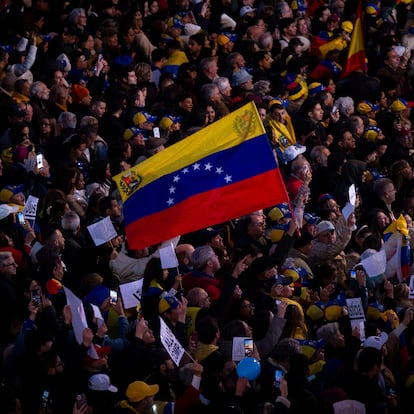
Spain to end fast-track path to legal status that Venezuelans have enjoyed since 2018
Since the program began, Madrid has granted papers to approximately 240,000 members of this community on humanitarian grounds. But a surge in applications has collapsed the system

In June, Spain will end a program that has allowed tens of thousands of Venezuelans to regularize their legal status almost automatically since 2018. The Spanish government will stop systematically granting residence permits on humanitarian grounds to this group, thereby terminating one of the most unique—and least debated—mechanisms of the Spanish asylum system.
After years of internal debate over what to do about Venezuelans, who have ended up monopolizing the system, the government has decided to return them to the standard immigration process that all other migrants must follow.
The decision has taken shape in the middle of preparations for a special regulation to grant legal status to undocumented migrants. Under the terms of this project, individuals who can prove they were in Spain before December 31, 2025, have no relevant criminal record, and have been in the country for at least five months at the time of application will be eligible.
Government sources argue that this is a change in form but not in substance. “Applications based on humanitarian grounds from Venezuelans or individuals of any other nationality will be processed through a new channel,” these same sources explain. In practice, this decision is not good news for Venezuelans who were planning to emigrate to Spain. For them, the process will become more complicated, since in practice authorizations on humanitarian grounds are rare and are usually linked to very specific circumstances, such as medical ones; therefore, a privileged pathway they previously enjoyed within the system is now gone.
Since this specific pathway was opened in 2018, Spain has granted approximately 240,000 such permits to Venezuelan citizens. In some years, they accounted for more than 95%—and in others, nearly 100%—of all permits granted on humanitarian grounds. The figures have fluctuated, but for years they hovered around 40,000 per year. By 2025, the number had grown to 50,000.
A bottleneck
The process worked in a relatively straightforward way. Venezuelans would apply for asylum and enter the international protection system. Instead of being granted refugee status, they were issued a residence permit on humanitarian grounds. It was not asylum in the strict sense, but it operated within the same system. This permit was valid for 12 months, renewable for another 12, and allowed them to work and reside legally in Spain.
In practice, it served as an administrative solution for thousands of cases that did not fit the classic definition of a refugee but could not be resolved through deportation either. Those two years of legal residency also paved the way for a more stable path to legal status and, over time, to citizenship.
The main problem is that what began as an exception for thousands of people—justified by the government due to the deteriorating situation in Venezuela—ended up becoming a structural mechanism. And it eventually collapsed.
In addition to the tens of thousands of applications received each year, there was a lack of resources to process them. The system was strained at every level: from scheduling appointments to processing applications. Over time, the Venezuelan case ceased to be just another episode in the complex and slow asylum process and became one of its main bottlenecks.
This nationality has accounted for a significant proportion—at times, more than 60%—of the international protection applications filed in Spain. Without Venezuelans, that percentage dropped to around 5%–12%, which placed the figures below the European average.
The decision by the government of Pedro Sánchez, a socialist, comes in a context shaped by several factors. On the one hand, the evolving political situation in Venezuela following the capture of Nicolás Maduro on January 3, which has altered the circumstances that originally justified this exceptional treatment. But there is also the need to adapt to the new European framework, which is more restrictive regarding asylum and will take effect in June 2026.
Spain’s welcoming policy has made it one of the main destinations for the Venezuelan diaspora outside the Americas. The community has grown exponentially in just a few years. According to the INE statistics bureau, in 2018 there were just over 255,000 Venezuelan-born individuals living in Spain. Now there are nearly 700,000, of whom more than 250,000 hold Spanish citizenship. In 2024 alone, 35,403 Venezuelans acquired citizenship.
Sign up for our weekly newsletter to get more English-language news coverage from EL PAÍS USA Edition









































