
The Venezuelan migrants stranded in Miami: ‘We want to leave the US but we can’t’
Without Venezuelan consulates in the United States, its citizens cannot obtain the documents they need to self-deport, and end up in a limbo
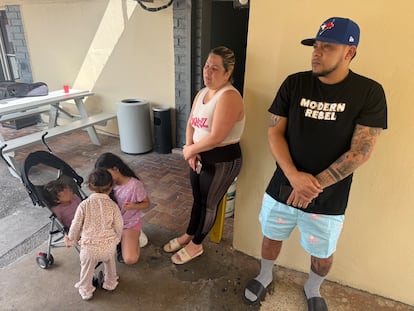
They want to leave, but they can’t. It’s the paradox suffocating a group of Venezuelans, including several children and babies, who remain trapped in Miami after a failed attempt to leave the United States voluntarily. They want to “self-deport”: they packed their bags, bought their tickets, and showed up at the airport to leave. And yet, they couldn’t board the plane. Upon arriving at the airport, their travel documents weren’t recognized as valid, and the airlines denied them boarding. What seemed like the final leg of their journey turned into “a nightmare.”
This refusal is symptomatic of a structural problem affecting hundreds of Venezuelans in the United States: the inability to obtain or renew the documents necessary to leave the country. The reason is as simple as it is Kafkaesque: Venezuela has no operational consulates in the United States, leaving its citizens without a legal way to obtain passports or travel permits from American soil.
The group stranded in Miami made a stopover in the South Florida city from various parts of the country with the intention of returning permanently to Venezuela. Some of them no longer have legal documents, or their documents are about to expire, while others fear losing their status due to pressure from the Trump administration’s immigration policies.
Among these measures, the most drastic for the Venezuelan community in the U.S. has been the announcement of the termination of Temporary Protected Status (TPS), a decision that, after overcoming several legal challenges by the end of 2025, threatens to leave hundreds of thousands without work permits and at risk of deportation before the end of this year. Added to this is the definitive cancellation of the Humanitarian National Parole (CHNV) program in April 2025, which closed the main legal and safe entry point that had allowed more than half a million citizens of Venezuela, Cuba, Haiti, and Nicaragua to live in the U.S. in previous years.
Furthermore, a campaign of mass deportations has been prioritized that, despite official claims, does not distinguish between people with criminal records and those without. These policies have left the Venezuelan diaspora in a situation of legal vulnerability unprecedented in recent U.S. history.
A “limbo” with no way out
Among the Venezuelans who attempted to self-deport is 29-year-old Yelitza Pérez. After four years living in the U.S., she traveled to Miami from Missouri, convinced this would be the final leg of her return. Her decision was influenced by her husband’s deportation and the impossibility of supporting her two daughters alone in an increasingly uncertain environment. “What am I doing here without my family?” she asks.
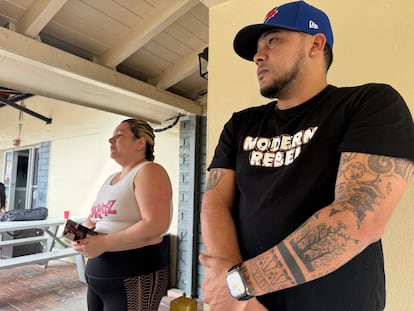
“When I went to the airline, they told me they wouldn’t accept my boarding pass,” Pérez recounts. Despite her pleas and insistence that she was traveling with minors, she was not allowed to board.
Since then, her situation, like that of the rest of the group, has been suspended in what she herself describes as a “limbo”: a space where it is not possible to move forward or backward. For three days, nine of them slept at the Miami airport, until the organization Hermanos de la Calle intervened and managed to transfer them to a motel, where they have been waiting for more than two weeks.
“They’re stranded, they lost their tickets, and they can’t fly,” explains Ricardo Pinza, a member of the organization, which usually works with homeless people and has had to expand its normal operations to assist these families. “We’re providing them with shelter and food; we’re doing what we can,” he adds. Some of those affected, Pinza recounts, invested all their savings in a return trip that has yet to materialize. “They spent all their money and ended up in a precarious situation.”
The core of the problem is a legal tangle. Many of these migrants no longer have valid documents to remain in the United States, but they also cannot leave. To do so, they need a one-time travel document that replaces an expired passport and allows them to return to Venezuela in a single trip.
The obstacle is that this document cannot be processed from within the United States. The absence of operational Venezuelan consulates in the country, a result of the rupture of diplomatic relations between Caracas and Washington in 2019, which are now being re-established, forces citizens to rely on family members in Venezuela to initiate the process from there.
Immigration attorney María Abellón explains that this limitation is at the heart of the problem. “To obtain a passport, physical presence at a consulate is required for the biometric process. Given this impossibility, what they are doing is requesting a safe-conduct pass through relatives in Venezuela, who then send it to them here. This usually requires at least a month’s notice,” she notes.
However, even with the document in hand, success is not guaranteed. Commercial airlines do not allow boarding without a properly recognized travel permit, which in many cases blocks the departure of those who have already purchased their tickets. “We want to leave, but we can’t,” Pérez says resignedly.
The cost of despair
Adding to the bureaucratic paralysis is the threat of scams. In their desperation, some resort to intermediaries who promise to expedite the process in exchange for exorbitant sums. In most cases, the money disappears and the document never arrives, or arrives and is rejected anyway.
Carlos Machado, 22, knows this better than anyone. He’s been stuck in the same motel for weeks, his pockets empty, after several supposed lawyers approached him on social media promising to expedite the document. “I paid $900 for my first safe-conduct pass, and it was rejected. The second was $850; also rejected. For the third, I paid $1,120. All failed,” he says. In total, he’s handed over almost $2,900 to intermediaries who didn’t solve anything, an amount that for many migrants represents months of work.
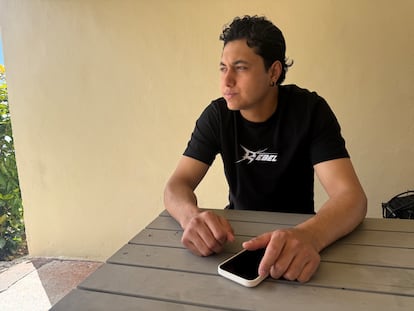
Machado doesn’t know when he’ll be able to leave. Nor does he know if his next attempt will end the same way.
Following the capture of Nicolás Maduro and his extradition to the United States earlier this year, diplomatic relations between Washington and Caracas have taken a historic turn toward normalization. Under the leadership of Delcy Rodríguez, who assumed the interim executive power, both governments agreed to formally reestablish relations, ending a seven-year period of severed ties and heightened bilateral tension.
In this context, Rodríguez herself confirmed last week the dispatch of an official diplomatic delegation to the United States, headed by Chargé d’Affaires Félix Plasencia. The primary objective of this mission is the reopening of embassies and consular offices. This measure seeks not only to reestablish communication channels but also to reactivate services for the large Venezuelan community in the U.S. and facilitate the return of foreign investment to the country.
Meanwhile, at the motel where the Venezuelans trapped in Miami are staying, life is on a prolonged pause: a group of families who wanted to leave peacefully are now waiting for an administrative procedure that, for now, remains at a standstill.
Sign up for our weekly newsletter to get more English-language news coverage from EL PAÍS USA Edition









































