
Anchoring off Tenerife, small‑boat transfers and talks with 22 countries: The difficult return home for the hantavirus cruise passengers
Spain is negotiating with various nations over how to repatriate their citizens. Uncertainties remain over the arrival of the ‘MV Hondius,’ its disinfection, and possible quarantines

Two days before the MV Hondius arrives in Granadilla de Abona, a municipality in Tenerife, in Spain’s Canary Islands, several questions remain about how and when each passenger will be able to return home. It is clear that the 14 Spaniards will be transferred by military plane to Madrid to quarantine at the Gómez-Ulla Hospital, but it is unclear how long this quarantine will last, or what will happen if any of them refuse to self-isolate. For the other 133 passengers, of 22 different nationalities, their repatriation will depend on negotiations with their governments.
European countries, the United States, and the United Kingdom are already reaching agreements with Spain, but much remains uncertain about what will happen to citizens of third countries. “No one will leave [the ship] unless they are going directly to the airport for their country of origin,” said Virginia Barcones, Director General of Civil Protection and Emergencies, on Thursday. She indicated that the Netherlands will be ultimately responsible if no agreement is reached. It is also unclear exactly how or by whom the ship will be disinfected.
Spain’s Ministries of Foreign Affairs, Transport, the Interior, and Health, in coordination with the World Health Organization and European authorities, are finalizing every step from the moment the cruise ship reaches the Canary Islands, which is expected on Sunday at midday. The first step will be a medical check-up to ensure that all crew members have no symptoms of the hantavirus, which has so far caused eight infections and three deaths on the cruise ship.
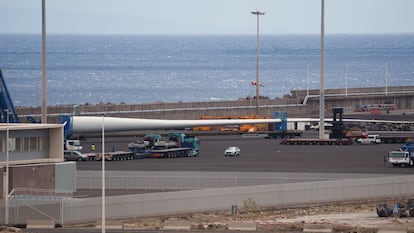
One of the demands made by the Canary Islands’ premier, Fernando Clavijo, is that there be no contact with the local population. To minimise it, he reached an agreement with the central government for the ship not to dock at the port of Granadilla de Abona. However, this means the passengers will have to be brought ashore in small boats, which will ferry them in groups of five.
Pedro Gullón, director general of public health, acknowledged that this presents an additional logistical challenge, although it does not alter the public health risk. “The rounds will be slower, but they weren’t going to be able to bring all 140 people ashore at once anyway. It’s another hurdle we’ll have to overcome,” he said.
The Tenerife Port Workers’ Union continues to protest against the cruise ship’s arrival. Its spokesperson, Elena Ruiz, expressed her skepticism this Thursday about the possibility of a ship anchoring in the outer waters of the Port of Granadilla: “There has never been any anchoring in Granadilla due to its characteristics. All the experts we’ve consulted, from the harbor pilots to the workers, still don’t know how they’re going to do it,” she said.
The State Coordinator of Maritime Workers, the largest union in the potentially affected ports, however, welcomed the decision to anchor the ship: “We understand that this is the most prudent measure from the point of view of health and safety and the protection of the people who work in the port facilities and the general population,” it said.
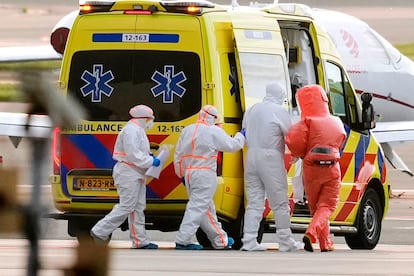
Vehicles provided by the shipping company will be waiting for the passengers there — “supervised and guarded by the government,” in Barcones’ words — to take them to the South Tenerife airport, just 10 minutes away. The staff handling the transfer will have full protective measures to avoid infection, taking into account the virus’s mode of transmission, Gullón added.
“We tend to think that we have to do everything dressed in astronaut suits and conjure up images of other kinds of situations. Person-to-person transmission is quite infrequent, and measures will be taken according to the type of transmission,” said Gullón, adding that healthy passengers do not require medical vehicles or “extreme” situations.
Passengers from countries that already have transport arrangements in place will be repatriated, but those that do not will have to wait. Spain is negotiating on several fronts. With the European Union and those countries adhering to the European Civil Protection Mechanism, authorities are in a “final phase of negotiations for the transfers” of 41 people, according to Barcones.

These include eight EU countries: France (five passengers), Germany (seven passengers and one crew member), Greece (one), Belgium (two), the Netherlands (six passengers and five crew members), Ireland (two passengers), Poland (one crew member), and Portugal (one crew member). In addition, three countries are adhering to the European Civil Protection Mechanism: Turkey (three passengers), Ukraine (five crew members), and Montenegro (one).
Negotiations with third countries are more complicated. Barcones said talks are well advanced with the United States (17 passengers) and the United Kingdom (19 passengers and four crew members), both of which have already signalled their willingness to send aircraft. Discussions are also under way with all the others: Japan (one passenger), New Zealand (one), Argentina (one), Russia (one crew member), the Philippines (38), India (two) and Guatemala (one).
In the case of the Filipinos — the largest crew contingent — a spokesperson from the Philippines health authorities said the ship’s operator would be responsible for their repatriation, according to the newspaper Inquirer.net.
Barcones has made it clear that, should agreements not be reached with these countries, the responsibility will fall on the Netherlands, the ship’s flag state, as established by maritime law. “From the outset, the Netherlands has responsibly assumed its role. It is possible that the country of origin of someone, especially a crew member, might not send the aircraft, and the Netherlands would then be responsible,” she said.
The next step, and also the next unknown, is the disinfection of the ship and its transfer to the Netherlands, which will require a crew on board. “We are studying the disinfection protocols to determine the best way to proceed, while also collaborating with the Canary Islands, consulting with our international health services, and with international organizations, including those related to the ship,” said Gullón.
Once the passengers, crew, and the ship itself are back in their respective countries, the quarantine procedures will need to be determined. Gullón explained that they are studying how long the Spanish passengers will have to remain isolated from other people. “We have to assess this based on the virus’s incubation period, when symptoms are most likely to appear, so as not to prolong the quarantine beyond what is necessary from a public health perspective,” he explained.
Hantavirus can incubate for up to 45 days, although, based on what is known about the Andes variant — the only one that is transmitted between humans and the strain detected on the cruise ship — the contagion period is usually around 48 hours before and after the onset of symptoms, which tend to resemble those of any respiratory infection.
The idea is that the 14 Spaniards will follow the protocol voluntarily. Should they refuse, the Spanish Ministry of Health is preparing a legal report to implement the quarantine. The department maintains that Spain has sufficient legal grounds to act regarding an international vessel carrying people infected or potentially infected with a virus, as it is a matter of international health and a risk to public health.
The ministry cites Organic Law 3/1986, which allows for “the adoption of urgent measures for the recognition, treatment, hospitalization, control, or quarantine of patients and their contacts.” It also argues that the General Health Law grants the state exclusive competence in external health matters and empowers it to coordinate government agencies in the face of national or international risks.
The Ministry of Health acknowledges that these measures must be proportionate, justified, and maintained only for the necessary time, and that when there are restrictions on fundamental rights — as is the case for mandatory quarantine — judicial authorization or ratification will be required. “The competent authorities generally consider it a determining factor that the measures adopted are carried out in compliance with and in accordance with existing protocols, both those established by the WHO and those of the Ministry of Health,” said the department.
Sign up for our weekly newsletter to get more English-language news coverage from EL PAÍS USA Edition









































