
US pressure on Mexico ramps up as Trump sets his sights on narcopolitics
The United States is threatening to pursue more cases against Mexican politicians and close consulates in its territory in the lead-up to the World Cup and the renegotiation of the USMCA trade agreement
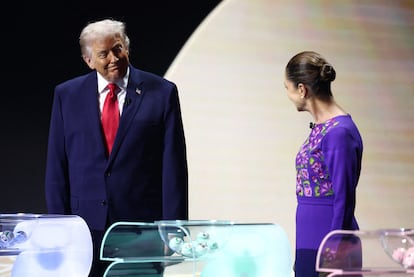

Bilateral relations between the U.S. and Mexico have entered a new phase — more critical, and with increasingly little room for manoeuvre for Mexico. After the U.S. Department of Justice indicted the governor of Sinaloa and nine other senior officials last week, everything suggests this is only the prelude to a more aggressive U.S. campaign against the links between politics and organised crime.
In recent days, the White House has rolled out new plans, the president and acting attorney general have issued forceful statements, and there have even been moves aimed at tightening the net around Mexico’s diplomatic apparatus north of the border. The pressure is mounting, not only because of the scale of the narcopolitics allegations. In just a few weeks, two key dates for the North American triangle — with Canada included — will begin: the World Cup and, above all, the negotiations to renew the USMCA trade pact, Mexico’s economic lifeline.
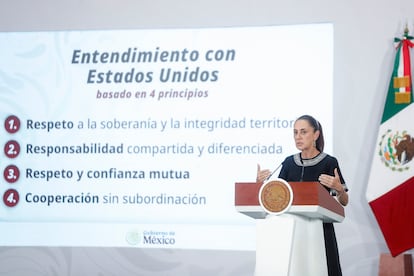
Faced with this pressure, Mexican President Claudia Sheinbaum’s response has so far been defensive, trying to carve out some space by insisting on Washington’s own obligations: arms trafficking, the drug market, and even the indifference shown toward a handful of extradition requests.
Since this new chapter in the fraught bilateral relationship began, Donald Trump had maintained an unusual silence. On Wednesday, he broke it with his characteristic bluntness: “If they’re [referring to Mexico] not going to do the job, we will.” The threat carries even more weight because it comes paired with the roadmap for his personal war on drugs. Both the Counterterrorism Strategy and the National Drug Strategy, presented this week, are the culmination of the White House’s military intervention campaign in Latin America.
In one of his first acts upon taking office, Trump designated drug cartels as terrorist organizations, a move that goes far beyond mere rhetoric, opening the door to military interventions in third countries. This has already happened in the Caribbean with the U.S. strikes on alleged drug boats. The documents released this week confirm and deepen this interventionist approach: “We will continue our military and law enforcement campaigns against all the cartels and gangs designated as terrorist organizations,” reads the 2026 Counterterrorism Strategy. “We will do so in concert with local governments when they are willing and able to work with us. If they cannot, or will not, we will still take whatever action is necessary to protect our country.”
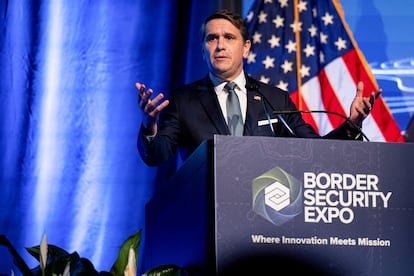
For Mexico, the legal threat has already materialized with the indictment by a New York court against the governor of Sinalos Rubén Rocha Moya — now on leave — and nine other Sinaloa officials. The Department of Justice has requested their arrest and extradition on charges of working for the Sinaloa Cartel. And all signs suggest they will not be the last. On Wednesday, the acting U.S. attorney general, Todd Blanche, said — without offering details — that more charges are ready against Mexican politicians allegedly linked to drug trafficking. Sheinbaum has again insisted that Washington “send evidence,” while also opening the door to a Mexican judicial investigation into the accused.
The escalation also has a significant prequel. An accident three weeks ago in the mountains of Chihuahua revealed that two CIA agents were conducting joint operations with the state attorney’s office. According to Raúl Benítez Manaut, a researcher at the Center for Research on North America, that controversy was the trigger for everything that has followed.
“The president’s response, wrapped in a very pronounced nationalism, did not sit well with the White House,” notes the academic, who does not believe there will be any developments in the short term: “The extradition treaty with the United States gives Mexico 60 days to proceed with the request. Given the Attorney General’s Office investigation, the accused will almost certainly file for legal protection, which will give them even more time.”
The timeline also coincides with the start of the World Cup, which Mexico and the United States are co-hosting with Canada. According to the academic, the soccer tournament will be “a buffer against tension” — a pause for which preparations are largely complete and that will now take priority.
“The U.S. security apparatus is already here — the FBI, the CIA — overseeing the security protocols. They are concerned, for example, about the Guadalajara venue,” says Manaut.
He predicts that, until after the World Cup, there will be “no movement, no arrests, no destruction of laboratories, for example.” Regarding what might happen afterward, everything will depend on the evolution of the Rocha case in Sinaloa. “If there are no credible advances in the Mexican investigation, a mini-Maduro operation involving a governor from one of the northern states cannot be ruled out,” the expert notes, referring to the U.S. capture of the Venezuelan president from the Presidential Palace in Caracas.
The pressure also has another crucial variable. The Mexican economy is going through a dangerous period of weakness, and, coupled with Trump’s trade war, the USMCA has become more important than ever. “If the U.S. decides to walk away from the negotiating table, Mexico will have no alternative but to make some concessions on security,” Manaut adds. The Mexican government has stepped up its displays of effectiveness in the fight against crime, with a sharp rise in arrests — including the killing of “El Mencho,” the most‑wanted drug lord, in an operation — as well as increased drug seizures and the transfer of nearly 100 jailed cartel bosses across the border.
Acting U.S. Attorney General Blanche alluded to these extraditions during his recent, controversial statements. “One consequence of having a lot of the leaders of some of these cartels brought here over the past year […] is some of them will likely want to cooperate, and that cooperation could lead to additional charges.”
For analyst David Pérez Esperanza, who served on the Executive Secretariat of the National Public Security System during the administration of Mexican president Andrés Manuel López Obrador, “The U.S. is making political use of the statements made by these detainees, increasing the pressure and leaving very few alternatives.”
Another twist in the pressure campaign emerged on Thursday. According to CBS, U.S. Secretary of State Marco Rubio is considering closing some Mexican consulates, accusing the diplomatic network of trying to influence the November midterm elections, where Trump’s control of Congress is at stake.
Analyst Esparza believes Sheinbaum is up against a dilemma that is increasingly hard to avoid: “Either maintain a defensive nationalist discourse as leader of the Morena party, or act pragmatically against corruption, as she has already done by removing Attorney General Gertz and Adán Augusto López from their posts.” The fight against corruption, the academic concludes, “is the great unfinished business of the Fourth Transformation [the political movement launched by López Obardor], which has so far only been a narrative.”
Sign up for our weekly newsletter to get more English-language news coverage from EL PAÍS USA Edition









































