
Sinaloa, under the shadow of narcopolitics: ‘This war will never end’
The US indictment of Governor Rocha and members of his administration over ties to El Chapo’s sons is fueling a mix of fatigue and resignation in a region marred by corruption and violence
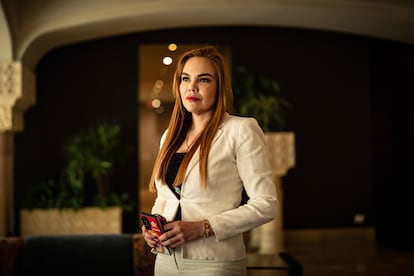
As she was driving out of party headquarters, five vans with dark‑tinted windows cut her off. She doesn’t remember how many men got out, but they were dressed in black, their faces covered with balaclavas, and they carried rifles. From that moment on, everything becomes hazier. They pushed her into the back seat of one of the vehicles, blindfolded her, and began driving in circles around Culiacán, the capital of the Mexican state Sinaloa. There was no physical or verbal abuse, just veiled threats like “we’ve got half of Culiacán here” or “we can take you home whenever you want.” Nearly nine hours later, as the sun began to rise over the soft hills surrounding the city, Paola Gárate had her blindfold removed and was released near a supermarket. It was Sunday, and in just a few hours, the polls would open to choose Sinaloa’s next governor. Dazed but relieved, that was how the election day began for the president of the Institutional Revolutionary Party (PRI) in Sinaloa.
In the days leading up to the 2021 elections, reports surfaced of kidnappings and beatings of more than 50 PRI campaign workers. At the time, Sinaloa was one of the nearly impregnable strongholds of the PRI, which was defending its hold on the governorship against a veteran candidate, an old teacher with two failed attempts behind him. This time, Rubén Rocha Moya was backed by Morena, a party sweeping across the country like a tropical cyclone that would end up winning in Sinaloa as well.
For years, the opposition’s complaints have barely moved from the drawers of the state prosecutor’s office. But since Wednesday, everything is being viewed differently. What happened in those days before the election has taken on a new dimension with the indictment issued by a New York court against Governor Rocha and nine senior members of his administration, who are accused of working on the payroll of the Sinaloa Cartel, one of Mexico’s most powerful drug‑trafficking organizations.
Furthermore, prosecutors allege that during the campaign, Rocha met with Los Chapitos — the faction of the Sinaloa Cartel run by the sons ofJoaquín “El Chapo” Guzmán — to ask for their help in winning the gubernatorial election. According to the indictment, during the meeting — “which was guarded by cartel hitmen armed with machine guns” — the leaders of Los Chapitos were given a list of Rocha’s opponents and their addresses, so the cartel “could intimidate those opponents into dropping out of the election.”
Sitting in a hotel café, Paola Gárate says the U.S. indictment confirms what they have been denouncing for years. After an initially defensive reaction from the Mexican government, the case has strained bilateral relations and prompted Rocha to temporarily step down, opening the door to a possible Mexican investigation. Gárate also recalls that during the campaign, young men, presumed cartel lookouts working to provide information, approached her more than once and told her: “Blondie, you’d better stop, Morena is going to win.”
Gárate stepped down as president of the PRI last year, but is still one of the most influential voices in the opposition. She says she isn’t afraid, but insists that opposition members in Sinaloa “are being targeted.” She cites as an example another murky episode seared into Mexico’s recent memory.
On July 25, 2024, Héctor Cuén, a veteran politician and businessman who had contributed to Governor Rocha’s victory only to later break with him and become one of his main adversaries, was murdered in a case marked by inconsistencies. At first, the state attorney’s office claimed the incident had been a robbery attempt to steal his van at a gas station. Months later, the federal attorney’s office stepped in to confirm what rumors in Culiacán had suggested: Cuén was killed at the same place where one of the founders of the Sinaloa Cartel, Ismael “El Mayo” Zambada, had been ambushed through betrayal by one of El Chapo’s sons — his former associate — in order to hand him over to the United States.
Now imprisoned across the border, where El Mayo has pleaded guilty and begun cooperating as a kind of informant, he stated that the bait for the trap had been a meeting arranged with Cuén and the governor himself. Rocha has repeatedly denied this, but the shadow of that meeting — especially after the accusations from the U.S. State Department — now looms larger than ever.
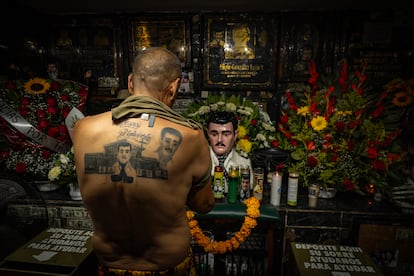
The episode of the meeting with El Mayo has been like one of those road signs that signal a change in direction — a turning point with many possible paths. Barely a month later, the internal war within the Sinaloa Cartel began. The two families that had been united for decades for the sake of business now became bitter enemies, in yet another chapter of the underworld’s familiar story of betrayals and revenge: Los Chapitos versus Los Mayitos. A war that has now lasted more than a year and a half and has left thousands dead and missing, with Culiacán as its epicenter and bloody battleground.
Weariness and resignation
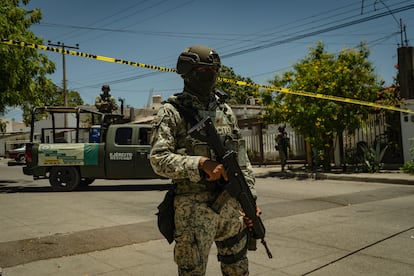
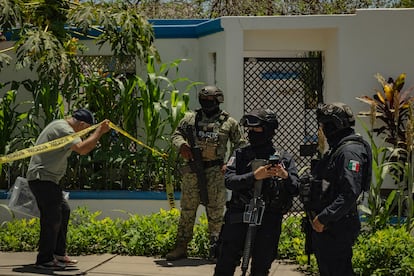
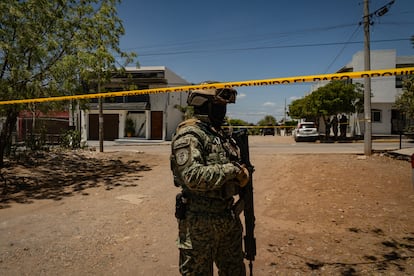
The street is deserted, cordoned off with yellow army tape as soldiers guard the area under the stifling spring sun of Sinaloa. Only a gray-haired head peeks out from behind the bars of a house entrance. It’s a neighbor who had been cooking for her grandchildren when she heard the crash. She doesn’t want to give her name and says she wasn’t going to go out because “things can get ugly around here.” But when she heard the soldiers arriving, she decided to see what was happening. The noise she heard was a car crashing into a house. The neighbor says it was abandoned, though she would sometimes see people coming and going who weren’t from this working-class neighborhood in the city center.
The most likely explanation is that it was a safe house used by criminal groups. The neighbor says that ever since the cartel’s internal war began, she locks herself in as soon as evening falls. Torn between exhaustion and resignation, she has little hope that anything will change with the indictment of the governor and other politicians accused of ties to drug trafficking: “They’re all the same — this war is never going to end.” A few blocks away, the army has also sealed off another street. The façade of another suspicious house looks like Swiss cheese. A car stopped for a few seconds and unleashed a burst of gunfire before speeding away through these dirt streets.
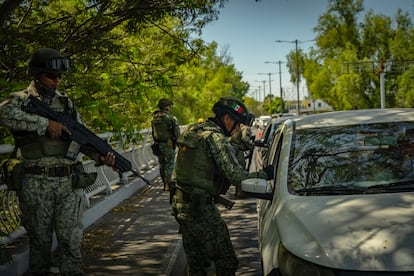
Since the fighting between factions began, the federal government has taken control of security in Sinaloa, greatly increasing the military presence by deploying thousands of soldiers. While Governor Rocha first tried to downplay the crisis and later to ignore it, the violence spiraled. During the worst months, there were more than seven killings a day on average. Sinaloa is the birthplace of Mexico’s most notorious drug traffickers, and Culiacán had been deceptively calm since the last internal conflict nearly 20 years ago. When the cartel was united, it had no interest in drawing attention. Noise is bad for business.
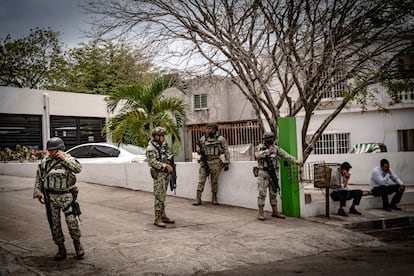
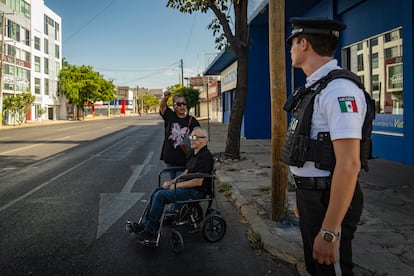
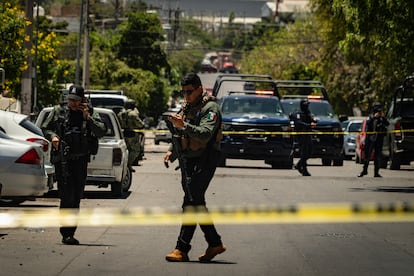
The residents of Culiacán have grown used to the presence of the military. Some even affectionately call them “the nephews.” The latest official figures showed an improvement: killings dropped by nearly 50%, although they remain high, with an average of more than two per day.
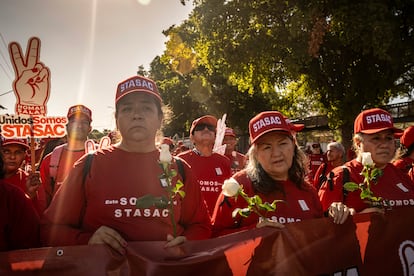
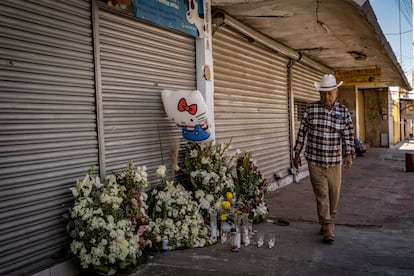
It is still too early to tell whether the blow dealt by U.S. authorities will mark another turning point. But just one day after the State Department’s announcement, crime reporters recorded nine murders in the capital. One of the victims was the newly elected president of the Culiacán City Hall Workers’ Union, an influential hub of political operations. Homar Salas was shot dead alongside his bodyguard as he was pulling his car out of his garage.
A long history of narcopolitics
The shadow of narcopolitics has hung over Sinaloa for decades, with pressure from the United States constantly looming. In the late 1960s — when Sinaloa was already a major supplier of heroin and marijuana to be distributed across the border — the White House set its sights on the governor at the time, Sánchez Celis, over his ties to Miguel Ángel Félix Gallardo, the father of modern drug trafficking. Nicknamed “The Boss of Bosses” for good reason, Gallardo served as a personal bodyguard to the governor’s family and even became godfather to one of his sons. In the 1980s, the Drug Enforcement Administration (DEA) confirmed that Gallardo had a direct line to another governor — so much so that he landed drug-laden planes on a runway at one of the politician’s ranches.
This history has been meticulously documented by Alejandro Sicairos, a veteran journalist from Sinaloa with more than four decades covering the issue. “Narcopolitics in Sinaloa has operated like a bogeyman used to bring institutions and politicians into line with U.S. interests,” he says from the offices of the magazine he runs. “People think what’s happening with Rocha is new. There has always been pressure. In the end, this will all be resolved through negotiations between governments, at a diplomatic level. And most likely the United States will shelve the case against Rocha until it needs to use it again.”
For Marlene Fontes León, director of Iniciativa Sinaloa, a local civil organization that fights corruption and promotes transparency, “beyond the political implications, we see a structural problem. A weakness in the control systems in Sinaloa and throughout Mexico. Corruption is a pervasive mechanism through which organized crime infiltrates. Now it is up to Mexican authorities not to evade their responsibility to investigate and punish any act of corruption.” For now, the governor’s temporary resignation opens the door to a possible investigation by Mexico’s Attorney General’s Office, which is under pressure from the United States to arrest and extradite those charged.
In addition to Governor Rocha, there are nine other accused individuals, most of them close allies. Senator Enrique Inzunza is almost like a younger brother to Rocha — he saw him born and looked after him from childhood until he became a lawyer. He later served as Rocha’s legal adviser and secretary general of government. The mayor, Juan de Dios Gámez Mendívil — who has also temporarily stepped down — is his godson, his campaign manager, and his key ally at City Hall in Culiacán. The deputy attorney general, Dámaso Castro Saavedra, was in charge of the investigation that covered up the murder of Héctor Melesio Cuén.
In the corridors of the state congress, it was the only topic of conversation in recent days. Members of Morena’s parliamentary group acknowledge — euphemistically — that “the situation is complex.” They also try to deflect blame by arguing that such accusations have been a constant since the days of the PRI’s iron rule, when the party governed the state for decades. It’s the same argument Rocha himself used to respond to the accusations in the days following his electoral victory: “The criminal world has always worked with the PRI. Where would we get that kind of historical track record that PRI governments have? Who have they dealt with? Them — not us!”
In the halls of the state congress, it was the only topic of conversation these past few days. The Morena parliamentary group acknowledges, euphemistically, that “the climate is complex.” And they try to deflect blame by arguing that these kinds of accusations have been a constant since the days of the PRI’s iron grip, which also governed the state for decades. The same argument Rocha himself used to respond to the accusations in the days following his electoral victory. “Organized crime has always worked with the PRI. Where would we get this deep-rooted history that PRI governments have? Who have they made deals with? With them — not us!”
Sign up for our weekly newsletter to get more English-language news coverage from EL PAÍS USA Edition









































