
The United States puts a spotlight back on narcopolitics in Mexico
The accusation against the governor of Sinaloa once again highlights the allegations that have dogged Morena’s electoral campaigns since 2021
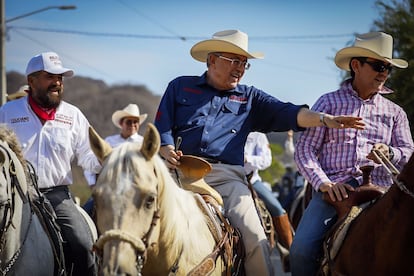

The specter of narcopolitics is once again looming over Mexico’s ruling party, Morena. The accusations brought by the U.S. Department of Justice against Rubén Rocha Moya, the governor of Sinaloa, echo earlier cases in which Morena was accused of receiving support from drug‑trafficking groups in local campaigns during the administration of former president Andrés Manuel López Obrador. These allegations appeared in electoral proceedings and in complaints filed before international bodies such as the Organization of American States (OAS).
For more than five years, Rocha Moya has been dogged by allegations that Sinaloa Cartel groups supported his campaign with money and logistics. He was one of the 12 governors from the political movement known as the Fourth Transformation, who were elected on June 6, 2021. It was a dream day for the ruling party, but one marred by political violence. In that election, Morena and its allies won states within the cartel’s sphere of influence (Sinaloa, Sonora, Baja California, and Baja California Sur), as well as territories dominated by the Jalisco New Generation Cartel, including Nayarit, Colima, Michoacán, and Guerrero, all along the Pacific coast.
Morena and its allies also won San Luis Potosí, with a Green Party candidate; as well as Zacatecas, Tlaxcala, and Campeche. But the campaign was marked by political violence — more than 30 candidates were killed — allegations of organized crime interference, and opposition challenges before electoral institutes and courts.
In Sinaloa, the candidate defeated by Rubén Rocha was Mario Zamora, from a coalition of the Institutional Revolutionary Party (PRI), the National Action Party (PAN), and the Party of the Democratic Revolution (PRD). He received 359,000 votes — roughly half the tally obtained by the alliance between Morena and the Sinaloa Party (PAS). In his appeal before the state’s electoral tribunal, Zamora denounced a widespread climate of violence and the support that criminal groups allegedly provided to the winning coalition.
According to his appeal, “the violent acts against candidates, candidates’ families, activists, and party leaders, which occurred before election day, contributed to creating a climate of insecurity and fear among the population, as did the events that took place on election day — the presence of armed individuals, the theft and burning of ballot boxes — and violated the principle of fairness, since voters were intimidated, preventing them from voting freely and affecting the election results.”
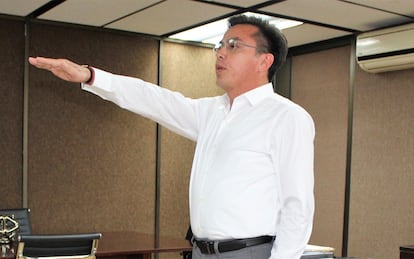
Zamora denounced the kidnapping of the PRI’s state organizing secretary, Alberto Salas, as well as the theft of ballot boxes at 51 polling places, documented by the National Electoral Institute (INE). He also reported the abduction of the brother of the PRI candidate in the municipality of Badiraguato, Guadalupe Iribe, who withdrew her candidacy in exchange for her brother’s release, and the mass kidnapping of PRI operatives in Mazatlán and Culiacán hours before the election.
However, the state court dismissed the evidence and upheld Rubén Rocha’s victory, and he was sworn in as governor on November 1 of that year. Several of these allegations overlap with those cited by the U.S. Department of Justice in the document accompanying its extradition request.
Complaints in other states
The appeal in Sinaloa was just one of many brought by the opposition against Morena’s victories. Allegations of criminal interference were also lodged in Colima, Guerrero, San Luis Potosí and Michoacán. In the latter, outgoing governor Silvano Aureoles assembled an extensive case file accusing organized crime groups of acting in favor of Morena’s candidate and current governor, Alfredo Ramírez Bedolla.
The Michoacán case reached the Electoral Tribunal of the Federal Judiciary, which, in a controversial ruling, acknowledged conditions of violence and the involvement of organized crime. However, it ruled that this was localized and not decisive in the outcome. The tribunal upheld Morena’s victory and ordered the INE to develop risk maps and protocols to prevent political violence in future elections. Silvano Aureoles staged a week-long sit-in outside the National Palace, hoping that then-president López Obrador would review the case, but he was never received.
On August 23, 2021, the leaders of the PRI, PAN and PRD met in Washington, D.C., with Luis Almagro, secretary‑general of the OAS, to deliver a dossier of more than 50 pages on the influence of organized crime in Mexico’s elections. International missions that observed the process acknowledged that the main problem had been the intervention of criminal groups. And the U.N. High Commissioner for Human Rights, Michelle Bachelet, expressed concern over the levels of violence and the killing of at least 91 politicians during the process, 36 of whom were candidates.
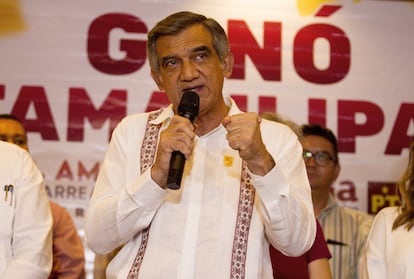
In 2022, during the local elections in Tamaulipas, Morena and its candidate, Américo Villarreal Anaya, were also accused before the state electoral institute of allegedly receiving support from criminal groups. During that campaign, the opposition claimed that Morena in Tamaulipas had been financed by the controversial businessman Sergio Carmona, who was known as the “king of huachicol (fuel theft)” and killed in November 2021.
The issue was exploited politically by the opposition, but it was also raised by figures close to López Obrador, such as the former presidential legal adviser Julio Scherer Ibarra. In his recent book Ni venganza ni perdón (Neither Revenge Nor Forgiveness), Scherer writes that this businessman, linked to the illegal importation of fuel, provided financial support to the party when it was led by Mario Delgado, who is now secretary of public education.
“Carmona not only financed Morena, but was a fundamental part of the party’s electoral machinery in the north of the country,” Scherer writes. As with the current U.S. indictment, the government and the party leadership dismissed the matter, demanding conclusive evidence.
In the 2024 elections, during the challenges to the presidential race, the PRI, PAN, PRD, and candidate Xóchitl Gálvez again alleged that widespread violence and the intervention of organized crime were determining factors that warranted annulling the process. Once more, the Electoral Tribunal deemed the claims unfounded, although in its ruling, it reiterated concern over isolated incidents that could have influenced voters’ will in specific areas.
The case opened in the United States against Rubén Rocha and nine politicians in his inner circle reopens the matter ahead of the 2027 elections, in which the governorships of Sinaloa and 16 other states — many of them with a significant presence of organized crime groups — will be renewed.
Sign up for our weekly newsletter to get more English-language news coverage from EL PAÍS USA Edition









































